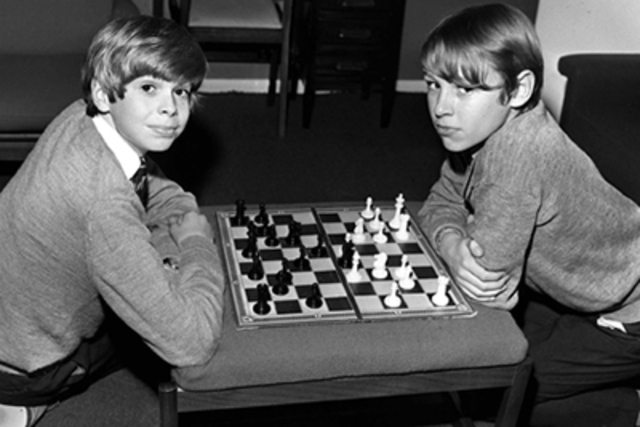
 Neil and Peter at age 14. (First Run Features)
Give me a child until he is seven and I will give you the man.
This Jesuit axiom is the premise behind the Granada Television documentary 7 Up. In 1964, 22-year-old Michael Apted worked as a researcher on the program, which selected a group of British schoolchildren from different classes in the hopes of shedding light on what the nation would look like in the year 2000.
The resulting films have shed light on a changing world over the years, but its value isn’t simply as an anthropological or social document. More profoundly, this body of work is a study of the passage of time on ordinary men and women. Apted went on to make direct commercial features, including Coal Miner’s Daughter and even a James Bond movie, but it is the Up series by which he will be remembered.
Neil Hughes has had the most dramatic life arc of any of the participants. When he was seven years old, we met him skipping cheerfully to his home in a Liverpool suburb. By 14 he had mellowed, by 21 he was living in a squat, but in 28 Up, the pivotal episode in the series, Hughes was homeless, making do with trailer homes and warm sheds in Scotland.
Neil’s life swings were the series extreme, but 28 Up also revealed unexpected changes in Suzy Lusk. We saw her as an awkward ballet dancer at 7, a terribly awkward 14 year old upstaged by a family dog hunting down a rabbit behind her, a scene re-played in several of the films; and as a cynical chain-smoking 21 year old. But at 28 Suzy is happily married, her coiled and tense body language wiped out by a visage of something like contentment.
28 Up was the only one of the earlier series I saw when it was first released. The participants were a generation my senior, but seeing their lives fan out in ups and downs was a revelation. We can’t know if the struggles and triumphs we feel today are the sum of our existence. There are lessons only time can teach, and part of the interest in the Up series is that we imagine our own lives at their age and marvel at the changes in our own lives.
 Peter at 56.
The latest installment in this long-running series, 56 Up doesn’t have many surprises. But anybody who has followed the series looks forward to the next edition, and those new to the series can simply enjoy the progression that happens before them, as excerpts from each of the previous programs (and sometimes footage not previously used) makes up the picture of the subject’s current life station.
As Apted and his subjects have aged, the director expected this year to be a downer, but Tony and Symon and John and Nick and the rest of the Up gang keep living productive lives. The New Yorker’s David Denby recently made the myopic assertion that if they were Americans, they’d live more productive and entrepreneurial lives, but I think he’s been watching too much reality TV. The Up films present reality without sensationalism, and I find it impossible to look at these lives as safe and wasted.
John and his wife have done charity work, bringing medical supplies to struggling hospitals in Bulgaria, from which their ancestors came. Symon and his wife became foster parents. Lynn worked with developmentally challenged children. The prodigal Peter, who bowed out after 21 Up, returns to the series to promote his country-rock band. Other than Peter, these developments all happened by 49 Up, and if seven years later some lives are more static than others, they’ve all lived lives and families to be proud of. And Neil, so down and out at 28? If you’re not familiar with his life since then, I don’t want to spoil it for you.
The Up methodology is not perfect. In 21 Up, John questioned Apted’s portrayal of him and his school mates as all privileged children who have had their lives easily laid out for them. John has a thoroughly upper-class carriage but in 56 finally explains the struggles he really went through, which the director had never revealed until now. Jackie argued with Apted in 49 Up that it was unfair to distill seven years of their lives in the brief cyclical segments that the public sees. Neil speaks with some impatience about the many viewers who write him letters telling him that they know exactly how he feels. Nobody knows exactly how he feels, Neil insists. And in the end this is true for anyone who sees the films.
Whether you’ve caught up with the series recently (all seven of the previous films are available on Netflix Instant) or have seen them as they came out over the years, audiences can’t help feeling that they’ve come to know these people. There’s only so much we can know about the particulars of their lives and struggles. What we learn from them, and perhaps what the subjects themselves have learned in the process, is the perspective of seeing the span of life, the big picture. It may be true that the character of a person may be more or less set by the time they are seven. But there’s no predicting exactly where that character will lead.
—
Directed by Michael Apted.
With Bruce Balden, Jacqueline Bassett, Symon Basterfield.
Running time 144 minutes