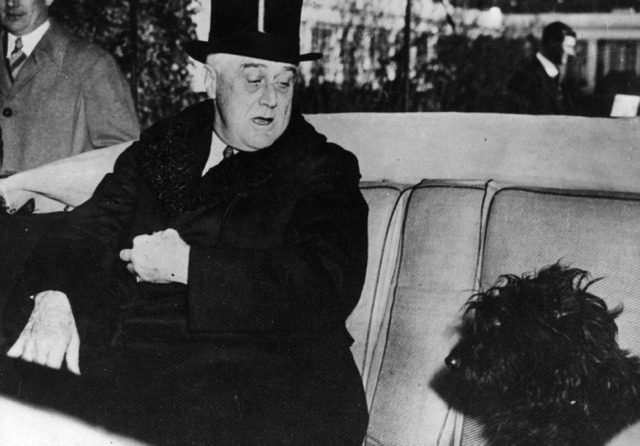
 President Franklin D. Roosevelt with his Scottish terrier, Fala, in February 1941. (Getty Images/Hulton Archive)
The 85th Academy Awards last Sunday concluded with a big surprise when Michelle Obama appeared via satellite to present the prize for Best Picture. And as exciting as it was to see the first lady announce that Argo was picked as the top film of 2012, it was not the first time that the White House participated in an Oscars ceremony.
Laura Bush appeared in a taped segment in 2002, and President Ronald Reagan, recently sworn in, taped a greeting for the 53rd Academy Awards in 1981. (In fact, that ceremony was postponed by a day following the assassination attempt on Reagan by John B. Hinckley Jr.)
But the White House’s participation in the Oscars goes as far back to 1941, when President Franklin D. Roosevelt gave addressed the attendees of the 13th Academy Awards. Roosevelt’s six-minute speech transmitted by radio from the White House to the Biltmore Hotel in Los Angeles.
In February 1941, the United States was still several months away from entering World War II, but Roosevelt’s administration was positioning the country as the “Arsenal of Democracy.” Having just been elected to his third term, Roosevelt was pushing for Congress’ passage of the Lend-Lease Act, which would go on to supply the Allied powers already engaged in World War II with U.S. equipment and munitions.
Roosevelt looked to Hollywood to help build support for the pre-war effort. In his Oscar speech, he thanked acknowledged the newsreels that played before movies in that era. He also took note of the fact that while the American film industry was the biggest in the world, its movies were not welcomed in certain countries.
But mostly, Roosevelt talked about building up a defensive perimeter around the Western Hemisphere and securing the Americas as a bastion of democracy. And he called on the film industry to lend some cultural support.
“I do not minimize the importance of the motion picture industry as the most popular medium of mass entertainment,” he said. “But tonight, I want to place the chief emphasis on the service that you can render in promoting solidarity among all the peoples of the Americas.”
Roosevelt is also largely responsible for ensuring that the film industry has a welcome audience in the White House. Although he was not the first president to screen a film there—that distinction goes to Woodrow Wilson, who watched The Birth of a Nation in 1915 an promptly denied he knew what the D.W. Griffith-directed film was about—he saw the creation in 1942 of the White House’s in-house movie theater.
DCist obtained a recording of Roosevelt’s speech, which is embedded below, from the Franklin D. Roosevelt Presidential Library and Museum in Hyde Park, N.Y.
Transcript:
I’m happy to greet the motion picture industry of America, whose representatives are gathered from far and near, for the annual awards dinner of the Academy of Motion Picture of Arts and Sciences.
In these days of anxiety and world peril, our hearts and minds and all of our energies are directed toward one objective. That objective is the strengthening of our national defense. Every day that passes, we realize that more and more things in our lives must be evaluated in just such proportion as they can contribute to the national defense.
The American motion picture as a national and international force, is a phenomenon of our own generation. Within living memory we’ve seen it born and grow up, grow up into full maturity. We’ve seen the American motion picture become foremost in all the world. We’ve seen it reflect our civilization throughout the rest of the world. The aims and the aspirations and the ideals of a free people, and of freedom itself.
That is the real reason that some governments do not want our American films exhibited in their countries. Dictators, those who enforce the totalitarian form of government, think it a dangerous thing for their unfortunate peoples to know that in our democracy, officers of the government are the servants—and never the masters—of the people.
In all that I have said on that all-important subject through many months past, I have emphasized that in the assault on the democratic form of government that imperils world civilization today, our problem of national defense has become one of helping to defend the entire Western Hemisphere—all three of the Americas—North, Central, and South. We can no longer consider our own home problem of defense as a separate interest. It involves the defense of the democracies of all of the Americas, and therefore, in fact, it involves the future of democracy wherever it is imperiled by force or terror.
An all-important factor in hemispheric defense, in the defense of democracies today, is the Lend-Lease Bill, whose early enactment by the Congress we confidently anticipate. It is a pleasure here and now to acknowledge the great service which the newsreels have performed in acquainting the public of America with all the implications as it takes its way through the various legislative stages.
Acceptance of the task of cooperating with all of the Americas in defending the entire Western Hemisphere, implicit in our plans for national defense, is a natural outgrowth of our own good-neighbor policy in our relations with the other American republics. Happily for democracy, the Americans stand forth today as a notable example of international solidarity in a world in which freedom and human liberty are threatened with extinction.
We have been seeking to affirm our faith in the Western world through a wider exchange of culture, and of education, and of thought, and of free expression among the various nations of this hemisphere. Your industry has utilized and is utilizing its vast resources of talent and facilities in a sincere effort to help the people of the hemisphere to come to know each other better.
In carrying on the program of advancing the spirit of inter-American solidarity and continental defense, our government has established machinery to coordinate our growing commercial and cultural relations with the other republics. Our government has invited you to do your share of the job of interpreting the people of the Western Hemisphere to one another. And all of us in all the 21 American republics and in Canada are grateful that your response is so immediate and so wholehearted.
I do not minimize the importance of the motion picture industry as the most popular medium of mass entertainment. But tonight, I want to place the chief emphasis on the service that you can render in promoting solidarity among all the peoples of the Americas. For all of this, and for your splendid cooperation with all who are directing the expansion of our defense forces, I am glad to thank you.
In the weeks and the months that lie ahead, we in Washington know that we will have your continued aid and support.