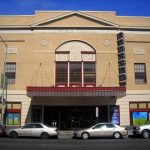
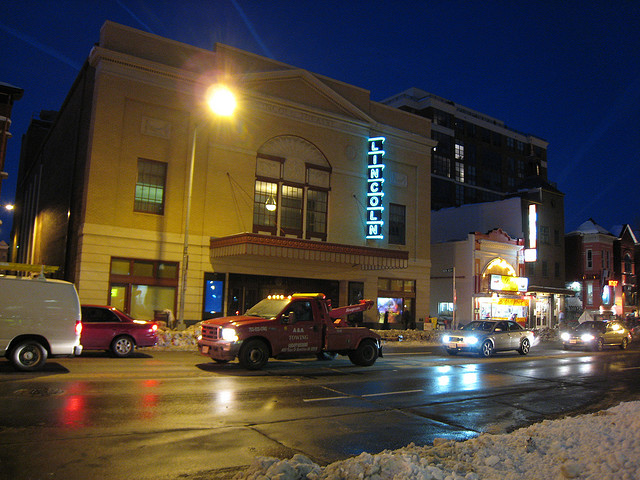
 Photo by Doug Duvall
The Lincoln Theatre saw the most action its enjoyed in months last night when a few representatives of the D.C. Commission on the Arts and Humanities took questions from the concerned public on, well, the very future of the venue itself. Unfortunately for the people among the sparsely populated auditorium who asked questions—or just cowboyed the meeting (more on that later)—the commission had very little to say other than boilerplate answers about valuing the public’s opinion.
The Lincoln, which passed into city ownership in January 2012 after the board that previously ran the theater nearly crashed into bankruptcy, has gone unused for the better part of a year. Last December, DCCAH announced a search for a contractor to take over operations of the theater and resuscitate it as a major venue along the U Street NW corridor, with a winning bidder scheduled to be announced March 31. (There is a separate search for a contractor to renovate the theater’s decrepit heating, ventilation, and air conditioning infrastructure.)
Bids for the theater’s management contract were collected by January 18, and many in the audience wanted to hear who, specifically, is gunning to take over the 90-year-old venue. Lionell Thomas, the DCCAH’s executive director, refused to identify the potential contractors, saying the bidding process was being kept confidential. In its request for letters of intent last year, the commission said it was looking for a commercial or nonprofit operators with experience running mid- to large-sized entertainment venues who would be interested in rehabbing and running the Lincoln for as long as 10 or 15 years.
As for the actual programming that might play at a revamped Lincoln? Well, the people who turned up to the forum had some ideas, even if the evening did occasionally verge into something resembling one of the town-meeting scenes on Parks and Recreation. One person in the audience suggested the Lincoln be dedicated to performance art; George Cook, the head of Artomatic, recommended installing some kind of photo collage.
Fortunately, others’ contributions were a bit more organized, especially those coming from the Friends of Carter Barron. Several of the organization’s leaders offered their services, most vocally the group’s president Gloria Hightower, who used up several minutes to introduce everyone she brought in tow, then reiterate the organization’s offer. “The Friends would love to work with you,” she said.
Jon Gann, the director of the D.C. Shorts film festival, also had a few suggestions of his own, including the possibility of reshaping the Lincoln from one massive auditorium into a venue containing several smaller spaces. He also asked if the Lincoln would be affordable for local arts groups to book, and if the city would even considering selling the air rights above the historic theater.
But all Thomas had to say was to chide Gann for his monopolization of the question-and-answer time, and a standard answer that “the city is looking at all options.” Calvin Gladney, a partner at Mosaic Urban Partners, which is consulting DCCAH on the Lincoln Theatre, had little more to add. In charge of the presentation, Gladney’s answers were limited to little more than suggesting the importance of community input.
In fact, there were almost no answers to be gleaned last night. But the question that seemed to loom largest was whether the Lincoln—if it can be restored—will be a competitor or a complement to the rest of the neighborhood, specifically the renovated Howard Theatre. Many in the audience seemed to favor the latter in hopes of keeping the Lincoln devoted to homegrown performances.
Others, however, said that in order to prosper, the Lincoln will need to balance between local acts and the kind of big-ticket entertainment that can pack a 1,200-seat house with relative ease. Rachel Newman, who worked as a sound director and production manager at the theater between 1995 and 2006, recalled the days when the Lincoln hosted big touring acts like Sigur Rós and Dave Chappelle, and even played host to ESPN boxing matches.
“You can’t do community shows without major shows,” Newman said.
In the mean time, as a city-owned venue, the Lincoln could be put to use for official District business, the Rev. Anthony Motley said. He recommended that the D.C. government start using the Lincoln as the site for the mayor’s annual State of the District address.
The arts commission’s representatives acknowledged Motley’s suggestion, as they did everyone else’s, but, as they did for the rest of the evening, gave little indication just how seriously this input was being considered.