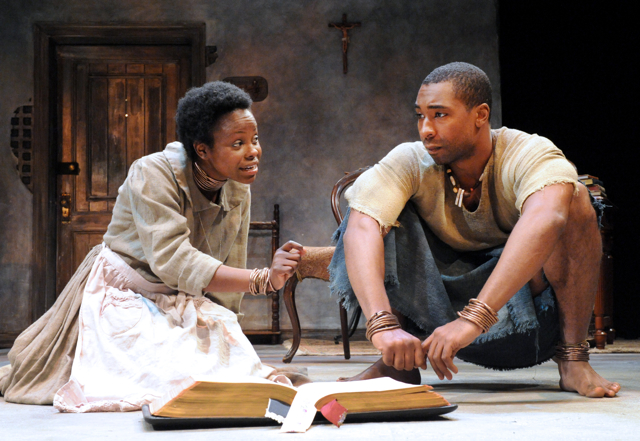
 Nancy Moricette and JaBen Early in ‘The Convert’ (Woolly Mammoth Theatre Company/Stan Barouh)
With all due respect to The Walking Dead, it’s kind of a shame that the public mostly knows Danai Gurira from that show, in which she portrays of one of television’s biggest badasses, the katana-wielding, zombie-taming Michonne.
While Gurira is superb in that role, turns out she’s got another, much more compelling talent up her sleeve: she can craft a helluva play. Not that this is anything new (Gurira won an Obie in 2006 for In the Continuum); it’s just worth recognizing the multitude of her talents that aren’t showcased on AMC.
Woolly Mammoth Theatre Company, with whom Gurira has a longstanding professional relationship, is currently staging her newest piece, The Convert, a raw, electrifying twist on George Bernard Shaw’s Pygmalion (and its other iterations, My Fair Lady, Pretty Woman, etc.), through March 10.
Gurira has transferred Shaw’s story of conversion to late 19th-century Rhodesia. With three acts with two intermissions, and a great deal of dialogue in Shona, this is a serious undertaking.
It’s also worth mentioning, since I doubt dramaturgs get many shout-outs in these things, that Woolly’s John M. Baker does his job with aplomb, with a section in the program called “Unearthing Rhodesia,” which describes the horrifying political conditions in southern Africa, starting in the 1880s and leading up to the year this play begins, 1895.
Britain’s ruthless colonization of the Shona and Ndebele populations fueled by greed for metals and minerals still hovers over the current devastation of Robert Mugabe’s Zimbabwe. It clearly hovers closely over the playwright’s heart, too.
Most of the action takes place within the rigidly proper sitting room of an ersatz Henry Higgins-type, a missionary named Chilford (Irungu Mutu), who practically vomits every time he’s confronted by what he sees as the “savagery” of the “natives.”
(It’s an intriguing set, all the way up to the dirty blue sheets stretched out on a metal grid above, like soiled, wrinkled clouds.)
Chilford’s maid, Mai Tamba (a funny and heartbreaking Starla Benford), implores him to hire her niece, Jekesai, so “she can learn about Jesus”—but really, it’s so that her niece can have a stable place to live and go to school. Reluctant at first, Chilford eventually takes to Jekesai’s enthusiasm, as well as to the ego stroke that tutoring her gives him.
He renames her Esther, and so their complex partnership begins.
In the role of Esther/Jekesai, Nancy Moricette is a dynamo whose bravery as an actress, and investment in each scene, makes the other actors better when they’re sharing the stage with her—particularly Mutu, who can sometimes feel a bit one-note as the shrill, uptight minister.
What has always bothered me about the Pygmalion story, particularly in My Fair Lady, is how we’re supposed to be swept up by the transformation from ugly duckling to beautiful swan.
Higgins, an upper-crust snob, basically deigns to “take on” a young woman as a kind of anthropological project, and after berating and humiliating her into passable shape for parading around in his over-privileged, out-of-touch chunk of society, they fall in love.
How on earth are we ever supposed to buy the “happy ending” of this coupling?
Gurira offers an ingenious, much more believable, twist on the story, albeit taking it out of romantic comedy territory and into melodrama. She gives us the two different versions of Eliza all at once: the more innocent, malleable version embodied by Esther.
Esther gravitates toward Christianity, because it opens more doors for her at first than would staying under the control of her uncle and male cousin, both of whom essentially view her as property. (This lack of choice is ever-present in wartime, when so often either side’s victory means nothing for women.)
The “final product” Eliza is represented by Prudence: The pretty, witty fiancé of Chilton’s repugnant misogynist friend, Chancellor (Alvin Keith), who’s seething with rage under a placid surface. Forcefully rendered by Dawn Ursula, Prudence knows that her years of education mean nothing in terms of power or autonomy.
She wears elegant outfits, knows exactly how many sugar cubes to put in her tea, smokes from a pipe, and her Queen’s English would make Patrick Stewart’s ears bleed with embarrassment.
But, put simply, she was born the wrong gender at the wrong time.
As a woman of color, Gurira has a voice that is both important and all-too-often screamingly absent from theater. As a writer, Gurira is a force to be reckoned with. How nice to finally get an Eliza Doolittle who fights back.
The Convert runs through March 17 at Woolly Mammoth Theatre Company, 641 D Street NW, (202) 393-3939. Tickets $35 to $67.50.