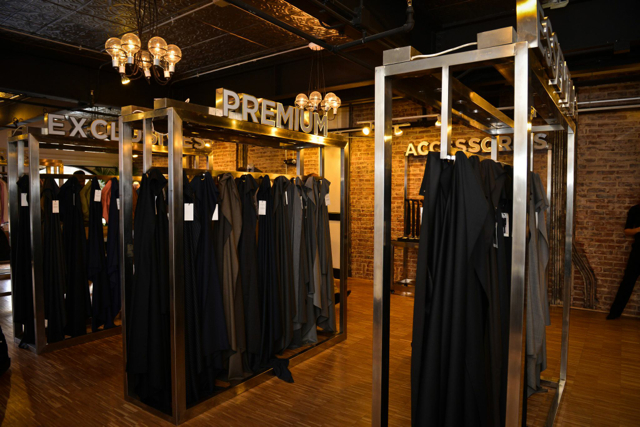
 Browse, but don’t take home Indochino’s merchandise. (Photo courtesy Indochino)
If you’ll forgive the phrasing, it appears to be quite fashionable for fashion industry types to remark on D.C.-area residents’ lack of style, especially when it comes to what men wear. Baggy suits, billowy oxford shirts, pleated trousers that puff out the posterior—we see it every day, usually in our closets.
It’s relatively easy to build a wardrobe for the D.C. office life, provided one is willing to accept the trade-off that he might look as though he is wearing one of his dad’s old suits. After all, who’s going to resist when a certain menswear chain gives its merchandise away at a three-for-the-price-of-one clip? How solid are those guarantees that you will like the way you look?
Then again, there is a new trend in men’s retail here. It can be boiled down to this: delayed gratification. That’s the bargain one signs when shopping from companies like Bonobos, the New York-based clothier, or Indochino, a Canadian suit-maker that rotates its tailors around the country.
In late January, Bonobos, an online clothing maker founded in 2007, opened its sixth storefront on Cady’s Alley in Georgetown. (It was preceded briefly by a holiday shop in Bethesda.) The thing is, one does not simply walk into Bonobos with the expectation of leaving with a fresh pair of chinos. The store, though bursting with the company’s full collection of trousers, shirts, belts, and suits, is merely a showroom for the website. A shopper walks in to the store, tries on articles until they find the right fit and color, and then one of sales clerks places the order through the company’s website.
Oh, and it’s by appointment.
So, why the big to-do about browsing items of clothing if one still has to wait three-to-five business days to wear them? “When men are at a bigger store, they might feel a bit uncomfortable,” Katie Manning, the store’s assistant manager says.
Getting men to see shopping as less of a chore seems to be the M.O. of enterprises like Bonobos’ brick-and-mortar presence, even if there’s a wait to actually enjoy the merchandise. Bonobos, which traces its origins to its founder’s inability to find a pair of khakis that didn’t puff out his rear like an adult diaper, specializes in trimly fitting, sometimes brightly colored apparel that fits in the same price range offered by brands found at department stores like Lord & Taylor or Nordstrom. It’s not bargain wear by any measure, but neither is it the kind of eye candy that most people will only glimpse in designer windows and Esquire spreads.
Still, Bonobos is clearly selling an experience. The appointment system keeps the clientele in and out in an orderly fashion, but it also lends to the store’s lounge-y atmosphere. Upon entering the store—the company calls it a Guide Shop—one of several pretty young women on the sales staff explains to the shopper in detail the selection of trousers, shirts, suits, and other items but aiming for more familiarity with the shopper than a department-store clerk would have.
“We kind of pride ourselves on being between their mothers and girlfriends,” Manning says.
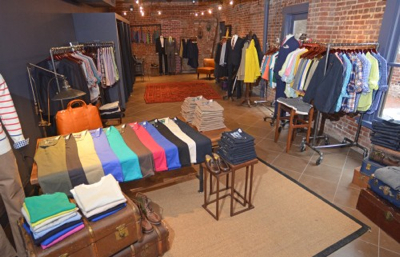 Bonobos Guide Shop in Georgetown. (Photo courtesy Bonobos)
More or less, though, it is a personal shopping service. Like any good Internet-based company, Bonobos keeps careful track of what its customers browse, and the in-person experience is no less meticulous than a cookie-empowered website. Not long after I leave the store, I receive an email listing the items I tried and the precise sizes, in case I want ever to place the order. (For the record: a pair of straight-leg navy chinos, 32-inch waist by 30-inch leg; and a medium slim-fit purple-and-white Bengal stripe shirt.)
The situation at Indochino is a bit more elaborate, but, like Bonobos, that company, too, arose out of its founder’s inability to find something off-the-rack. Kyle Vucko’s solution was to partner with a designer, find some investors, and start a made-to-measure suit company.
Even though that model, at least conceptually, would not seem to lend itself readily to online commerce, Vucko and his co-founder, Heikel Gani, struck a vein of demand for meticulously customized suiting that manages not to break the customers’ wallets. How does one get a made-to-measure suit from a website, though? By visiting a local tailor or, Indochino prefers, using its in-house measuring kit. Still, is everyone confident enough of being their own best tailor?
If these companies’ idealized male shopper is one who wants a tangible preview of merchandise that is available only online, Indochino eventually struck out with its own real-world stores. Unlike Bonobos’ walkable store catalogues, however, Vucko’s company opts for a rather old-world model: that of the traveling tailor.
Menswear-makers who tour the country with measuring tapes and fabric swatches are nothing new, you see their display ads every week in The Washington Post and The New York Times. But those companies tend to cater to older customers, and the experience is tends to be an awkward visit to a hotel suite. Like Bonobos, Indochino is seeking to tap into that market segment that wants to socialize while it shops, though still considering it a utilitarian visit.
“There’s a group of guys who want to see and feel the fabrics,” Vucko says. And since Indochino’s founding in 2007, D.C. has been one of the company’s biggest markets, so bringing the traveling tailor tour through Washington is nothing special, really, though it is certainly marketed as an event.
Indochino has been posted up at LivingSocial’s retail space at 918 F Street NW since last weekend and will be there through Sunday. Like Bonobos, it is appointment-based, with valet-like salespeople who take the customers through the lineup of suits, shirts, and accessories. And, like Bonobos, there is a certain manufactured vibe—call it office life for high-tech city-dwellers. (Indochino is based in sleek, urbane Vancouver and features among its latest offerings suits that feature both specially cut iPhone pockets and are made of wool that is treated to repel water.)
The selection itself is impressive. Indochino allows the customer to customize each facet of its suit—lapels, vents, pockets, buttons, cuffs, and monogramming—and shirts. Want a wide cutaway collar with a double-barreled cuff? Sure, they’ll do that.
“Guys are more about style than they used to be,” Vucko says, even dropping that shudder-inducing early-2000s term “metrosexual.” “Guys shop differently than women. They’re following rules.” Indochino’s model, he says, is one of “help and guidance.”
Chris Baird, the tailor who takes my measurements, takes more notes than the usual in-store tailor. Previous suit purchases have involved little more than a quick measuring of my chest, waist, and leg. By the time Baird is finished, he has entered into his iPhone numbers describing those parts, as well as measurements of my wrists, knees, neck, midsection, and wingspan. The experience is also a reminder that whatever number might be printed on a label of a pair of pants plucked from the racks at Macy’s, it does not reflect one’s actual size.
“Guys say to me ‘I’m not a 35’,” Baird says about past customers who object to the measurements of their waists. “I’m like, ‘Well, fuck, dude. You’re not a 30 either.”
Like Bonobos, Indochino now has my measurements on file, which creates a layer of sartorial security for the online shopping experience. One could place the order at the company’s temporary shop, but the three-to-six-week wait on the suit won’t be any different. Still, the effect on in-person retail is obvious. Indochino might send its team around the country with sample wares and flashy customer experiences, but the overhead is relatively low. There is no back room or storage area, just racks of single examples of catalogue items, a few well-placed iMacs, and a sales team trying to push the brand.
And in an era when lots of commerce is achieved by a customer browsing a store’s inventory and then returning home to find a better price online—any Best Buy executive can attest to that effect—some companies are trying to thin the barrier between physical retail and the Internet.
“The biggest challenge is making offline and online mirror each other,” Indochino’s retail manager, Jen Clarke, says. “This is our evolution from offline.”
From Clarke’s perspective, the sense of delayed gratification seems beside the point. Though many who book appointments at Indochino’s physical shops are familiar with the company, most are hearing about it for the first time. And there is a certain appeal to being able to obtain a perfectly fitting suit without having to shell out Savile Row money. (Its suits run between $380 and $800.) Indochino sources its fabrics from several countries—Australia, New Zealand, Italy, and Mongolia—and produces its suits in Shanghai, but Vucko says with fewer middlemen and barriers than other designers use.
“I think that’s the way retail is going,” says Clarke, who before Indochino worked for Club Monaco, Aritzia, and Abercrombie & Fitch. “E-commerce companies need something” for customers to touch, if not actually obtain right on the spot.
Sarah Patterson, the manager of Bonobos’ Georgetown store sees the appeal in having a storefront for a website. “We could so easily run out of a certain size,” she says. The website never will.
Clarke puts it more bluntly, in a way that gets back to that old trope about the way men in D.C. dress. In her experience, most men are clueless when it comes to buying the right suit. “There’s a niche,” she says. “Guys need suits that fit and they need help.”
Really, both companies are pushing their lifestyle brands more than anything. Patterson describes Bonobos as “kind of a party in a store.” Sure, it’s a warmly decorated space that aims not to intimidate its customers, but at an actual party, you’d get a drink right away, not have UPS bring it to you a few days later.