Martin Austermuhle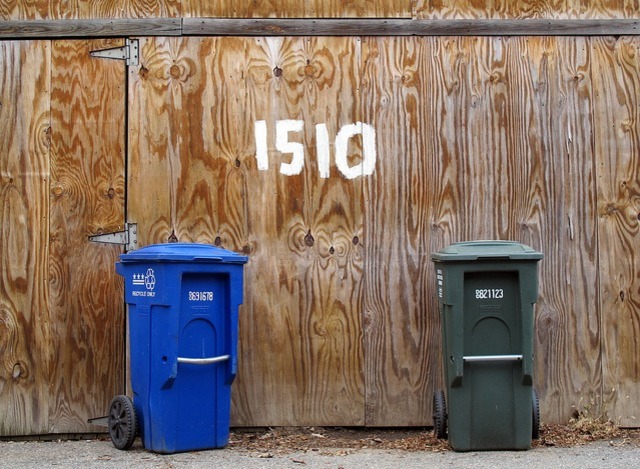
 Photo by blogancircle
If you live in small building or standalone home in D.C., you’re used to your usual massive garbage can (for people that get their trash collected once a week, it’s the 96-gallon Supercan) and much smaller recycling can (only 32 gallons). Well, the sizes of those respective refuse cans might soon change.
Speaking today at a D.C. Council committee hearing, D.C. Department of Public Works Director Bill Howland said that the city was debating potentially increasing the size of recycling cans, while at the same time shrinking down the Supercan. While no final decisions have yet been made, he said that the blue recycling cans could double or even triple in size, while garbage cans could shrink by a similar amount. He said that having 64-gallon recycling and garbage cans had crossed the department’s mind.
“DPW has investigated the possibility of increasing the size of the recycling containers used by those in our service population to 64 gallons, double the current size. This initiative is consistent with one of the recommendations from the Sustainable DC working group on waste issues,” said the department in a written response to a question posed by Councilmember Mary Cheh (D-Ward 3).
In 2012, D.C. collected 96,444 tons of household waste and 26,468 tons of recycling. Some environmental advocates have said that if recycling cans are made bigger, residents will be more likely to use them. According to DPW, D.C.’s residential recycling diversion rate—the ratio of how much is recycled relative to how much total garbage is produced—stood at 25.81 percent in 2012, a four percent increase from the two years prior.
Howland said that the big obstacle is ultimately cost: replacing the city’s 32-gallon recycling cans with 64-gallon alternatives would cost $5 million. Additionally, replacing all the Supercans in the city would run around $10 million; it’s been more than a decade since the city has fully replaced its 80,000 cans. (Currently, residents have to pay to get their cans replaced.)
And in another interesting initiative, Howland said that DPW had plans for a pilot composting program. For now, though, the program will be limited to restaurants and food retailers; their food waste will be dropped off at a local trash transfer station and taken to Maryland to be composted.