Martin Austermuhle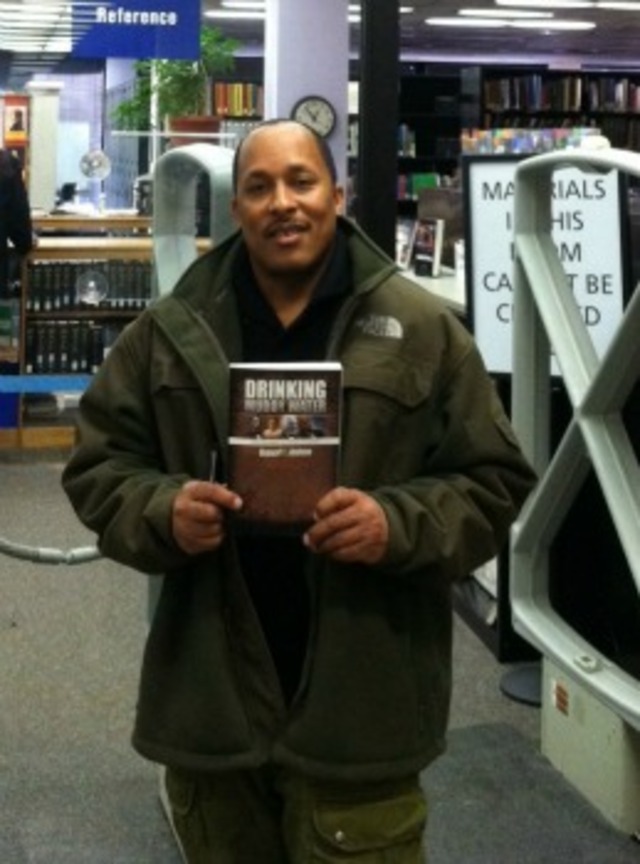
 By DCist contributor John Muller
Ron Moten is known for many things. He’s a former D.C. criminal who turned his life around and dedicated himself to quashing beefs between street crews. He was a confidante of Mayor Adrian Fenty’s, and in 2012 ran—as a Republican—for the Ward 7 seat on the D.C. Council. He’s bombastic, distinctly gifted at attracting attention. And now he’s a published author.
The publication of Drinking Muddy Water is Moten’s first foray into long-form writing, and he takes the responsibility seriously—the book comes in at close to 300 pages. It is mostly a browbeating, score-settling memoir, Moten’s latest effort to remain relevant in a city that no longer posts a triple-digit homicide rate or the flash mob intimidation tactics of his former organization, Peaceoholics.
The most revealing parts of the book deal with Moten’s early transformation into an activist. Learning of his younger brother’s kidnapping and death while locked up, Moten decided to change his life then and there. After his release he joined Al-Malik Farrakhan’s Cease Fire: Don’t Smoke the Brothers, where he learned to “squash beefs” and regulate the streets he had previously sold drugs on. Initially police were confused who the violators were.
“We later called Commander Monroe, who we had a relationship with, and he told the police to let us go. In the process, we were threatened by a guy by the name of ‘Joe Slimmy’ who was about six-foot-four inches and 260 pounds. I caught him on 14th and Crittenden (one block from Cease Fire Headquarters). He popped off slick out the mouth; I hit him with a right hook and then caught him on the way down with a UCF style knee to the jaw knocking him out. Then Al-Malik [Farrakhan] rolled up in his wheelchair and smacked the daylights out of him,” wrote Moten.
After a schism with Cease Fire, where he met Jauhar Abraham, Moten left to form a promotion company that worked with go-go bands, local boxers, and urban fashion entrepreneurs Universal Madness and H.O.B.O. (Helping Our Brothers Out).
In February 2004, a homicide within the walls of Ballou High School in Southeast Washington set off a mad scramble within and between service providers of the city’s youth violence prevention complex to gain a foothold. Moten and Abraham were able to capitalize, introducing Peaceoholics to the community and city officials.
The group’s rise, aided by positive press, was meteoric. With new funds the group set-up a makeshift office in Congress Heights and began designing curricula, conducting workshops throughout the city and taking trips down south to meet with fabled Civil Rights leaders. This is where Moten says he learned the meaning of Lou Rawls 1962 song, “I’d Rather Drink Muddy Water.”
“Most people know very little about the world of gang beefs, murder, drug trafficking, and the constant fear of retaliation that I lived and then fought against through Peaceoholics. This distance between the world that I have dedicated myself to changing and the world of most Americans is one of the primary reasons I wrote this book,” he wrote.
During the first years of Fenty’s mayoralty Moten continued to build his reputation and profile as murders increased from 181 in 2007 to 189 in 2008 before falling to under 150 in 2009 and dropping under 100 in 2012.
Trained as an economist at Oberlin College, Fenty’s impersonal leadership style led to an alliance with Moten. “You guys are the only ones who give him credibility in the hood!” former Councilmember Michael A. Brown reportedly said. Their quixotic relationship would soon become the focus of the 2010 mayoral race, with Gray incorporating Moten into his stump speech.
“Mayor Fenty made one of his biggest mistakes, showing his honesty and political naiveté! As we walked to the car, he told Nikita Stewart [of the Washington Post], ‘Moe and me are friends and we go way back to Alice Deal Middle School,’ which was true and yet not true!” … “The truth is Mayor Fenty and I went to school together, but never talked on the phone and never ate lunch together. We might have waved at each other and everybody shopped at his parents’ shoe store, Fleet Feet. Still, he only knew of me because on any given day he might hear Mr. Reginald Moss, the best principal D.C. has ever had, call me and my best friend, Roosevelt Jackson, to the office where he told us we had 25 words or less to explain why he should not suspend us for one reason or another,” explained Moten.
The public relations damage was done, and despite Moten’s best efforts to galvanize the “go-go community,” Gray won the Democratic primary by almost thousands of votes en route to becoming mayor. Moten was simply “collateral damage,” reportedly intimated Councilmember Marion Barry (D-Ward 8), who is alternatively praised and disparaged in the book.
To his credit, Moten avoided indictment for the sloppy, or rather non-existent, paperwork that derailed the Peaceoholics, while a cluster of councilmembers, non-profit leaders, and affiliates of Mayor Vincent Gray’s 2010 shadow campaign have been arrested and charged with fraud. However, in the book Moten is more laudatory than explanatory of his work with the group. “We went from $40,000 to receiving over $15 million in government contracts within a 7 year period. It reminded me of going from $150 to $150,000 in 6 months when I was a drug dealer except this time, it was done the right way,” he writes.
Much of the book is old news for observers of the city’s daily news cycle, including the last chapter, “The Evolution of a Civil Rights Republican,” in which Moten tries to explain that he became a member of the DC GOP out of conviction rather than retribution. While Moten’s inside-out admonishments of the black community he knows—the breakdown of the nuclear family and a prevalent consumer culture that puts greater value on the latest Jordan sneakers than report cards or PTA participation—are legitimate, his scattered words of praise for Jack Kemp and Frederick Douglass as stalwarts of the Republican brand are not.
On the back cover of the book Moten is pictured speaking at a meeting of the Anacostia Coordinating Council between Arrington Dixon, former D.C. Council Chairman and active member of the DNC, and Barry. As Moten admits: “Hey, I can take care of my own self-interest better than some political party.”
After his share of hits and misses on the streets and his latest foray into electoral politics, Moten seems ready for the next chapter of his life—domesticity. “Now, at age 42, I pray I will finally get married to a woman who can complement my strengths and weaknesses as I do hers. I’m ready to marry and build a strong family institution! It is time for me to lead by example, because, up until now, I realize I have played a role in creating the mess I am speaking about to others.”
At its best, Moten manages to share intimate and instructive lessons of his own versions of D.C. street dreams—realized and deferred—coming up as a cocaine dealer on Hanover Place NW and the “1-4 zone,” organizing area youth for the Million Man March, and his hackneyed claim of allegiance as a member of the Republican Party in last year’s Ward 7 race.
But at its worst, the 300-page book comes off as an impetuous fit of pique against members of the city’s local media, non-profit community and John A. Wilson Building denizens who no longer regard him as the wunderkind he was during the tenures of Anthony Williams and Fenty. Moten’s treatise on city “politricks” and “friendnemies” can also be excruciating to read, with hundreds upon hundreds of typos and egregious errors such as twice calling John Mercer Langston, the first black United States congressman to represent Virginia, “John Mercer Hughes.”
Still, it’s classic Moten—brash and uncompromising, but not necessarily insightful or forward-looking.
Drinking Muddy Water (Sudden Change Media; Washington, D.C., 296 pages, 40 b/w photos, index) is available at Howard University Bookstore and will reportedly be available on Amazon shortly in e-book with videos imbedded in the text. For orders email theothersidemedia@yahoo.com.