Martin Austermuhle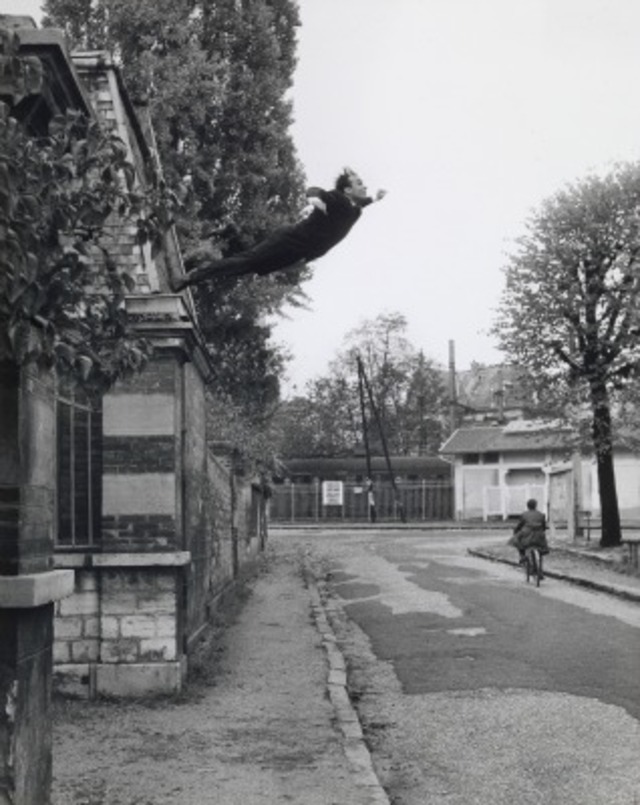
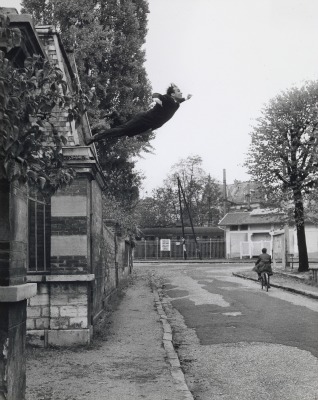 Yves Klein; photographed by Harry Shunk and Janos Kender, Leap into the Void (1960), Gelatin silver print
By DCist contributor Julia Langley
It shouldn’t be surprising that there never was such a thing as true photography. Photographs have been manipulated for one reason or another ever since the medium was invented in the mid-19th century. Ansel Adams once said, “A photograph is usually looked at—seldom looked into.” Luckily, an enjoyable, informative and accessible exhibition at the National Gallery of Art asks us to do just that.
In Faking it: Manipulated Photography Before Photoshop, Mia Fineman, assistant curator in the Department of Photographs at The Metropolitan Museum of Art, reveals the history of artifice in photography from 1840 through the early 1990s, when computer software took the place of hands-on manipulation of images.
The exhibition is broken up into themes. The first room shows how photographers tried to overcome the early medium’s limitations. With early film available only in black and white, photographers painted on negatives and prints. When a member of a group was missing from a photography session, his picture was taken later and added in. If the exposure times for a scene of sea and the sky meant both couldn’t be captured at the same time, it was easy to combine two different photographs into one image. Early photographers were not expected to be straight documentarians. Just as painters were free from the expectation that their canvases depicted the world as the naked eye saw it, photographers were given leeway in creating a believable reality.
The exhibition is a reminder that technology is neither good nor bad. It all depends on who is using it and why. Artists like Henry Peach Robinson made theatrical scenes evoking powerful emotion. Capturing images from the subconscious was the work of Surrealist photographers. Amateur and professional photographers out for a laugh or an easy payday created images of people chased by spirits, carrying their own decapitated heads, trapped inside glass bottles and other hilarious actions. Images meant to instruct, inspire and entertain are a big part of the exhibition. But they are not all.
We are reminded that leaders—Joseph Stalin, for example—falsified photographs as part of his chilling campaign of political repression. Four images on view show the same photograph of Stalin standing with, at first, four party officials, but one by one men vanish from the photo. The fourth image shows Stalin and just one other man, leaving one to assume what happened to the other three before they were erased from the official record. Knowing from even the briefest acquaintance with Stalin’s leadership of the Soviet Union, that it certainly wasn’t good.
Veracity itself became a subject for artists such as Yves Klein. In his 1960 photograph, “Leap into the Void”, he shows himself flying off the ledge of a Parisian building, suspended in mid-air above an empty street. Removed from the original image are the people under the ledge holding his safety net. Klein published this self-portrait in a fake newspaper under the title, “A Man in Space!” He then placed his newspaper next to real newspapers at kiosks around Paris to make a statement about what is real, what is fiction and what is news.
Questioning what we see and how we see is essential, especially in today’s Internet age. Faking It exposes the faulty thinking behind the idea that photography is any more straightforward or truthful than any other art form. A dare for those who visit: will you ever look at photographs the same way again?
Faking it: Manipulated Photography Before Photoshop is on display at the National Gallery of Art through May 5, 2013.