 A lullaby is a dangerous thing to introduce into a two-and-a-half hour movie that proceeds at a Romanian snail’s pace. Cristian Mungiu, director of the acclaimed drama 4 Months, 3 Weeks, and 2 Days (2007), does just this in the middle of Beyond the Hills, based on Tatiana Niculescu Bran’s “non-fiction” novels about a 2005 case of a troubled young woman subjected to an exorcism by the Romanian Orthodox Church.
The fascinating, tragic source material would make a great movie, but Beyond the Hills is not it. Deliberate, patient film making can build an intense, breathtaking tension. But the slow crawl that characterizes films of the Romanian New Wave is often powered by a monotony that defiantly lacks tension. This can work as deadpan, as in surveillance sequences in Corneliu Porumboiu’s Police, Adjective that feel slower than real time. It works to convey the domestic ennui of Radu Muntean’s Tuesday, After Christmas. But the subject at hand would have been better served by a different approach.
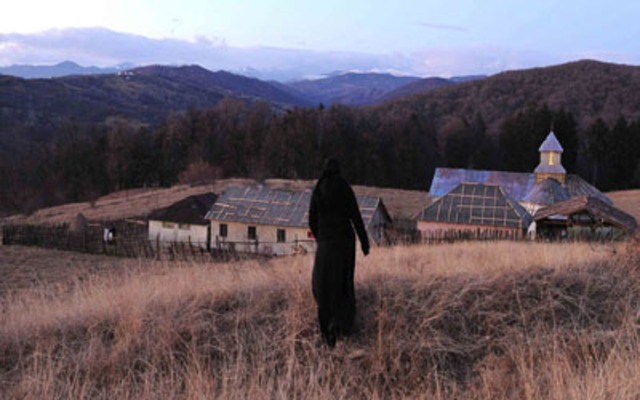
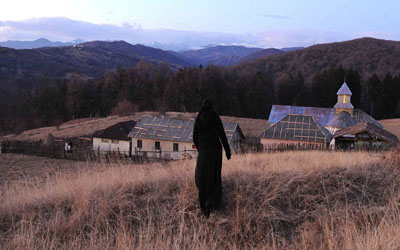
Mungiu tries to have it both ways with his fertile source. He strips it of any mainstream cinematic slickness, but his hand-held style is its own kind of gritty sensationalism. And somehow it doesn’t have a sense of place. There are plenty of bleak, picturesque shots of weather-beaten monasteries, barren, snowy landscapes, and modestly furnished nuns quarters. But, perhaps deliberately, the location seems to be a blank slate, the nuns’ habits blending into each other with a lack of separation. How can there be much tension when everything is the same?
More importantly, the tension of the relationships at the core of the film—not just between Alina (Cristina Flutur) and Voichita (Cosmina Stratan), but between Voichita and God—don’t register. As with the litany of modern-world horrors related by the positively medieval priest who leads the monastery (Valeriu Andriuta), the friends’ dialogue comes off like a laundry list of topical concerns rather than conversation between intimates. Beyond the Hills is the movie debut of both young actresses at the center of the film, and it shows in their lack of depth and chemistry. When Voichita sings to her visiting friend Alina to calm her to sleep, I just wanted to fall asleep in my seat.
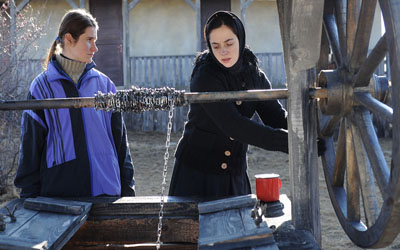 Cristina Flutur and Cosmina Stratan (IFC Films)
The film begins from Voichita’s perspective as she makes her way through a crowded train station to meet Alina, who as the script frequently reminds us, is visiting from Germany. Alina approaches her friend as a train sounds a warning signal, and then from out of frame comes the train plowing through the tracks Alina just crossed. Alina walked in front of an oncoming train to give her friend a hug, an early sign that something isn’t right.
Voichita asks her elders if her friend can stay at the monastery with her, and Alina quickly turns from a friend who maybe doesn’t notice locomotives barreling down the tracks toward her to a stalker, jealous of any earthly or heavenly rival for her friend and former lover’s attention. Voichita and her fellow nuns are portrayed as bound by their monastic roles, but so is Alina, and all of the actors are bound by the director’s strategy, more distancing than immersive.
The subject matter is in many ways loaded, but the movie does not consider the church and the medical profession always at odds. Nuns call for an ambulance at the first sign of Alina’s troubles, and her examining doctor is hopeful that a prayerful rest at the monastery is just what the young woman needs. The film indicts both church and state without subtlety. It deals with serious issues plaguing Romania, but despite art house airs and longeurs typical of the Romanian new wave, the slow arc boils down to a ham handed melodrama. I wanted to like Beyond the Hills, but if anything I wish Mungiu was more aesthetically austere. It doesn’t have the discipline of a Bresson or Dreyer, either of whom who would have hit one out of the art house park with such a tale.
—
Written and directed by Cristian Mungiu
Inspired by the non-fiction novels of Tatiana Niculescu Bran
With Cosmina Stratan, Cristina Flutur, Valeriu Andriuta.
Not rated. Contains violence, nudity, and holy dread.
Running time 150 minutes