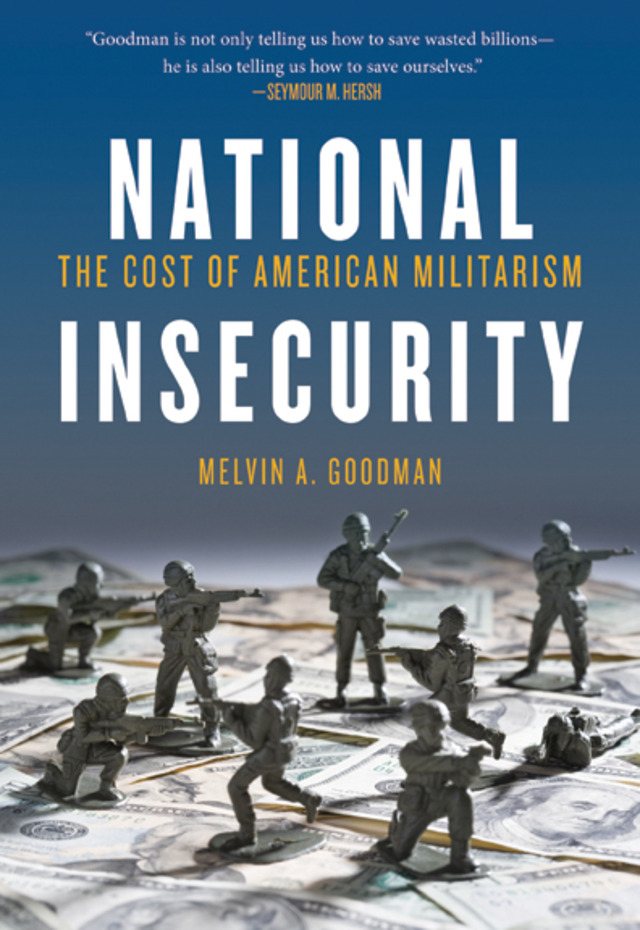
 What exactly is national security? If it entails the safety and well-being of Americans and American land, could national security mean a protected environment with clean water and air? Could it mean that sick people can afford timely treatment? Or that personal income will be protected from unfair taxation or pressures that facilitate irresponsible spending?
These concepts may not be considered “national security” in the usual sense, but as Melvin Goodman writes in National Insecurity: The Cost of American Militarism, those issues currently present more imminent threats than any from overseas. Yet, he says, they sit on the back burner as defense spending has gone up and the economy has suffered. He will be discussing his new book (City Lights Publisher, March 2013) at 6:30 p.m. on Wednesday, March 20, at Busboys and Poets’ 14th and V location.
Goodman was a CIA analyst during the Johnson, Nixon, Ford, Carter, Reagan, and first Bush presidencies. Though the United States originally had a “rationalist” foreign policy that relied on intelligence community findings, he explains that the Soviet Union then emerged as the country’s “greatest strategic threat.” That threat no longer exists, but we continue to “barricade ourselves behind a national missile defense, fight wars in which no vital national security interests are at stake, and post hundreds of thousands of troops overseas.” As the Pentagon has come to wield unparalleled power, the U.S. seems to have become the militarized nation President Eisenhower warned against in his farewell address: “We recognize the imperative need for [military] development. Yet we must not fail to comprehend its grave implications. Our toil, resources and livelihood are all involved; so is the very structure of our society.”
Goodman points out the consequences of being such a nation, including a reluctance to take part in international agreements that would foster strategic cooperation. Another is the alarming use of drones, which until recently had not been touched by Congress. Though the author suggests this “moral issue” was inherited from George W. Bush’s administration, Obama’s apparent willingness to perpetuate it, as well as other questionable military actions, is described as possibly the President’s greatest failure and conveys the extent to which militarization has become the norm.
This talk will reveal how the Pentagon’s monopoly over the federal budget has hurt not only the American economy, but the country’s national security even in the traditional sense, especially in volatile areas like the Middle East as anti-American sentiments breed. Goodman proposes several ideas to combat this problem, calling for a “radical restructuring of U.S. foreign policy,” with greater emphasis on diplomacy, negotiation, arms control, and multilateralism. He urges us to take a cue from President Eisenhower before it is too late.
National Insecurity is Goodman’s sixth book, following the critically acclaimed and similarly grim The Failure of Intelligence: The Decline and Fall of the CIA. He is a senior fellow at the Center for International Policy and an adjunct professor at Johns Hopkins University.
The event will take place in the Langston Room and is free to the public.