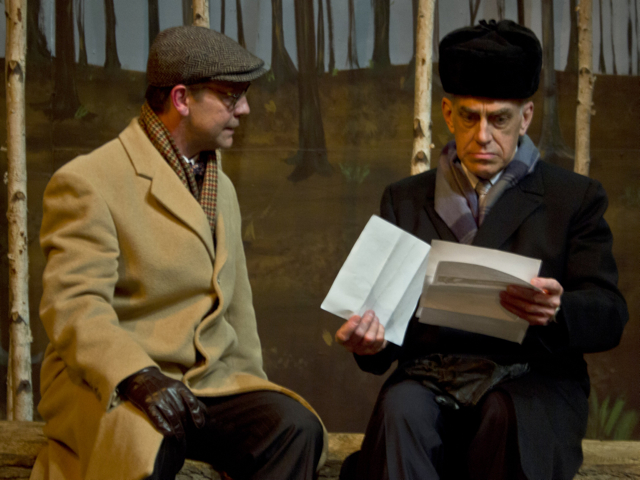
 Brit Herring and Steve LaRocque in ‘A Walk in the Woods.’ (Quotidian Theatre Company/St. Johnn Blondell)
As the average attention span continues to shrink down, it’s an almost edgy act of rebellion to entertain oneself with productions as slow, quiet and and methodical as Quotidian Theatre’s latest, a staging of Lee Blessing’s Cold War meditation, A Walk in the Woods.
Originally produced by Yale Repertory Theatre in 1988, Blessing’s Olivier-, Tony-, and Pulitzer-nominated piece was inspired by a 1982 summit outside Geneva between American and Soviet arms negotiators. Paul Nitze and Yuli Kvintsinsky met away from cameras but could not escape media speculation and gossip. The version of that we get here is, of course, completely fictionalized, but no less true for using real history as a springboard into more interesting questions.
(And anyway, as Mark Twain put it, “The only difference between reality and fiction is that fiction needs to be credible.”)
Blessing imagines his pair of conflict resolvers as straight out of The Odd Couple, with Felix Unger in the form of American newbie John Honeyman (an apple pie name if ever there was) and Oscar Madison in cynical but endearing Russian expert Andrei Botvinnik (Steve LaRoque, oozing charisma).
At first Honeyman (Brit Herring), like any good American workaholic, can’t get comfortable not actively being serious and on-task, as he humorously rebuffs Botvinnik’s attempts to divert the conversation onto more “frivolous” topics like Willie Nelson (on “Blue Eyes Crying in the Rain,” he quips, “It’s sad; Could be Russian”).
Predictably, through the course of four scenes and two acts (a structure that quickly begins to drag), both learn from one another and grow to hold a genuine affection for one another.
Also, as expected in these kinds of stories, the naïve idealism of the new negotiator gives way to the cynical realization that it doesn’t matter a hill of beans what these two agree on when those in the seat of power won’t compromise.
So yes, the idea that our prejudices usually melt when we recognize what we have in common with others we have long considered to be different is by no means a new area of exploration in art. But Blessing’s sharp writing still manages to keep the mind engaged (as do two fine performances by Herring and LaRoque.)
Though it would have been easy to specifically name, for instance, Ronald Reagan and Leonid Brezhnev, Blessing relegates any mention of the two men’s leaders to the abstract; a strong choice.
The witty, paradoxical exchanges are engaging, even if they’re expected.
“We don’t trust you.”
“Why?”
“Do you trust us?”
“Yes! Well — we try.”
At the play’s most riveting moment, Botvinnik illustrates America and Russia’s separate histories, using pinecones like pieces in a real-world Risk. “What would Russians have done if they’d arrive in America? They’d have killed all the Indians and taken their land.”
How odd to look back on a time when two superpowers hogged the whole stage. The datedness of the Soviet-American bickering is half of Walk‘s appeal. This question of what compromise means—is it about saying yes more often than saying no? Or is it just that well-timed no’s lead to more amenable yeses?
World annihilation, Blessing suggested more than two decades ago, will never be that far off in a society that seems to embrace war as much as it claims to detest it. With a nuclear North Korea and Iran ever-present on the horizon, times have changed, but the setbacks to maintaining peace haven’t.
A Walk in the Woods runs through through April 14 at the Writer’s Center (4508 Walsh Street, Bethesda). Tickets $30.