 Of the thousands who descended upon the U.S. Supreme Court to demonstrate today, most were there to offer their steadfast support or opposition toward same-sex marriage. They held signs, recited chants, and listened to speakers.
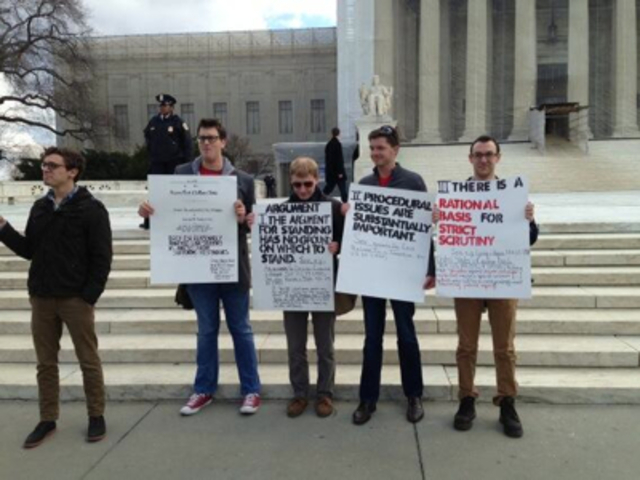
And then there were the five law students who weren’t there to argue the merits of striking down California Proposition 8, but to quibble with the Supreme Court itself over the legal procedure the justices will apply in their ruling.
The students, all from the Georgetown University Law Center, are mad that the court will review the arguments in Hollingsworth v. Perry using rational basis, the most lenient form of judicial review in the U.S. court system.
In a rational basis review, judges test if a law or other governmental action is in the reasonable interests of that government in a way that passes muster with the Fifth or 14th amendments to the U.S. Constitution. The standard gives a wide berth to state laws, such as Proposition 8.
“Rational basis means that the court will give great deference to any state law passed so long as that it is rationally related to government interests,” said Gabe Lezra, who was propped up one of four posters decorated to look like a court brief.
“We were going to do a table of authorities, but we ran out of time,” he said. As a result, the fifth student, Alex Charles, was left to wave a miniature American flag while his classmates hoisted the posters.
Instead, the students would have rather seen the Supreme Court apply strict scrutiny, in which gay people are treated as a “discrete and insular minority” entitled to the same protections as other groups.
Lezra said his groups nitpicking of Supreme Court procedure is all in the service of the push for same-sex marriage. “We are absolutely pro-marriage equality,” he said. “We also think the way the court has gone about dealing with cases involving LGBT people is unaccpetable and this applies their own precedent and standards.”