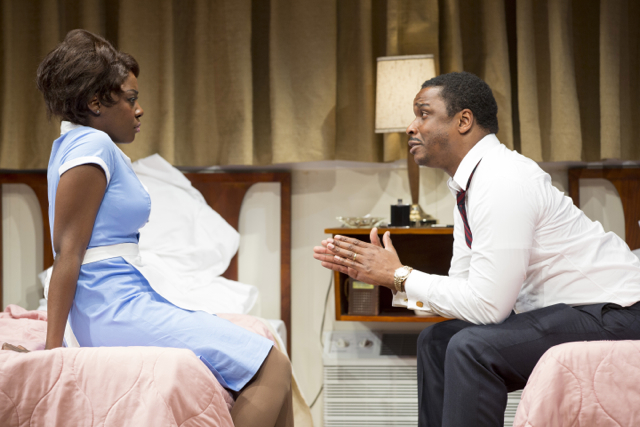
 Joaquina Kalukango as Camae and Bowman Wright as Dr. Martin Luther King Jr. (Arena Stage/Scott Suchman)
On April 4, 1968, Martin Luther King Jr. was shot to death at the Lorraine Motel in Memphis, the day after he delivered a powerful address. In his “I’ve Been to the Mountaintop” speech, he ominously hinted that he was aware of how threatened his life was, saying: “I may not get there with you. But I want you to know tonight, that we, as a people, will get to the promised land.”
A full 45 years later, Katori Hall’s The Mountaintop, an Olivier-award-winning theatrical rumination about what King’s last night might have been like — kicks off with tonight’s sold-out performance at Arena Stage, in the city where almost 50 years ago King led the March on Washington for Jobs and Freedom and uttered his immortal “I Have a Dream” speech.
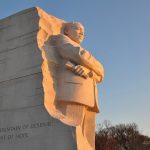
The towering King Memorial, a mere two miles away from the theater, provides a nice contrast to what you will see on stage. Hall, who was a playwright-in-residence at Arena in 2011, depicts a tired, anxious King, waiting in his hotel room for Ralph David Abernathy to return with cigarettes when he is met by Camae, a woman who brings him coffee and then spends the next hour and a half engaged in an intense interaction.
“The core of the play is the great ‘what if?’,” director Robert O’Hara says “What if King was visited on the night before his death by a beautiful young woman? Here we’re able to explore the kind of eroticism that comes from being youthful and powerful and having an incredible light but also feeling very old and tired,” “I wanted to make sure there was a lot of eroticism in the play, which to me was missing on Broadway.”
The Mountaintop opened in New York in fall 2011, directed by Kenny Leon and starring Samuel L. Jackson and Angela Bassett. To O’Hara, who approached Hall while the play was still in development, the high-profile production with two huge stars, both of whom were at least two decades older than the characters they were playing (King was 39 when he died, while Jackson was 63 when the show debuted; the fictional Camae is in her 20s), was not what he had envisioned from reading the script.
O’Hara has an empathetic perspective when it comes to playwrights, probably because he’s also one himself. (His Antebellum won the 2010 Helen Hayes Award for Outstanding New Play.)
“A director can sometimes mess up a new play,” he says. “So I give playwrights as much room as possible to speak their mind and be a part of the brain trust.”
Joaquina Kalukango, who plays Camae and first met Hall when they were students at Julliard together, also saw the original Broadway production of The Mountaintop.
“This production has a lot more tension, a lot more sexual energy,” she says. “We’re being truthful to the text and what it calls for and to the spirit of the play. It’s very deep in this production from what I feel.”
Though King was married to Coretta Scott King from 1953 until the day he died, he was also a known womanizer, and the chemistry between the two characters, in the claustrophobic hotel room, will display a side of King that the audience probably does not hear about too often.
Bowman Wright, who plays King, admits that Hall’s depiction of the icon as a man with just as many flaws as the next did get under his skin the first time he read it. “It’s a tough one,” he says. “It hits those points of how you see King and admire him and — ‘Wow, this is really kind of ‘What’s going on here?’
“I learned about King like most people do. The ‘I Have a Dream’ speech and the idea of King being a peaceful person turning the other cheek. Just very nice and fluffy to everyone and people don’t realize how radical he was.”
For his portrayal, Wright researched King’s speeches and interviews but says he wanted to avoid doing surface impressions of the man whose powerful voice and striking face is emblazoned on world’s collective memory of the civil rights movement.
“I didn’t want to do it like King. I didn’t want to sound like King,” he says. “My whole thing was to find out where he speaks from and where his heart lies rather than imitate him,” Wright says. “What makes this even more powerful is you can see a great man without that and look in in the mirror and say, ‘I can do it too.’”
Kalukango agrees. “For the first time I saw the human being and not a mythical angel,” she says.
Because both she and Hall grew up in the south—like King, Kalukango is from Atlanta—the actress said she was drawn to the way Hall captures the language of the south.
“I remember my first encounter with [racism] was at age five,” she recalls. “We were going to Kentucky to get fireworks and everyone just stopped and looked at us. I think, growing up as a child, it’s hard to have all of the information. A lot of stuff gets filtered.”
This production arrives in D.C. straight off a run at the Alley Theatre in Houston. Kalukango and Wright have had about a week to get back into the swing of the show, this time in a much smaller space, which has meant scaling back and focusing on smaller, more precise movements.
“There were just little things like learning how to smoke cigarettes properly and ashing them,” Kalukango says. “It’s challenging because we’re onstage for an hour and 40 minutes, no intermission. Once you begin, you just need to keep the ball rolling. It was really hard to figure that out.”
As part of her own research process, Kalukango says she looked at pictures of women in the 1960s, and acclimated herself to the idea of the constant smoking and drinking, and the uncomfortable fashion. “I had to tap into a side of me that I have never before,” she said. “Tap into what it means to be a woman who was very experienced and walks around the world and owns it; who’s not afraid to say things and challenge people. Who’s very loud and sometimes very vulgar.”
“If you look at the film of King during that evening, you can see an exhausted man,” says O’Hara. “I didn’t know now that he was such a heavy smoker. He was being followed by the FBI — followed by not protected. So that was interesting to me.”
Of course, the audience shouldn’t expect a documentary of what really happened. As O’Hara says, “It’s a darker exploration. And also very funny.”
He adds that while it might be a disillusioning experience to see King in a version of how he might well have really been, “We sort of go to this blanket, wide-eyed blurry focus so we can get through our day. But the theater does not uphold what people need to hold on to.”
The Mountaintop runs through May 12 at Arena Stage. Tickets available at ArenaStage.org.