 Via Shutterstock
Paul Zukerberg, an attorney and marijuana policy reform advocate running in the April 23 special election for an At-Large seat on the D.C. Council, says the Metropolitan Police Department and Metro Transit Police Department are not making public their statistics of pot-related arrests. But the number of marijuana arrests grew in recent years, and Zukerberg says police are not being transparent if that trend is continuing, though he suspects it is.
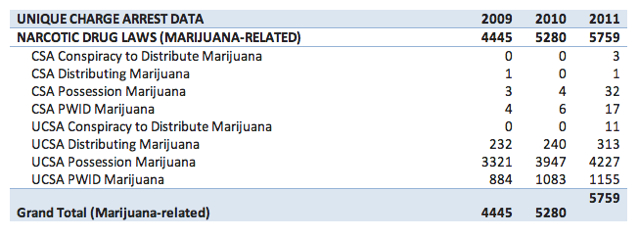
According to documents Zukerberg obtained through Freedom of Information Act requests and shared with reporters, MPD made 4,445 marijuana-related arrests in 2009, 5,280 in 2010, and 5,759 in 2011. However, when he asked for figures from 2012 and the first few months of 2013, Zukerberg was told that an upgrade to the department’s records management system does not reply to searches for marijuana arrests. Zukerberg was told that such a query does not “fall within the parameter of our currently available data.”
By historical comparison, MPD made 1,844 pot arrests in 1995.
But Zukerberg suspects that the numbers are continuing to spike. “They’ve given us data for 2009, ’10, and ’11, so you can see the trend,” he says in an interview. “This is the crime increasing at an incredbily rapid rate, and not to have those figures is troubling. People’s lives are getting turned upside down.”
During a debate with the other April 23 candidates today on The Kojo Nnamdi Show, Zukerberg argued that D.C. arrests twice as many young people for marijuana as it graduates from high school.
A spokesperson for the Metropolitan Police Department did not reply to requests for comment.
MPD often touts its crime statistics, particularly to show recent drops in the rates of homicides and violent crimes. Though without current figures for drug-related arrests, Zukerberg says it casts doubt on the department’s reporting.
“It makes it very difficult to use a data-driven analysis of crime if you don’t have the data,” he says. “It sounds very similar to what the fire department is saying.”
What Zukerberg says is happening is that D.C. police officers are increasing their enforcement of the Uniform Controlled Substances Act, the District’s 1981 anti-drug law. “They don’t have as many serious cases to deal with,” he says. “When I first started practicing, no self-respecting cop would bring in a kid for half a joint. Now even half a roach is being prosecuted to the fullest extent of the law.”
Zukerberg has been practicing for 28 years. He says he doesn’t think marijuana use in the District has increased as rapidly as enforcement against it. And with Mayor Vince Gray’s fiscal 2014 budget calling for the hiring of up to 100 more police officers, Zukerberg says the District is poised to continue cracking down on small-scale possession and use of a non-narcotic substance at a time when other major U.S. cities— New York, Boston, Philadelphia, and Chicago—are moving toward decriminalization.
In the case of of Metro Transit Police, Zukerberg got back records that showed marijuana-related prior offenses of people arrested in the transit system, but not the natures of the arrests themselves. He was instead referred to Metro’s five-year crime report covering the period from 2007 to 2011, which shows the number of arrests for several types of crimes, but not drugs.
Metro Transit Police made 161 drug-related arrests in 2012, says Dan Stessel, a spokesman for the Washington Metropolitan Area Transit Agency. However, he could not specify how many of those arrests were for pot. “There is no breakdown based on the type of drug, but it is accurate to say that the majority of these arrests were for marijuana,” he writes in an email. There were another 47 drug arrests on Metro in the first three months of 2013.
Stessel adds that because drug charges are classified as “Part II” offenses in the FBI’s Uniform Crime Reporting program, the Metro Transit Police Department does not include them in its public lists.
Zukerberg, though, has his conclusions. Without accurate counts of how many people are being busted on pot charges, D.C. will not be able to truly gauge the effect of treating marijuana use as a serious crime.
“We don’t know how many thousands of kids’ lives were ruined, and I guess the police department doesn’t care to bother to count anymore,” he says.