Martin Austermuhle
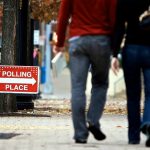
 Image via Shutterstock
It’s hard to have a discussion about D.C. without discussing race. Usually, though, the city’s leaders have found clever and coded ways to talk about race without actually saying as much. That diplomatic two-step somewhat ended today, as candidates for an At-Large seat on the D.C. Council went back and forth on whether or not the city’s legislature needs another black representative.
The conversation was spurred by a comment made by a leading union official to the Washington Post in an article on the state of the race, which will be decided on April 23:
George T. Johnson, head of Local 20 of the American Federation of State, County and Municipal Employees, which endorsed Bonds hours after Brown withdrew from the race, said there is a strong desire within the black community to ensure the seat is held by an African American.
There are seven white and six black council members, including Bonds.
“People have perceptions about what this city is becoming . . . and they want this council to remain black, and if they don’t get out there and put black folks in there, there will be a white city council,” Johnson said. “That is a rough thing to say, but that is the truth.”
Johnson and his union are backing Interim Councilmember Anita Bonds (D-At Large), who is black, against Elissa Silverman (white), Matthew Frumin (white), Patrick Mara (white), Paul Zukerberg (white), and Perry Redd (black).
During a debate on The Kojo Nnamdi Show this afternoon, Bonds was asked about the comment. “There is a natural tendency to want your own,” she said. “People want their leadership to reflect who they are.” Redd agreed, saying: “When Europeans are in control of any elected body, they do not care for the most vulnerable.”
There’s a certain political reality that Bonds and Redd are responding too—you don’t have to look very far beyond how the city voted in the last mayoral election to see that the majority black wards went with Mayor Vince Gray while those with more white voters sided with Mayor Adrian Fenty. (The fall was dramatic to be sure: only four years prior, Fenty won every precinct in the city, white and black.)
The same happened in the April 2011 Special Election, and also in last November’s contest between Councilmember David Grosso (I-At Large) and former Councilmember Michael Brown. (Brown recently dropped out of the April 23 race.) It was Grosso’s win, in fact, that pushed the white members into a 7-6 majority.
But Nnamdi, who is also black, interjected to note that the color of a councilmember’s skin doesn’t equate with their political views or their ability to respond adequately to the needs of black residents. He’s right: during debates in recent years over raising taxes on the city’s highest earners, members didn’t align based on race. In fact, the proposal—which would have in theory put more money into social services—saw support and opposition come from across the races.
Zukerberg, a defense attorney who has argued for the decriminalization of marijuana, also called out the idea that a black council would be better for black residents. “We have had a black majority city council, and a black mayor and they have done nothing to help those young people,” he said, referring to young black men who are disproportionately arrested for minor drug offenses.
There’s also a wrinkle in the discussion that isn’t very, well, black or white: according to the recent Census, 10 percent of the city’s residents are Hispanic, yet D.C. doesn’t yet have a Hispanic councilmember. (The most recent Hispanic candidate was Josh Lopez in 2011.)
The issue likely won’t go away anytime soon: once the special election is done, campaigning will begin in earnest for next year’s mayoral primary, which is expected to pit Councilmember Muriel Bowser (D-Ward 4), who is black, against two of her white colleagues, Councilmembers Jack Evans (D-Ward 2) and Tommy Wells (D-Ward 6).
There’s reason to think that not everyone sees things through a racial lense, though: when Phil Mendelson was elevated to the council’s top spot last year, there was little talk of how he represented a step back for the city’s black residents. (He faced no real internal competition for the job.) In most citywide elections, in fact, Mendelson has fared well across racial lines.
In an Examiner article on Grosso’s win, it was Councilmember Yvette Alexander (D-Ward 7) who made clear that it’s less about race and more about being responsive. “I don’t care what color you are,” Alexander said. “I care if you’re sensitive to my issue.”