 For some reason, very few scientists end up serving in our political landscape. While most of the current Congressional class is made up of lawyers, teachers, and farmers, a mere eight representatives (0.015 percent) previously worked as scientists. And it shows — just as developments seem to occur in areas like stem cell research and climate change, let’s just say some politicians have ways of shutting that whole thing down.
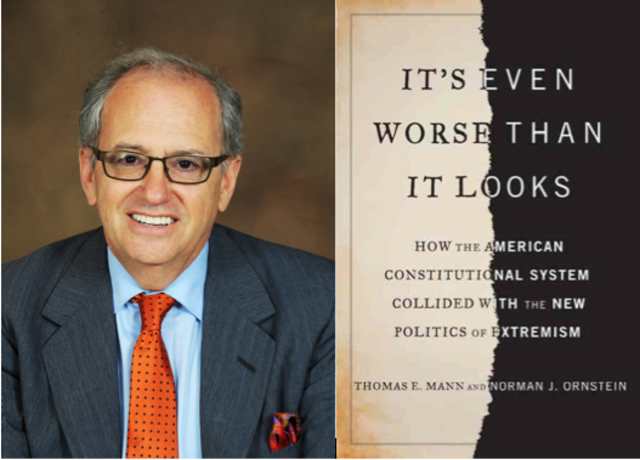
Why is science becoming detached from legislation, and how can these two stubborn entities be reunited? On Wednesday, April 10 at 5 p.m., Norm Ornstein of the American Enterprise Institute will address “Making Science Policy in a Dysfunctional Political Era” at the American Association for the Advancement of Science (AAAS) as part of their Distinguished Speaker Series. Ornstein has authored many books and articles including the provocative recent titles It’s Even Worse Than It Looks: How the American Constitutional System Collided With the New Politics of Extremism (Basic Books, 2012) and “Let’s Just Say It: The Republicans are the Problem” (Washington Post, 2012), both written with his Brookings colleague, Thomas E. Mann.
Science policy has broad applications beyond teleporting molecules, black holes, or even the all-important studying of duck privates. It encompasses technological innovations in energy, defense, the environment, health care, and other big deals for both parties. President Eisenhower instituted the nation’s first science and technology presidential adviser after the Soviet Union launched Sputnik, deciding that the country’s scientific edge depended on additional resources from the government. For several decades since the mid 20th century, money has been allocated to fund scientific research and training. The amount has declined due to disagreements over the budget and federal responsibility to support such endeavors (enter the “Dysfunctional” part of the speech).
Ornstein is particularly knowledgeable on Congressional conflict as well as scientific lawmaking. He led the scholars and practitioners who created a blueprint of the McCain-Feingold campaign finance law, and is a fellow in the American Academy of Arts and Sciences. He is one of the most quoted political pundits in the country, and regularly does commentary on TV and radio, as well as writing “Congress Inside Out” for Roll Call, co-directing the AEI-Brookings Election Reform Project, and taking part in AEI’s Election Watch series.
This will be the first talk of AAAS’ 40th annual Distinguished Speaker Series, which seeks to explore “issues with implications for science and policy from national to global perspectives.” Though the event is free and open to the public, please register to attend via AAAS’ website.