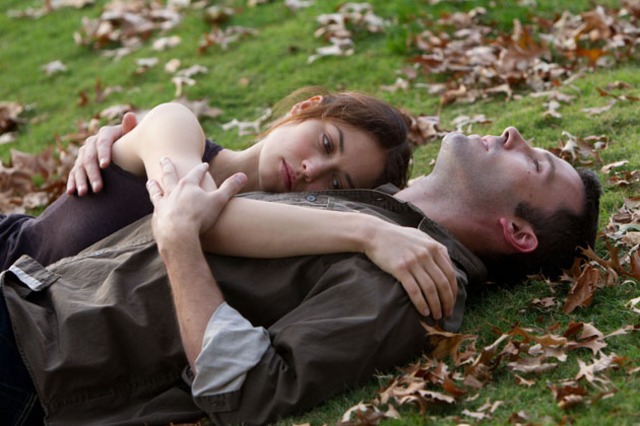
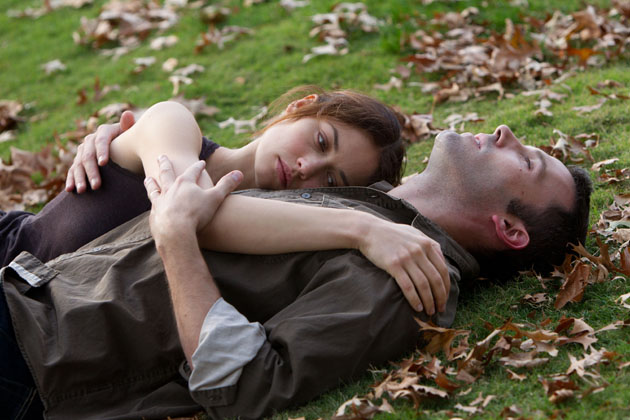
 “Stop me before I twirl again.” Olga Kurylenko and Ben Affleck (Magnolia Pictures)
Terrence Malick is nothing if not an ambitious director. His lofty aesthetic aims were clear from the very title of his last movie, The Tree of Life. The self-importance that oozed from that announcement filtered down through landscapes out of Anne Geddes, a practically mute “leading lady” in Jessica Chastain, a vision of heaven as a grey beach of white people, and dinosaurs that signaled that one man’s branch on the titular Overarching Symbol was but part of the great cosmic design.
I’m grossly simplifying, but my problem with The Tree of Life wasn’t that it was complicated, but that it was somehow pretentious and trite at the same time, from its ideas to its images. Malick may have been in the business of dream-like visions of giggling couples long before deodorant commercials ever made them popular, but to the defense of commercials, they don’t have enough time to develop characters. In To the Wonder, Malick has two hours to form a plausible relationship, but the film’s central lovers barely come off as distinct people much less as human beings who interact beyond carefully-lit horseplay, and, which I’ll get back to in a minute, twirling, lots and lots of twirling.
Marina (Olga Kurylenko), whose name suggests the sea, opens the film with a mystical narration: “Newborn. I open my eyes. I melt. Into the eternal night. A spark. You got me out of the darkness.” She’s in love with Neil (Ben Affleck), which you know because she’s always twirling. Marina leaves the excitement of Paris to join Neil in America, in an Oklahoma subdivision that looks like it’s in the middle of nowhere. Love sends her into an unknown wilderness, and this displacement may well be the rationale for all that goddamned twirling, which I hope inspires next year’s Oscar broadcast to include a production number of To the Wonder dancers.
Marina and Neil move into a house that doesn’t look like anybody lives it. Not only does it have little furniture beyond a bed and a dining table, there’s little sign of moving boxes. There’s an emptiness to the way they live that could well be sloppiness (like Malick’s signature handheld camera), but the film soon makes clear that Marina’s emptiness and overheated imagery is spiritual as much as carnal. The sense of displacement comes not just from love but from a spiritual longing, represented by the displaced priest Father Quintana (Javier Bardem). When we meet Father Quintana and hear his thoughts, spiritual themes of seeking and light and darkness plays against the light of his parish and the light in the unfinished home where the lovers try to work out their relationship.
Malick’s ideas could have made a compelling, provocative movie. But the execution is by turns lazy and self-indulgent. Marina’s opening narration is typical of the godawful script (another favorite: “You, cloud. You love me too”). If Quintana’s narration has a more focused intensity, it figures. The movie’s strongest inner dialogues (which is the bulk of the script’s dialogue) come from Saints, inspired by St. John of the Cross’s Dark Night of the Soul and directly quoting St. Patrick.
To the Wonder is less well acclaimed than its predecessor, but if its focus seems narrower — on a single relationship — it’s still ambitious at heart. It parallels man’s search for spiritual meaning with his struggle for human intimacy. Which means it’s about man’s place in the cosmos after all.
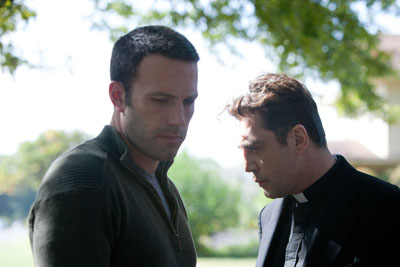 Ben Affleck and Javier Bardem (Magnolia Pictures)
The religious elements of the film have some critics throwing around Robert Bresson, and while Father Quintana’s crisis of faith recalls the struggling protagonist of Diary of a Country Priest, Malick does things Bresson would never have allowed. His Oklahoma landscape is packed with a picture postcard beauty, much of it inspired by great photographers: William Eggleston, Eugene Atget, Robert Adams, and Robert Frank all got there first, with images that are more evocative than decorative. But the biggest problem is all that twirling. Is Malick so revered that nobody has the presence of mind to sit down with him and pleade, “Please, Terrence: enough with the twirling!”
To the Wonder asks big questions, not just about the meaning of life and love but about displacement and poverty in America. But it drowns in the muddy waters of his own unquestioned aestheticism. The grotesque meth-heads that wander the film’s edges remind moviegoers of the days when Malick followed serial killers, and make you wonder what kind of movie might have emerged from a focus on less photogenic sinners. Badlands is still may favorite Terrence Malick film, and I hope that someday he can get his head of the clouds and lower his ambitions. Unfortunately, I don’t think his latest project will be that film. It’s “an examination of the birth and death of the universe” called Voyage of Time.
—
Written and directed by Terrence Malick
With Ben Affleck, Olga Kurylenko, Javier Bardem
Rated R for sexuality and nudity
Running time 112 twirls