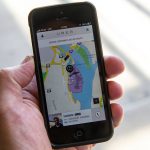
 District residents got a new transportation option last month when SideCar, a company with a smartphone app that connects users with strangers willing to offer them seats in their cars—a practice also known as carpooling—entered the D.C. market. When SideCar launched here, it left local regulators scratching their heads a bit, but the D.C. Taxicab Commission eventually said that its business model does not seem to fit the description of public vehicles for hire. But now it seems to be changing its mind.
Well, now Uber wants a piece of that market. In a “white paper” posted to his company’s website today, Uber CEO Travis Kalanick writes that in its cities where it faces ride sharing competition from companies like SideCar and Lyft, his sedan- and taxi-by-smartphone outfit will explore connecting ordinary drivers with people who need a ride.
SideCar, which started its D.C. operations on March 22, explicitly tells users it is not a limousine or taxi service, aiming to protect its drivers from local regulations. And unlike Uber, which connects customers with licensed sedan and cab operators according to proprietary fare schedules, SideCar users can elect to pay their drivers or not.
Kalanick writes that Uber hesitated to expand into ride sharing because of a perceived regulatory risk to drivers who sign up to participate in the practice. But in D.C. and most other cities where SideCar operates, local regulators have given it and other ride sharing services a pass. And that has let those companies get a leg up on Uber, Kalanick believes.
“In most cities across the country, regulators have chosen not to enforce against non-licensed transportation providers using ride sharing apps,” he writes. “This course of non-action resulted in massive regulatory ambiguity leading to one-sided competition which Uber has not engaged in to its own disadvantage.”
Beginning today, Kalanick writes, Uber will explore entering the ride sharing market in several of the cities where it operates. It’s really up to whether or not local regulators have weighed in. “Uber will aggressively roll out ridesharing on its existing platform in any market where the regulators have given tacit approval,” he writes.
However, it will do things a bit differently than SideCar and Lift. Kalanick, who in Uber’s first year in D.C. seemed to relish flouting regulations before his company’s popularity helped change the city’s livery rules, is now making regulatory proposals of his own.
Kalanick states that Uber will enter the ride sharing market where a competitor has been operating without regulatory interference for more than 30 days. That would include New York, Seattle, Chicago, Boston, and California, and possibly D.C. But because ride sharing as conducted by SideCar is a relatively new concept, Kalanick is offering the lax regulators a plan as to how Uber would conduct its ride sharing operation.
First, its ride sharing service would come with an insurance policy of $2 million on each trip, the same policy that applies to sedan and taxi rides Uber books. Second, it would put each driver through an extensive background check that Kalanick calls stricter than those administered by local taxi regulators.
But whether Uber gets into the ride sharing game in D.C. is murky. Although the D.C. Taxicab Commission’s statement last month would seek to qualify as that free pass Kalanick alludes to, the agency is less sure now. Neville Waters, a commission spokesman, says in an email that upon further review, the city’s taxi regulators now perceive SideCar-affiliated cars to be public vehicles for hire and subject to regulations. Waters says that will likely mean Uber will not launch a ride sharing platform in D.C.
“Given that DCTC intends to enforce existing public vehicle for hire regulations as they pertain to SideCar drivers and vehicles the Uber statement would indicate that Uber would not offer ride sharing services in the DC market,” Waters writes.
UPDATE, 4:30 p.m.: Taxicab Commissioner Ron Linton confirms in a statement that SideCar will be regulated: “We are concerned the private cars used to provide these services have only ordinary, non-commercial insurance that we believe may deny coverage to passengers in the event of an accident. The Commission will take legal action against any person knowingly flouting District law by connecting passengers to unlicensed vehicles or operators,” he said.