

 NASA/Bill Ingals
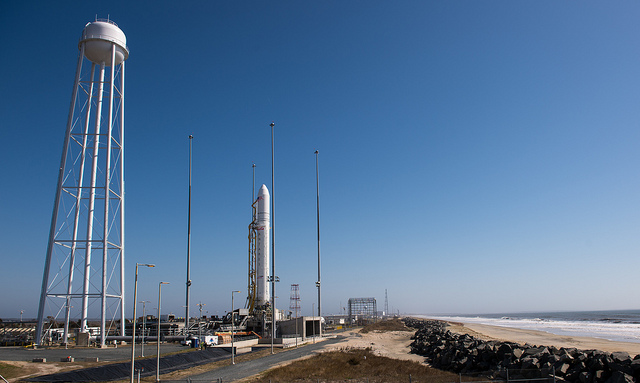
Look toward the southeast this evening, and you might just be able to see the fiery trail of a rocket bound for outer space. The Antares rocket, a privately funded craft built by Vienna, Va.-based Orbital Sciences Corporation, is designed to enter service later this year with supply runs to replenish the International Space Station.
The Antares, which was originally developed as the Taurus II, is launching from a NASA facility in Wallops Island, Va. In addition to serving as one of the space agency’s test ranges, the Wallops Flight Facility also hosts the Mid-Atlantic Regional Spaceport. (Figure out what the acronym is for yourself.) DCist got a look at the spaceport when it opened in 2011.
Today’s launch is just a test run, but if weather permits and the operation turns out successfully, Antares rockets will begin servicing the International Space Station as soon as August. Orbital Sciences is one of two U.S. companies with contracts to service the space station. The other, SpaceX, launches its rockets from Florida.
Upon liftoff, the Antares vessel launching tonight will burn through its first stage for four minutes until reaching an altitude of 113 kilometers. At that point, the Antares will separate from the launching rocket and continue on an unpowered trajectory for 93 seconds. After that, secondary engines will fire, lifting the craft to 256 kilometers above the surface of the Earth. About 10 minutes into the flight, a simulated payload will detach from the Antares.
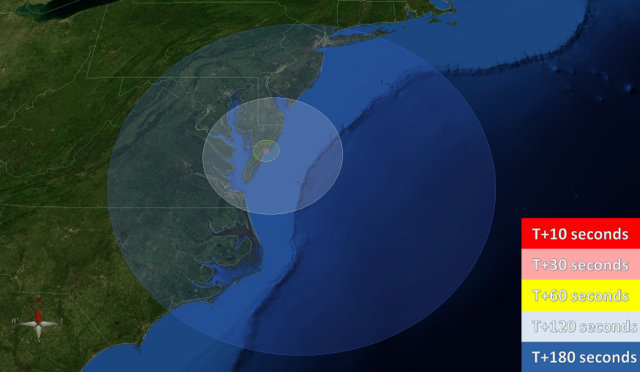
The liftoff window is scheduled from between 5 and 7 p.m. tonight. As the rocket ascends, it should become visible up and down the East Coast, including from D.C. However, given today’s overcast conditions, the spaceport says there is only a 45 percent chance the launch will happen tonight. According to NASA’s projected visibility map below, the rocket should be visible from D.C. about 180 seconds into its launch. People in most of Maryland, eastern Virginia, northeastern North Carolina, southeastern Pennsylvania, most of New Jersey, and even New York and Long Island should be able to see it, too. Though if you happen to be on the eastern shores of Virginia or Maryland, or even on Cape May, N.J., you’ll see it a bit sooner. (Click here for a big version.)
 NASA
NASA

.jpg)