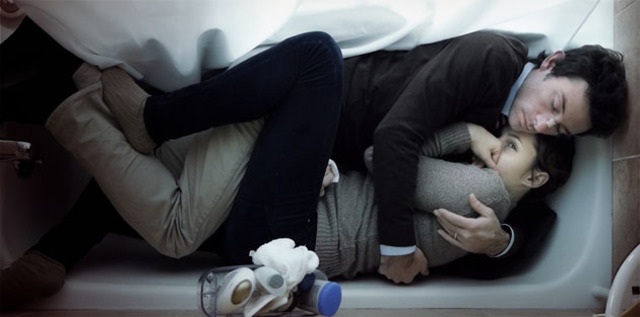
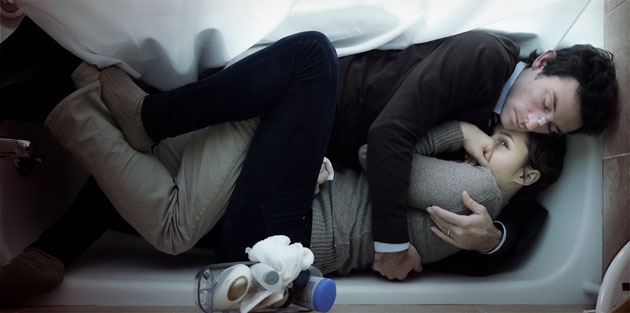
 Shane Carruth and Amy Seimetz (erbp)
“I don’t need any signage.” This is what Jeff (Shane Carruth) tells Kris (Amy Seimetz), after spotting her on the subway in what passes for cute meet in Upstream Color. Kris works for a sign shop, but that’s not what Jeff approached her for.
Carruth’s 2004 film Primer did not provide the audience with much in the way of plot signage. Where that film was a fluorescent-lit cautionary sci-fi, Upstream Color is a warmer experiment, but it is still an experiment. It’s an experiment that suggests that life is an experiment as well; one marked by infection and vulnerability, and connection and a lack of meaning that we try to fill, whether or not we think we need the signage.
Movie music swells or pulses according to whatever emotional cue a director is aiming for. It was always like this, but usually when movie music tells you how to feel, it’s so obvious that it becomes a disservice to the actors and cinematographer alike. But something like Upstream Color needs it. Carruth wrote, directed, and stars in the film, and as he did with his first feature, he wrote the music as well. With Upstream Color, Carruth’s music helps guide the audience through scenes that don’t necessarily carry any emotional weight. What if you saw a man walking through a subway car, with a blank, vaguely introspective expression? Now, add music. That’s what Carruth does. Where his acting lacks expression, his music fills in the blanks.
 Andrew Sensenig and friends (erbp)
Emotional blankness was a problem for me in Primer. That film kept the audience at an off-putting distance, and its skinny-tie bros were so indistinguishable, that I resisted his new movie’s similar inscrutability. But even if you don’t know what motivates the characters in Upstream Color, they are distinct actors. On a second viewing, I gave up trying to figure it out and just let the images and music work. They don’t all work, and parsing it too close makes it sound ridiculous — it’s not exactly a spoiler to mention that a member of a preview audience wondered if the film was an indictment of the electronic music industry. Carruth told a preview audience that he was interested in a making something that could only exist as a movie, that couldn’t work any other way, and despite the surface difficulty of Upstream Color, his marriage of image and music works as a movie, using complex techniques to get at basic emotions.
I like Upstream Color, but when I try to describe it, it sounds silly. Carruth doesn’t trust plot synopses, and with this film he’s only willing to call it a story about a man and a woman “drawn together, entangled in the life cycle of an ageless organism.” If I told you the movie was about lovers somehow connected to a piglet ranch, you’d think, huh? Props to Carruth for not spoon feeding plot points to his audience.
In interviews, Carruth comes across as a filmmaker who genuinely wants to communicate his ideas, but there’s a distancing at work in his films that expressly works against communicating. The difference with Upstream Color is that I kind of cared.
—
Upstream Color
Written and directed by Shane Carruth
With Shane Carruth, Amy Seimetz.
Unrated: contains sexuality and violence.
Running time 96 minutes
Now playing at West End Cinema