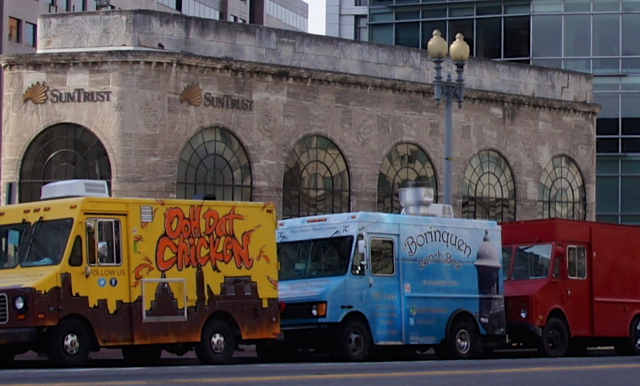
 Photo by Ted Eytan
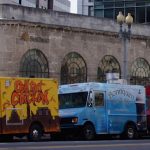
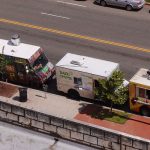
A coalition of food truck industry groups from the United States is taking up spatulas with their D.C. counterparts over the District government’s proposed regulations. In a letter addressed to the D.C. Council, the food truck associations are voicing their opposition to proposed rules that would require mobile vendors to position themselves in spots with at least 10 feet of unobstructed sidewalk, as well as a lottery system that would decide which trucks get the plum parking spots.
“These regulations represent some of the worst food truck laws in the county and, if passed, would transform the District overnight from a leader in mobile vending to one of the worst food-truck cities in the nation,” the letter reads. “Leaving your livelihood up to the outcome of a lottery is a gamble that no small business owner should be forced to make.”
The letter also states that the 10-foot rule would be unique to D.C. The missive is signed by directors of food truck associations in Ohio, Illinois, Minnesota, Maryland, Southern California, as well as the cities of New York and Philadelphia.
The current version of proposed food truck regulations—the fourth since Mayor Vince Gray first called for rules governing mobile food vending last year—would require D.C.’s food trucks to park only where the sidewalks are at least 10 feet wide. Such locations can come at a premium, and no other city feature such a regulation.
The signatory associations also express alarm at the lottery system, which would determine each month which trucks get to park in the most popular downtown locations, such as Farragut Square, Metro Center, L’Enfant Plaza, and Foggy Bottom. Under the terms of the proposed rule-making published last month by the Department of Regulatory and Consumer Affairs, food trucks, for a $25 fee, would enter a monthly lottery for a spot in one of these zones. The winners would then pay $150 for the month to park. Trucks shut out in the lottery would have to keep at least 500 feet from the designated areas, which encompass the parts of downtown D.C. with the greatest amount of foot traffic.
The letter’s signers see the proposed D.C. regulations as anti-competitive and deterring small businesses. “If you are good, the customer will eventually find you,” reads a statement from Brian Reed, the Central Ohio Food Truck Association and owner of a Mexican truck in Columbus. “Should the government be in the business of limiting the consumer’s exposure or availability to a good product? Probably not. They have proven they are willing to protect businesses that are too big to fail, but are they willing to stay out of the way of businesses that are small enough to need a chance?”
But D.C. is hardly alone in seeing its food truck operators pitted against city officials. The New York City Council last month proposed regulations that would confine food trucks there to designated vending zones. And in Chicago, food trucks are required to keep at least 200 feet from brick-and-mortar restaurants (except between midnight and 5 a.m.).
The food truck associations’ letter also repeats the warning that D.C.’s proposed regulations could drive the city’s food trucks to seek out business in neighboring jurisdictions. Arlington, for example, is considering whether to increase the amount of time that food trucks can idle in one location and expand areas where they are allowed to park.
Read the letter in full:
Dear D.C. City Council:
We are food truck owners from across the United States. We are hard-working Chefs and entrepreneurs and our food trucks have provided us with a pathway to building better lives for our families, our employees, and our communities.
This is why we are standing with our brothers and sisters in Washington, DC, to oppose the District’s recently proposed food-truck regulations. These regulations represent some of the worst food truck laws in the county and, if passed, would transform the District overnight from a leader in mobile vending to one of the worst food-truck cities in the nation.
These proposed regulations contain a number of arbitrary and counter-productive provisions, including one that would restrict food trucks where they are in highest demand to a limited number of spaces assigned by lottery. Food trucks would be prohibited from serving customers within 500 feet of lottery-assigned spaces and on streets where there is less than 10 feet of unobstructed sidewalk. For those dozens of food trucks that don’t win the lottery, the choice will be to either shut down for an entire month because of the limited number of viable places left to vend or leave the District of Columbia for more friendly jurisdictions.
Leaving your livelihood up to the outcome of a lottery is a gamble that no small business owner should be forced to make. And no other city in the country requires 10 feet of unobstructed sidewalk in order for a food truck to vend.
We join the Food Truck Association of Metropolitan Washington in supporting targeted laws that address legitimate public health and safety concerns. But Mayor Gray’s proposal seeks to impose a one-size-fits-all approach that severely restricts where food trucks can operate and threatens the very existence of D.C.’s food-truck industry.
Councilmembers, please reject the Mayor’s proposed regulations and send them back to the drawing board.Sincerely,
Central Ohio Food Truck Association
Illinois Food Truck Association
Maryland Food Truck Association
Minnesota Food Truck Association
New Orleans Food Truck Coalition
New York City Food Truck Association
Philadelphia Mobile Food Association
Southern California Mobile Food Vendors Association