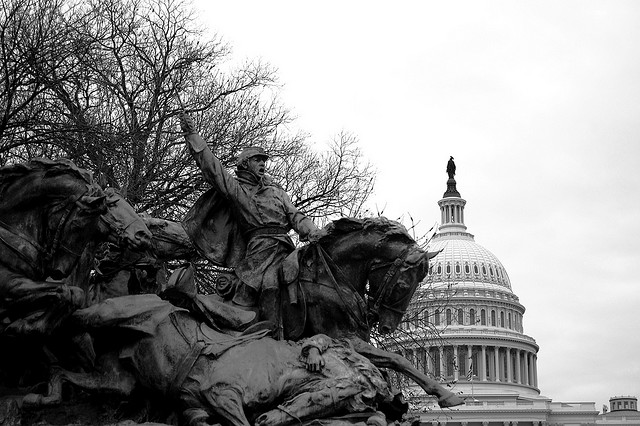
 This clear shot of the Capitol might become off-limits to film crews. Photo by owash
By DCist contributor Julia Langley
Exactly a hundred years after Ulysses S. Grant was born on April 27, 1822, a major monument to the former general was inaugurated on the east end of the National Mall.
Today, in the U.S. Capitol behind it, controversy rages on as Congress wrestles with plans to build a monument to another president and military leader, Dwight D. Eisenhower. As the argument boils down to a question of how we as a people should immortalize our leaders, an inspection of the Grant Memorial should prove instructive. This memorial, as many people fail to realize, tells a far different story than what at first appears. Instead of a triumphant tale of heroism and victory, the Grant Memorial is, upon closer examination, a view into the terrible toll of war.
Sited in front of the U.S. Capitol on top of a grand terrace 252 feet wide and 71 feet front to back, the memorial features a bronze equestrian statue of Grant on a central pedestal flanked by two sculptural groups of soldiers. Grant, at the apex of the central column, calmly attends to the war around him. Wearing an unadorned uniform, he sits low in the saddle, slightly slumping with his hat pulled over his brow. It is unclear to what, if anything, he attends. His proud horse, Cincinnatus, on the other hand, with his upright ears and flaring nostrils, appears alert to the action around him. Unlike the energetic, self-confident commanders portrayed in other Washington equestrian sculptures like that of General Andrew Jackson in front of the White House, Grant looks solemn and weary, less like a war hero and more like a man who has seen too much war.
On Grant’s right is a seven-man Cavalry Group. Their commanding officer raises his sword (now missing) and urges his men into battle. The horses leap into action as the bugler prepares to sound the charge. Yet this powerful and inspiring moment is about to turn tragic. One of the horses has fallen and trapped his rider beneath. The unlucky rider is about to be trampled by the cavalryman behind, who shields his eyes in horror. (The sculptor of the Grant Memorial, Henry Merwin Shrady, made himself the model for the fallen soldier by working from his reflection in a mirror.)
To Grant’s left is the equally dramatic portrayal of an artillery group. Three horses and five men bring forward a cannon, but the bridal of the lead horse has broken. While the other two horses attempt to stop, the lead horse plunges ahead, causing the driver to lose control. Three riders on the artillery carriage appear both anxious and resigned as they brace themselves to be pitched to the side. Everything and everyone is destabilized. Even terrain under the cart is uneven and rutted. In both groups, refuse from battle, including rifles, sabers, and a canteen, add realism to the scenes.
Shrady, the sculptor of the Grant Memorial, took great pains to ensure the accuracy of his depiction, going so far as to join the New York National Guard for four years in order to understand military practices and maneuvers. Because of his insistence upon recreating a veritable view of the Civil War, it took Shrady 20 years to complete the monument. Two weeks before its unveiling, however, the artist died of exhaustion. His self-portrait falling in the artillery group was a poignant prophecy.
But return to Grant, seated high above the fray. In battle, Grant was known to silently whittle on a stick. He spoke rarely, but with authority. Throughout the war, he watched while his troops incurred heavy losses. President Abraham Lincoln, upon hearing criticism of Grant’s leadership style and choices, replied, “I cannot spare this man. He fights.” Grant and Lincoln both understood that it was the leader’s duty to preside over chaos and death to secure the return of peace to the country. In Shrady’s memorial to Grant there is nothing heroic about leadership in a time of war. There are only hard choices and horror.
How, then, does a study of the Grant Memorial relate to the ongoing discussion of how best to represent Eisenhower? Recently, the New York Times quoted Justin Shubow, a fierce critic of the proposed Eisenhower Memorial and president of the National Civic Art Society, as declaring, “Monuments are civic art that cause us to solemnly reflect on who we are and what we value. They are heroic-sized, timeless, and possess grandeur. They present an ideal we aspire to rather than warts and all reality.” If what Shubow says is true, then the Grant Memorial is a total and complete failure. It is the most spectacularly realistic sculpture on the Mall and it certainly does not shy away from the warts of war. But do we want to trash this powerful, poignant, and moving rendition of a general who helped turn the tide of American history?
Shubow rejects Frank Gehry’s design for the Eisenhower Memorial because it attempts to tell us more about President Eisenhower than the cipher Shubow would like us to see. Gehry’s design, with its references to Eisenhower’s American childhood as well as his international achievements, goes beyond the traditional man of power stereotype. But, like the portrait of Grant, it would be grand if it could actually give us a sense of the man, his leadership style and his defining characteristics. Wouldn’t it be wonderful to stop pretending our leaders are supermen and superwomen and show them as they really were?