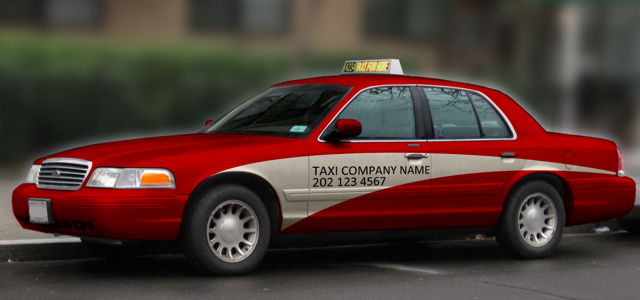
Deep red with a gray swoosh. That’s how the D.C. Taxicab Commission will propose the city’s taxicabs be painted as they transition to a fleet-wide color scheme over the next several years.
After hinting at the new design earlier this week, the commission published mockups of how five vehicle models will appear painted according to the new design. Cabs will be predominantly red, with curved and narrowing gray stripes that jut out of the front wheels and arc over the rear wheels. The shade of red is consistent with that the District of Department of Transportation applies to its Circulator buses.
The color scheme decision comes a few months after DCTC floated nine possible designs, which ranged from jet black to a green-and-yellow paint job that recalled the flag of Brazil. Many of the suggested designs, which were open to a non-binding public vote, inspired revulsion. Some members of the D.C. Council even threatened legislation to stop the process. Incidentally, it was the green-and-yellow getup that was the most popular when the proposed paint jobs went on display at the Verizon Center and Washington Auto Show in January, DCTC spokesman Neville Waters writes in an email. But Waters says that of the nine designs, there was not an actual “winner.”
“The colors on the display vehicles were developed to elicit public feedback,” he writes.
The commission published images of the proposed paint job on five vehicles: Ford’s Crown Victoria sedan, Lincoln’s Town Car sedan, Toyota’s Prius hatchback and Sienna minivan, and the handicap-accessible MV-1.
But the public will have another crack on weighing in later this month, when the proposed rules about cab colors go before a public hearing on May 29 at the D.C. government building at 441 Fourth Street NW. And whatever colors D.C. officials decide to dress the city’s roughly 8,000 taxis, it’ll be a while until the fleet appears identical. The color scheme regulations will apply only to new vehicles. Rules introduced last year require all cabs older than 15 years to be replaced, with all vehicles no more than seven years old by 2017.