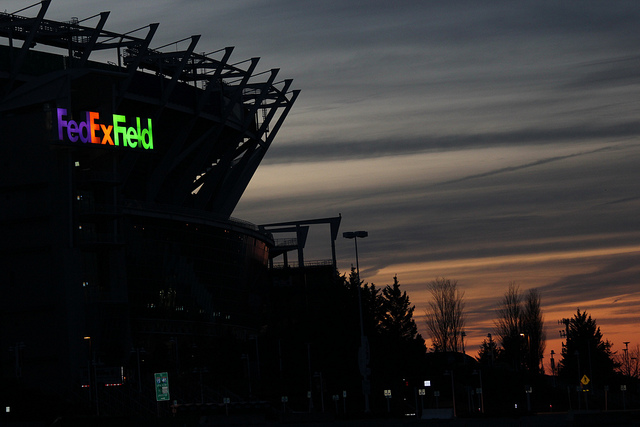
 Photo by Fred King
Despite a few months of bristling criticism over its name, the Washington football team has widespread support for doing nothing in the face of accusations that its name constitutes a racial slur, according to a new poll from the Associated Press.
In the survey, 79 percent of respondents say that team should not change its name. This comes after an offseason in which the team has been the subject of a Smithsonian Institution seminar about whether its name is offensive to Native Americans, a hearing before the federal government’s trademark board, a bill in Congress that would strip the team of its trademark, and, most recently, a D.C. Council resolution proposing the team switch its name to “Redtails.”
Similarly, several publications, including DCist and Washington City Paper, have stopped using the team’s actual name. The Kansas City Star has refrained from using it for several years.
But by and large, the 1,004 adults who responded to the AP-GfK poll are sticking by the Washington NFL franchise’s 80-year-old name. The AP reports that the respondents said that despite the criticism, they do not find the team’s name offensive:
“That’s who they’ve been forever. That’s who they’re known as,” said Sarah Lee, a 36-year-old stay-at-home mom from Osceola, Ind. “I think we as a people make race out to be a bigger issue than it is.”
But detractors reiterated the position that the local pro football team does march under the banner of a racial slur. “Much farther down the road, we’re going to look back on this and say, ‘Are you serious? Did they really call them the Washington Redskins?’,” a resident of Boston, where the franchise was founded, told the AP.
Still, support among changing the team’s name was incredibly thin—only 11 percent. That’s actually a slight increase from the last time a major polling organization conducted a survey on the team. A 1992 poll by The Washington Post and ABC News found only seven percent in favor of a name change.
The poll was conducted by telephone between April 11 and 15 and surveyed 1,004 U.S. residents using both landlines and mobile phones. Two percent of respondents identified themselves as Native American