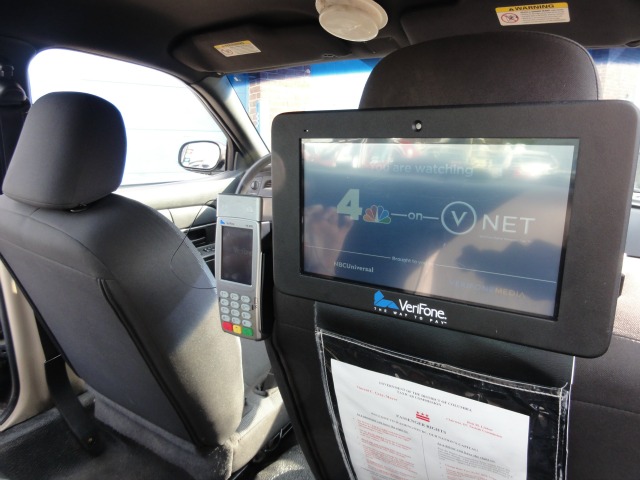
The D.C. Taxicab Commission says that every last one of the city’s 7,300 cabs will definitely, officially, and totally for real start accepting credit card payments this summer. The commission voted to approve proposed regulations requiring the installation of backseat devices—sometimes known as “smart meters”—in every taxi by Aug. 31, finally allowing customers to not have to worry about leaving a lousy cash tip.
And while many taxi riders might be celebrating the forthcoming convenience, that wasn’t the only edict handed down by the DCTC today. Another regulation approved today raises the “drop rate”—or base fare—from $3 to $3.25, and reinstates a $1 charge for additional passengers. The increased fees will pay for commission programs including enforcement actions, according to a commission news release.
Credit card payment systems were first authorized by legislation passed by the D.C. Council last year, and while the smart meters were originally supposed to be in place by late 2012, the process was delayed when a $35 million contract to credit card reader manufacturer VeriFone was tossed out. Instead, 10 companies, including VeriFone, have been approved to provide smart meters to the cabs.
D.C. Taxicab Commission press release:
The DC Taxicab Commission (DCTC) voted today to require all DC taxis to accept credit cards and other forms of non-cash payments. The rulemaking approved for publication to establish the Modern Taximeter System (MTS) is expected to become effective on May 31, 2013.
Installation of MTS is projected to begin June 1, 2013 and all taxis should be equipped with the appropriate equipment by August 31, 2013. In addition to offering an enhanced customer service experience, MTS will provide DCTC with valuable data and driver verification. The $0.25 passenger surcharge to support DCTC programs, enforcement actions and administrative services will also be collected by MTS.
The MTS regulations provide some assistance to offset any costs associated with implementing MTS. The Commission is authorizing an additional passenger fee of $1.00 for more than one rider; however all other extra charges – except the Snow Emergency Fee and Telephone Dispatch Fee – have been eliminated. The flag drop rate will also increase from $3.00 to $3.25.
Personal Information Monitors (PIMs) that will offer news, local current events, public service announcements and possibly advertising will be installed by December 1, 2013. Safety mechanisms will be added by June 1, 2014.
The Commission prepared a “Determination and Findings” document that outlines the depth of research and analysis underlying the MTS regulations. Included among the conclusions are the rationale for reducing the passenger surcharge from $0.50 to $0.25; the sharing of the $0.25 with drivers to alleviate the cost to transition to MTS while not increasing the cost to riders more than expected; the projection that driver revenue will increase by 2% to 4% after costs for MTS and the new dome light; and the MTS must take into account the needs of disabled passengers to ensure access to the cashless system. The technical considerations ensure that vehicle owners and drivers, digital reservation services and payment service providers, all have crucial roles in the industry and must fit together with the MTS similarly to an ecosystem.