 Getty Images
The District’s motto of “Taxation Without Representation” might have some extra bite today when members of the royal families of two European constitutional monarchies sweep through the city.
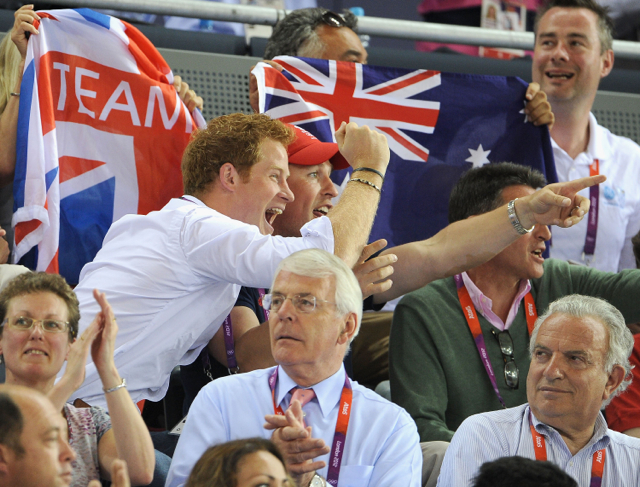
Prince Harry, who singlehandedly breathes life into the dreary old House of Windsor, will be making stops today at the U.S. Capitol, National Military Medical Center, and Arlington National Cemetery. Harry, 28, is visiting the United States on behalf of the HALO Trust, an anti-landmine charity of which he is the royal patron. (Harry’s mother, Princess Diana, was a major benefactor of the organization, too.)
But if that’s not enough royalty, today’s game of thrones also includes the Swedes. King Carl XVI Gustaf and Queen Silvia are on a U.S. visit, and today they’re hitting up several federal cultural landmarks. The Associated Press reports Carl Gustaf and Silvia will be swinging by the Library of Congress, the National Museum of the American Indian, and finally the Kennedy Center, where they will take in a performance of the Washington Ballet’s interpretation of Ernest Hemingway’s The Sun Also Rises.
The Swedish royals were in New York yesterday, and are touring the U.S. to mark the 375th anniversary of the founding of the New Sweden colony in what is now Wilmington, Del.
UPDATE, 10:39 a.m.: The paths of the visiting royals aren’t expected to intersect today, but should they, here’s a bit of history on the relations between Great Britain and Sweden. The two nations have been allies—or at least neutral of each other—for more than three centuries. With one exception: Between 1810 and 1812, the the two countries were at war.
The Anglo-Swedish War was a nearly bloodless conflict Sweden was forced to instigate after losing previous wars to Russia—thereby ceding control of Finland—and to France, which was then at the height of its Napoleonic power. As a signatory to the 1810 Treaty of Paris, Sweden became allied with France and was obligated to declare war on Britain, or else face a Gallic invasion.
But Sweden’s shotgun marriage to France collapsed after a new crown prince took over later that year. Jean-Baptiste Bernadotte, later King Carl XIV John, sued for peace with Britain in 1812, ending the paper war. The conflict’s only bloody moment, history records, was actually a bit of Swede-on-Swede violence when a zealous major general put down a riot in opposition to a conscription order issued in the (unlikely) event of a British invasion. Forty farmers in the tiny village of Klågerup were killed by Swedish troops.