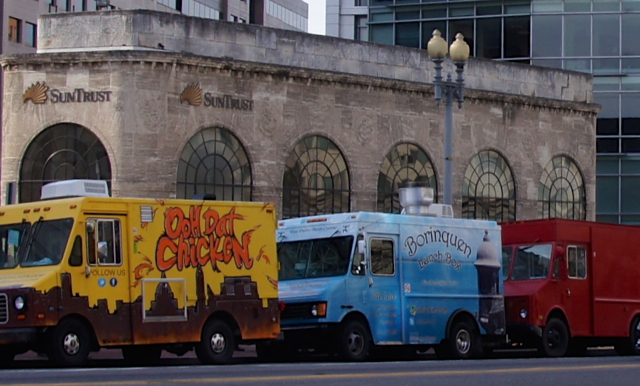
 Photo by Ted Eytan
The D.C. Council hearing on the proposed regulations over mobile vending is happening today, and it should be a classic legislative marathon. More than 60 witnesses are scheduled to testify before the Council’s Business, Consumer, and Regulatory Affairs Committee.
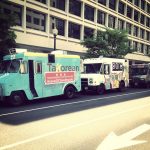
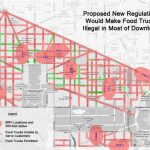
A trade group representing more than 100 food trucks has mounted a visible public campaign against the proposed regulations, which are now in their fourth draft since first being proposed more than a year ago. Among the rule-makings is the establishment of about two dozen designated “mobile vending zones” in which food trucks would be eligible to operate after going through monthly lotteries.
The Food Truck Association of Metropolitan Washington is leading the opposition against this proposed regulation, saying that limiting mobile vendors to these spots—which are clustered around busy downtown spots such as Farragut Square, Foggy Bottom, Chinatown, and L’Enfant Plaza—and forcing any truck that does not win a lottery spot to remain at least 500 feet outside the designated zones would drive its members out of town or out of business. But city officials told The Washington Post today that in total, the designated vending areas would create 150 spots, more than enough to accomodate all the food trucks currently in operation. Food trucks outside the lottery zones could park in legal spaces, but only for the maximum amount of time permitted by that block’s rules, and only on blocks where the sidewalks are at least 10 feet wide.
That last detail is one of the Food Truck Association’s biggest gripes. “Proposing that they must have 10 feet of unobstructed sidewalk in order vend and creating a potential infinite number of lottery-assigned spaces directly interferes with their ability to meet that demand,” John Gaber, an urban planning professor at the University of Arkansas, said at a Food Truck Association event before today’s hearing. “Food trucks are great things for communities; they provide more ‘eyes on the street’ for public safety and compliment the surrounding brick-and-mortar businesses.”
Supporters of the proposed regulations, including the Restaurant Association Metropolitan Washington, have said that the food truck group is “misleading” in its opposition. Pedro Ribeiro, a spokesman for Mayor Vince Gray, says there is a lot of hyperbole on all sides of the argument.
“Everybody needs to take a step back,” Ribeiro tells DCist. “We’re ensuring public space remains public space.”
Ribeiro argues the proposed regulations would leave food trucks in a better position than the rules that currently govern their industry—the city’s existing guidelines for ice cream trucks, which are required to have customers lined up as soon as they park or be forced to move elsewhere.
“We’re not trying to put anyone out of business,” Ribeiro says.