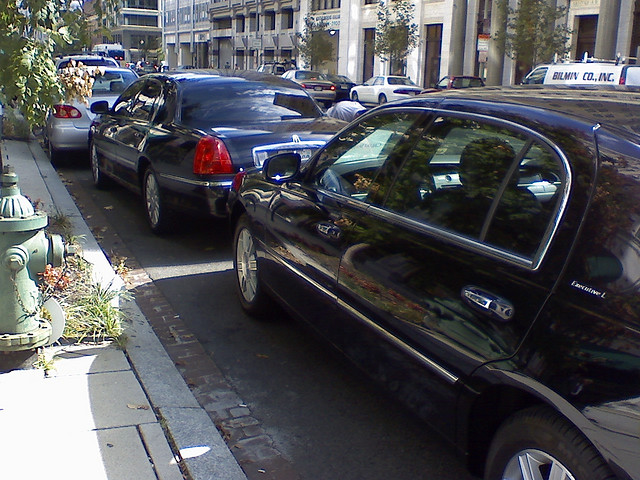
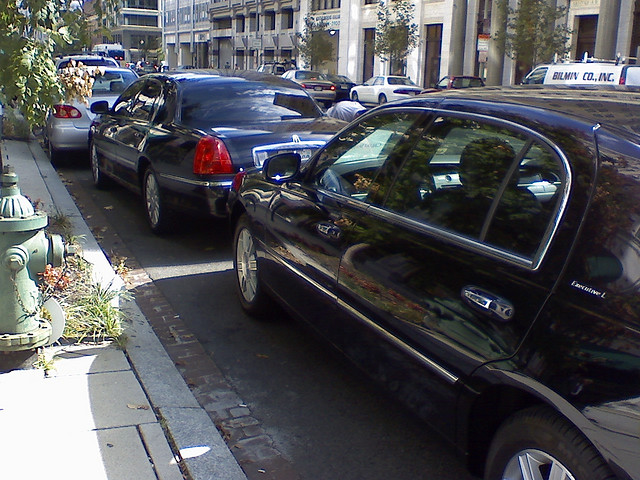
 Photo by Dan Macy
Just when we thought there was comity in our time, the clash between Uber and the D.C. Taxicab Commission is heating up again. This time, Uber says that the regulations the commission adopted last week to finally clear the way for cabs to accept credit cards contain provisions that will severely hamper the livery-by-smartphone company’s business.
As The Washington Post’s Mike DeBonis first reported, the regulations require credit card fares to be made through “payment service providers” that are integrated into a cab’s meter system. But Uber is taking issue with that, saying that its mobile application would not meet those requirements, imperiling its taxi dispatch service that began in D.C. in January.
Uber’s taxi service works the same way as its flagship sedan service: A customer punches up the app, finds a map showing the nearest affiliated drivers, and requests a ride, which is paid for by automatically charging the fare to the customer’s credit card on file with Uber’s billing department.
But Uber argues that the the taxi regulations issued last week, which go into effect June 1, would require it to link its payment system to the payment providers integrated into the new meters that taxis will begin installing this summer. If a workaround cannot be found in the next two weeks, Uber says it might have to axe its taxi service in two weeks.
“The way they set up these regulations is that on June 1, Uber’s system where you push a button get a cab and get in one and get out of the car and the payments are electronic, that’s gone,” Uber CEO Travis Kalanick tells DCist. “There’s only one payment service provider in the car.”
The new regulations address the issue somewhat, stating that digital reservation services—such as Uber—are permitted to associate with one or all payment service providers that are integrated with the various brands of “smart meters” that cabs will be adopting. However, Uber already has a payment provider. In public comments the company submitted to the Taxicab Commission during the review period for the regulations, it noted that it has a third-party company process the credit card payments it accepts from customers.
As a result, Kalanick now says that come June 1, his customers will be put out, but so will many drivers.
“We’ve got hundreds of drivers who are making more than $500 extra a week,” Kalanick says. “This is how they put food on their tables. The riders are hurt by this, it’s a bigger hit to the drivers I think.”
So Uber is once again lobbying the D.C. Council, approaching Councilmember Mary Cheh (D-Ward 3), who chairs the Council’s transportation committee and was a key actor in last year’s Uber fights. (Sometimes as an ally, sometimes as an enemy.) The company also launched a petition on its website today, beseeching its wired customers to hit up D.C. officials with their support. Uber has had some success in mobilizing its customers to flood city leaders with phone calls, emails, and tweets, as it did last year when it directed an avalanche of communication in opposition to a bit of Council legislation that would have forced it to implement a price floor on its black car service.
For now, though, Cheh tells the Post she hopes Uber and the Taxicab Commission can work it out among themselves. But just in case, Councilmember David Grosso (I-At Large) says he is drafting emergency legislation.
But for his part, Kalanick is anticipating another showdown. “We thought this was done in December when the law passed,” he says. “But we’re back in it. I’m sure we’ll be in D.C. soon.”
And if the taxi squabble isn’t enough, Kalanick is also preparing to deal with draft regulations that would define the types of vehicles that can serve as livery sedans. Among them, a proposal that would restrict vehicles that weigh less than 3,200 pounds from serving in a sedan fleet. Kalanick says that weight limit would rule out cars with hybrid engines, which are several hundred pounds lighter than their gas-guzzling counterparts.