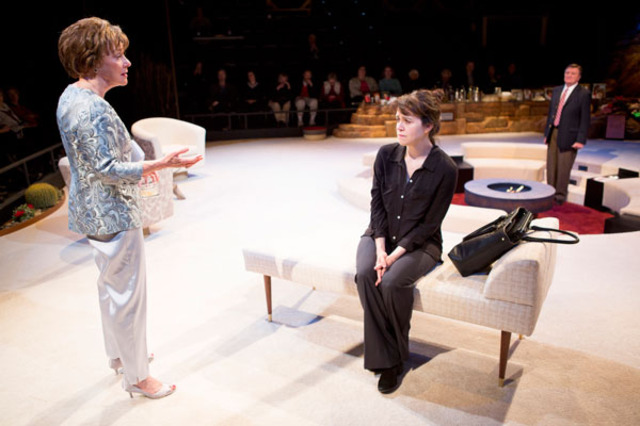
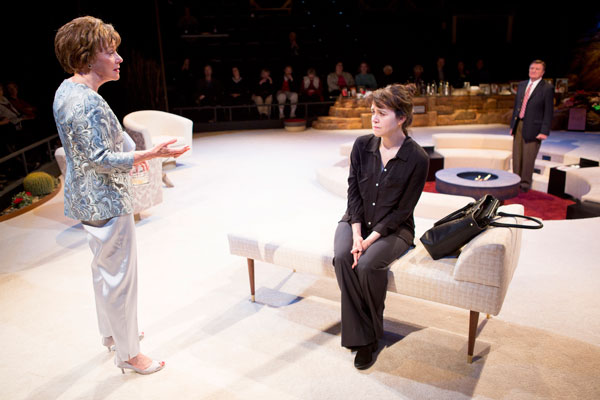
 Helen Carey and Emily Donahoe, with Larry Bryggman, in Other Desert Cities. Photographer: Scott Suchman
The protagonist of Jon Robin Baitz’s Pulitzer finalist Other Desert Cities Brooke Wyeth (Emily Donahoe), is a little hard to sympathize with at first.
What we mostly know about her in the beginning is that she occupies a spot in the 1 percent of writers. The kind who lives in Sag Harbor and gets sent on assignment to Sri Lanka for Gourmet Magazine.
Brooke is depressed, which makes her fairly narcissistic. “I’d probably make more money selling cashews in Central Park,” she quips, annoyingly.
Years after a follow-up to her successful first novel, after being side-tracked by a mental breakdown and a divorce, Brooke Wyeth is poised on the edge of a literary comeback—a memoir titled Love and Mercy: A Memoir.
And it is how the various details of the memoir, and the unspeakable pain on all sides of it, are revealed, which make this one of the more absorbing dysfunctional family dramas in a long while.
Set in the Palm Springs home of Brooke’s parents, Polly (Helen Carey) and Lyman (Larry Bryggman), the swanky, retro Western set by Kate Edmunds resounds with the sound of ice rattling in glasses of swanky, powerful alcoholics at a Hollywood/GOP elite party.
There is a shade of schadenfreude to their interactions, especially during the first act. It’s the kind of horror-glee that keeps the Real Housewives ratings up. Hey! These millionaires are even worse than we are!
But the white carpeting, “futuristic” Star Trek-like firepit, and a well-stocked bar the length of an entire wall are markers of a fortress designed to cover murky secrets with glitz.
You see, Brooke’s memoir threatens to blast open a painful, long covered, piece of her family’s history—the involvement of her older brother, whom she idolized, in a cult whose act of terrorism resulted in someone’s death — and provoked her brother’s suicide.
“I think living on the east coast has given you the idea that sarcasm is alluring,” Polly says at one point. As the steely matriarch whose willful survivalism and need for control threatens to crumble her relationships with her living children, Carey gives us a less brittle, much funnier version of Mary Tyler Moore in Ordinary People a role that shares some DNA strands with Polly.
(Best line: “It’s all or nothing with your generation. You’re either vegans or meth addicts.”)
But unlike Beth Jarrett in the Robert Redford Oscar winner, Polly grows more sympathetic as the audience’s understanding of her deepens. (Some will disagree and say she’s a monster; probably depending on how many Pollys you’ve had in your family.)
But Polly and Lyman’s chagrin at having their family story told by a subjective participant, their daughter, is valid in many ways. Though Brooke says she isn’t beholden to anything more than writing the story well, there is a kind of violation at the heart of every memoir: that in order to tell your own story, you must involve others, others who often don’t see the same experiences the same way.
More provocatively, this play centers on the phenomenon of families who are left behind to grieve loved ones who died too soon, which is already unspeakable. But on top of that, a layer that echoes of the all too recent Tsaranaev family, and before that the families of, say, Eric Harris and Dylan Klebold. How do you mourn someone who did something utterly horrifying?
“He was a happy child. Just like you,” Lyman tells Brooke about her brother, heartbreakingly.
Baitz asks what happens along the way to make so many children turn into such unhappy—sometimes violent, deranged—adults. And, more importantly, asks whether each little chip at that happiness is worth examining and attributing. And whether that’s something worth telling the whole world.
At Arena Stage through May 26.