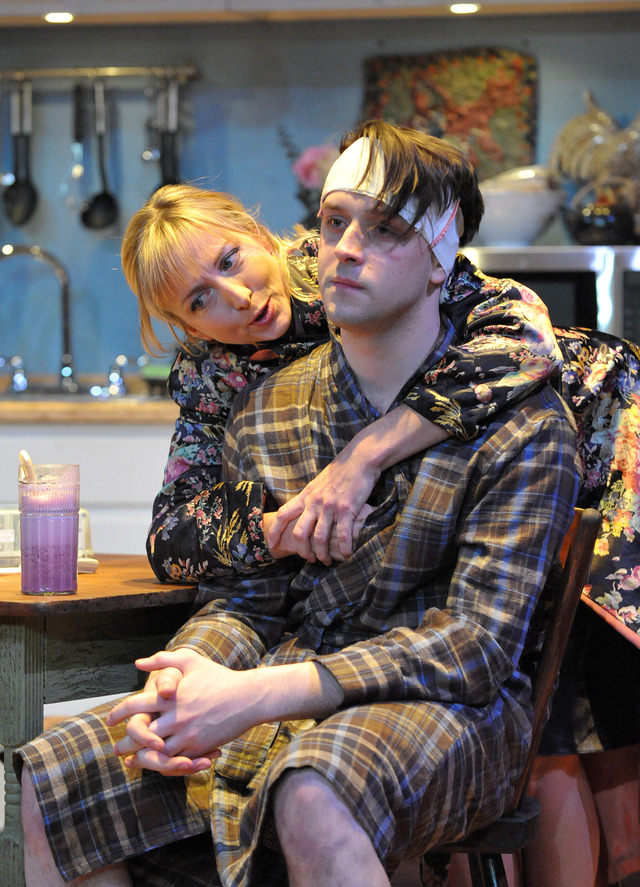
 Kate Eastwood-Norris and Brad Koed are dysfunctional mother and son.
At one point in Stupid Fucking Bird, Aaron Posner’s splendid, irreverent adaptation of Anton Chekhov’s The Seagull, Cirque du Soleil—the touring Canadian circus—gets compared, convincingly, to a hand job.
“I mean, there’s some pleasure, but nothing worthwhile has been… exchanged,” argues protagonist/bird shooter Conrad (“Constantin” in the Chekhov).
This is during a discussion—one of many meta moments—about “new forms” of theater and whether it’s possible to create them, a concept around which the play’s humor and subtext revolves.
While Posner’s final product may not be a new form altogether, it is certainly a refreshing splash of cool water on dry, well-trod terrain. Put it this way: As fine as the 2008 Royal Court Theatre’s mounting of Seagull was on Broadway, with Peter Sarsgaard and Kristin Scott Thomas in the lead roles, that was positively mopey in comparison to this.
Stupid Fucking Bird is what you get from a writer who not only adores the material he’s adapting, but understands it precisely.
“Start the fucking play!” kicks things off. And start it fucking does.
Crackling with electricity, Brad Koed’s Conrad seethes with thwarted creativity. He’s an aspiring playwright trying to eclipse, or even just prove his worth to, his famous actress mother, Emma, who resents her progeny in part because he’s a reminder of her age (“Dye and Botox can’t make me go away,” he explains).
We begin as Conrad is prepping a “site-specific performance event” called Here We Are, starring his aspiring actress girlfriend Nina (Katie Debuys), who’s hungry for meaningful art.
“You’re a genius!” “You’re awesome!” They gush at each other, more in love with the idea of being in love than in love with each other. But it’s sort of innocent and cute.
Unfortunately, Con’s work is as destined for failure as its description implies. Here We Are, which uses smoke and electronic music (very Cirque du Soleil-like) and amusingly forces Nina to squeeze the life out of the line “here we are” over and over as if it’ll provoke a revelation:
“Here we ARE. Here WE are. HERE we are.”
As one character says later, trying to be helpful, “I felt very… here.”
The world of countryside community theater begins with Conrad and Emma (whose narcissism the wonderful Kate Eastwood-Norris anchors in a kind of oblivious disregard for others who aren’t as naturally imbued with her formidable strength and charm).
It extends out to a range of supporting players, who each get their earned moment in the summer sunlight. In particular: Emma’s brother, Sorn (Rick Foucheux), a doctor longing to be young again (“I’m ready to do my late 20s really well now”), who gets laughs just from the way he drops olives into a martini; and Mash, played with cheeky ruefulness by Kimberly Gilbert, who utters that beguiling line from the opening of The Seagull, “I’m in mourning for my life.”
It is also Mash who ties each act together, as she copes with unrequited love via equal parts alcohol and sarcasm, strumming deceptively cheery-sounding ditties on her ukulele, with painfully direct lyrics like, “Life is disappointing.”
What’s so deeply satisfying is that this is no “modernization” or “rewrite” of Chekhov, but simply Chekhov extended. Posner fully absorbs the odd, dark, misunderstood comedy from the late 19th century, which, when it debuted, was so poorly received that the actors couldn’t hear themselves over the booing.
(“The theatre breathed malice,” Chekhov famously wrote afterward. “The air was compressed with hatred, and in accordance with the laws of physics, I was thrown out of Petersburg like a bomb.”)
Just as in The Seagull, Con’s relationship with Nina disintegrates after the embarrassment. Then Nina gets wrapped around the pinky finger of a genius short story writer with questionable lady ethics named Doyle Trigorin, who’s also Emma’s longtime lover.
But then Posner begins to tickle us behind the ears.
In desperation to win Nina back, Conrad turns to us, the audience and beseeches, “Does anyone have any ideas? I’m serious!” On the night I attended, when people finally realized that, yes, they were allowed to respond, the volume of recommendations was so thick that he quickly retorted with, “Okay, one at a time, please!”
These suggestions included to ignore her, make her jealous, “work it out with your mom,” “kill Trigorin” and to “chill the fuck out.”
You’ve got to imagine that one of these nights someone is going to say, “Kill a seagull.”
The play’s most intriguing asset, perhaps, is this break through the fourth wall, as well as the effortless way in which various interludes from linear action rearrange our expectations. Which does not, happily, feel merely like one of those show-offy, “Hey look at us breaking conventions!” moves.
“We see everything you do here,” Conrad tells us. “Like when you checked your playbill to see if I’d done something at the Studio…”
It’s good medicine, as we sit in the dark, to ask what we want from this whole experience exactly. Yeah, sure, there’s a script. But should anyone be forced to do what they don’t necessarily want to do? Does anyone’s motivation ever make sense the way it’s planned out? As Conrad yells at the pop art of Chekhov’s face, stenciled on the back wall of Misha Kachman’s set: “Love you. Fuck you.”
But. Here we are. Now go see this. Or get a hand job from Cirque du Soleil.
Stupid Fucking Bird. By Aaron Posner, adapted from The Seagull by Anton Chekhov. Directed by Howard Shalwitz; at Woolly Mammoth Theatre Company through June 23.