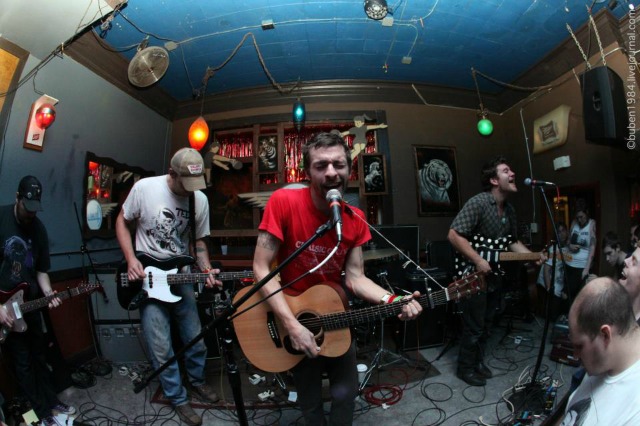
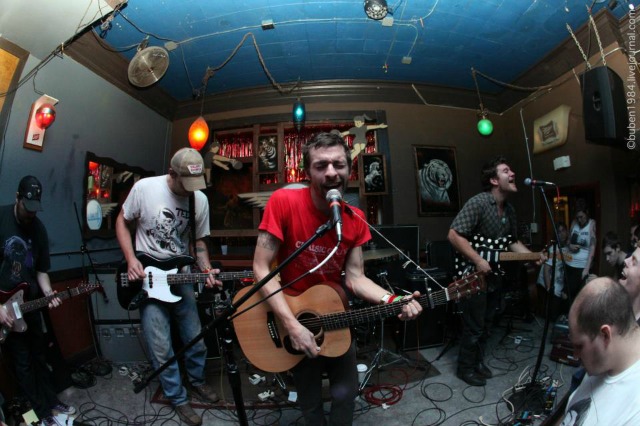
 Photo courtesy of the Pygmy Lush Facebook page
The last time Sterling, Va.’s Pygmy Lush took the stage in D.C., audiences saw the quiet, introspective version of the band. Their last release, 2011’s Old Friends, is a forlorn and beautiful guitar opus. However, Pygmy Lush is not all carefully arranged slow burners. Their initial work harkened back to the louder and more raucous days that Chris Taylor, Mike Taylor and Johnny Ward spent in Pg. 99. That underrated band incorporated hardcore vocals with sinister wall-of-sound guitar riffs and paved the way for bands like Deerhunter. Additionally, Pygmy Lush has been announcing on their Facebook page that the upcoming show at St. Stephens will be the first “Loud Lush” show they’ve done in years. It should be a treat to see the band shake off the shackles of melancholia and let loose. We talked to singer and guitarist Chris Taylor about the songwriting process and being in bands with his brother.
Find them online: Facebook
See them next: Tomorrow night at St. Stephen’s and the Incarnation Episcopalian Church with Screaming Females, Priests, Jail Solidarity, and Cane & the Sticks
How does the writing process work for you guys?
I don’t know. We’ve done it differently. It kind of changes but this particular writing process is similar to Mount Hope in which we rented a cabin in the Blue Ridge Mountains for a week with everybody kind of chipping in. We brought a bunch of food and we just kind of nailed ourselves to the idea of writing. Although we just kind of hung out and then picked up the instruments and things would come out but we didn’t have any regiment or anything. It wasn’t regimented. When everybody got bored, we’d pick up all the guitars and drums and start messing around. Old Friends was like a blitzkrieg. I think Mike wrote one or two songs but me and Johnny wrote six or seven a piece by ourselves and then brought them to each other. We kind of spent a beach trip two years ago sitting in a room playing the songs we wrote alone together and then we GarageBand-ed them or something and brought almost a whole record in its entirety to the other three guys. They put bass, drums and guitar on it pretty quick. After that final beach trip where we got it to the whole band, it took about three weeks to add everything else and we just kind of blitzkrieged it. It was just quick. I actually don’t remember but I think Bitter River was just a slow process of songs accumulating and then getting worked out. But I think we’re going to go back to Mount Hope. We got this trailer on a farm that the bass player kind of just moved out to. It’s totally isolated; it’s off the Potomac River in Lucketts, VA and it’s beautiful. It’s solitary and we’re going to do long weekends where we lock ourselves in and be a little less intentional about it and a little more spontaneous.
It’s funny that you say “intentional” because that’s how Old Friends sounded to me; very intentionally arranged.
Yeah, that would be accurate. It was just so put together. For the six or seven songs that I wrote, all the vocals and all the root notes were there. Same with Johnny. He had all of his vocals and all of the root notes. It was a real rough time for a couple of us for a multitude of reasons. It was another real big transitional period in some of our lives. It’s almost like we needed to get it out to stay a band, in a way. It was intentional in that regard. It wasn’t exploratory, really, at all. It was a business-like approach: real direct. We didn’t really get creative until we got to the studio and started adding bells and piano or extra vocals. Aimee Argote sang on a whole bunch of that. That was less intentional and more spontaneous in that regard. I almost feel like I don’t have too much ownership on the things that come out, songwriting-wise. I really do think it’s opening yourself up to something that’s already there and it’s running through a filter of your own personal experiences. I feel like it’s a river and you’re holding a fishing net out. It’s already there, you’re just tapping into it. An antenna too, where you just pick up on a frequency that’s already there and you’re running it through your filter. It’s weird to admit that something we do is intentional, but I think in our process or in our group way of going about it, it definitely works more that way. It’s less a real in depth discussion of what it’s doing and more, “Okay, that’s good. That’s it.” Then we move on.
Have you always been in bands with your brother?
I’ve been in other bands without him and he has without me but all the bands I’ve spent the most time in. Nitpick, our early high school band, our drummer Eric and my brother and I were all in Nitpick. Then in Pg. 99, Mike and Johnny were both in that band, too. The longest tenured bands have been with my brother.
I always wonder how the creative dynamic works with someone that’s in a band with a sibling. Can you speak on that?
I imagine it’s probably similar to a lot of other folks. It’s kind of hard to define because it kind of evolved and it changes constantly as to what that dynamic is. I think we’re odd birds in that we really are best friends. When me and Mike were little kids, we did that when we were five and six. Playing with stuffed animals, we’d make an entire imaginary world and sort of be creative in that way. Since we’ve been in bands, it kind of comes natural to have these same interests and have these same influences and try to get as close as you can to what you feel is really cool.
We definitely have ups and downs in terms of clashing and sometimes we’re the problem in a band because we’re both really strong personalities and have real strong ideas about how things should be and sometimes they differ. Most of the time, especially in the past four years or so, we’ve been real locked in on the exact same thing. So, it’s pretty easy and it’s exciting. Mike in Pg. 99 used to write everything. He wrote every guitar part for every song in that band. I shared lyrics, but I wrote most of the stuff lyrically and drew a lot of the art. So, our aesthetic and our audible output was always coming from us. Johnny’s kind of irreplaceable, too. In Pg. 99, he writes his drums like a guitar player would.
With Mike and Johnny, their music writing relationship has always been extremely cathartic. When Mike talks about his perfect drummer, he always talks about Johnny just knowing him and knowing how he plays and knowing how to play with him. He doesn’t have to describe anything to Johnny for it to happen. It just happens. In Pg. 99, Mike did all the writing. He took sort of a backseat in Pygmy Lush. We kind of want to mess around with what he can do, writing-wise, but he’s sort of let me and Johnny take the reins in terms of writing. So, that dynamic changed but it still works in the same way. He still has really strong ideas about everything but it’s usually cool. There’s never really too much conflict there.
I can imagine the other guys reading this and being like, “Bullshit,” but comparatively, I’ve been in a couple of bands with folks that I’m not related to or that I haven’t grown up with and everyone’s going to have their conflict but it seems to flow really well with our group. I think it’s a byproduct of our friendship and our chemistry and knowing each other so well.
Sometimes I think that can be a little bit of a hindrance just in that you’re so willing to say whatever you think but you’re not going to filter it or candy coat it for anybody. Sometimes that can be hurtful but I think ultimately, everybody understands what the goal is. We go through a lot of things that seem like an argument but you have to do it to get through to your point. I think everybody understands that. It’s part of the process and getting everything functioning and working right. There are no grudges and no one is taking it personal.
Being from Sterling which is further out in Northern Virginia, do you feel much of a connection with the bands and music scene coming out of D.C.?
No. Ever since Pg. 99, we kind of felt uncool. Even though we’ve played a lot: we played Wilson Center and a lot of D.C. related things, but I never felt a part of it. There are bands from our area, from the Fairfax area that we grew up with that we’ve played with a lot and maybe we’ll tour with and they’ll be like, “We’re so and so from Washington, D.C.” and we’re like, “Uh uh.” Ever since I’ve been in a band, we’re like, “Hi, we’re so and so from Sterling, VA.” It’s weird for me to have a regional identity in a way but I do. I think it was Method Man who said, “Never forget where you came from because you have no idea where you’re going.”
I feel like where we came from is part of who we are. I don’t feel like we came from D.C. I don’t feel like it would be very fair of us to claim that we did either. I think D.C. has this thing about it where it’s the birthplace of hardcore and it’s very attractive for hardcore bands not from the area to say that they’re from D.C., that they’re a part of that. Ultimately, I don’t feel part of that at all. That’s not me. The thing that was going on in D.C. when I was active: we didn’t get invited a whole lot to things and there was a lull in D.C. for awhile. Pygmy Lush is much different. Pygmy Lush I feel like did get a welcome mat finally from D.C. We did play the Black Cat now and we do get asked to play a lot of things. I do feel welcome there and maybe a little bit of a connection’s starting to form but that’s just now happening. It hasn’t been there all along.