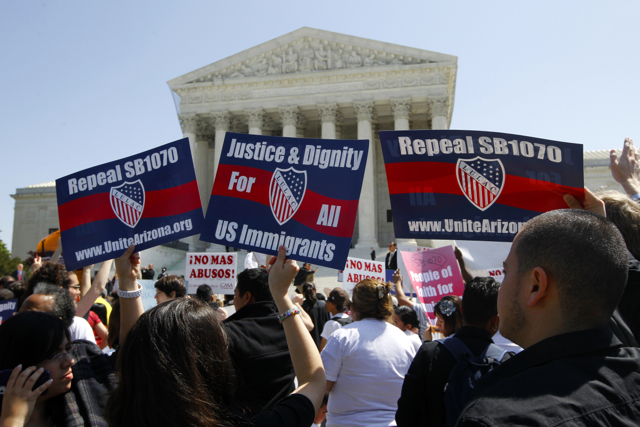
 Opponents of Arizona’s controversial immigration law outside the Supreme Court. (AP Photo/Charles Dharapak)
A new rule issued yesterday by the U.S. Supreme Court has a few observes worried that the top of the judicial branch is attempting to stymie protests outside its chambers. In fact, the court did issue a new rule yesterday banning demonstrations in its building and on its plaza, but only after a federal judge ruled that court rules that had been in place since 1949 were unconstitutionally restrictive.
Judge Beryl Howell of U.S. District Court for the District of Columbia ruled on Tuesday that the court’s ban on groups that “parade, stand, or move in processions or assemblages” was so broad, it could even be enforced against school and tour groups who visit simply for sightseeing purposes.
The law had been challenged by Harold Hodge Jr., a Maryland student who was arrested in 2011 while wearing a protest sign on the Supreme Court plaza. Lawyers for the Supreme Court defended the 1949 ban, saying it was needed to keep the entrances to the court clear of obstacles and to keep the justices inside free of external influences. But Howell ruled that was too loosely defined.
“The absolute prohibition on expressive activity in the statute is unreasonable, substantially overbroad and irreconcilable with the First Amendment,” she wrote in striking down the 1949 statute.
In response, the Supreme Court issued a new regulation yesterday, which focuses more narrowly on pickets and protests:
The term “demonstration” includes demonstrations, picketing, speechmaking, marching, holding vigils or religious services and all other like forms of conduct that involve the communication or expression of views or grievances, engaged in by one or more persons, the conduct of which is reasonably likely to draw a crowd or onlookers. The term does not include casual use by visitors or tourists that is not reasonably likely to attract a crowd or onlookers.
The court says the new regulation was approved by Chief Justice John Roberts. While it doubles down on pushing protesters outside the bollards that line the court’s grand plaza, in reality, that should not change the visuals of court activity that much. Demonstrations on the sidewalks, where most of the action on the court’s most high-profile days takes place, are as protected as ever.
Still the timing is nothing if not punctual. The Supreme Court will likely be the setting of more demonstrations later this month, when the justices make their widely anticipated rulings in two same-sex marriage cases.