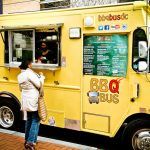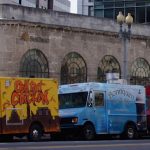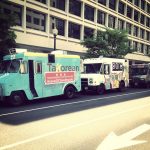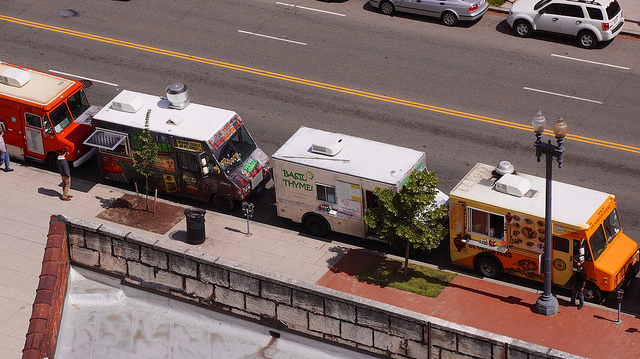
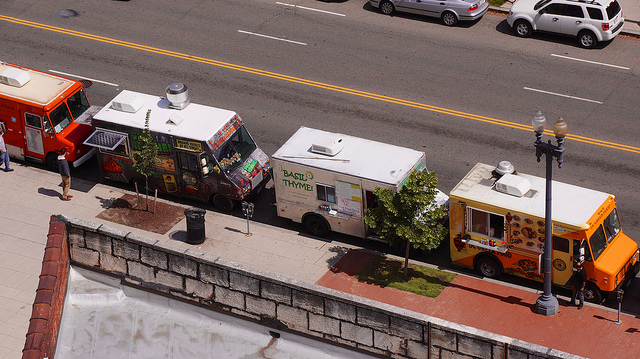
 Photo by Ted Eytan
The legislative saga that D.C. Councilmember Jim Graham (D-Ward 1) sometimes refers to as “one of the longest-running movies” in the John A. Wilson Building is finally near an end with the passage of amendments to proposed food truck regulations. The Council approved amendments that answer several concerns that mobile vendors have been raising since the fourth draft of the regulations was introduced in March.
The Council approved most of the regulations, at least the portions pertaining to food safety and labor standards, earlier this month. But after months of clamoring from the food truck industry, D.C. legislators elected to separate out several of the most controversial provisions.
As written, the regulations will create a network of designated mobile vending spots throughout the busiest parts of downtown D.C. where food trucks usually congregate, such as Farragut Square, Union Station, L’Enfant Plaza, and McPherson Square. The draft regulations originally proposed drawing 500-foot radiuses around the designated zones, which will be distributed through a monthly lottery. But the amended language approved today reduces the radiuses to 200 feet.
Additionally, the amendments adopted today reduce what is referred to as the “10-foot rule”—meaning that food trucks may only park along sidewalks at least that wide—to six feet, the same minimum width required of sidewalk cafés at brick-and-mortar restaurants.
With the vote, D.C. “moved a step closer in a process that has dragged on for years,” says Che Ruddell-Tabisola, the political director of the Food Truck Association of Metropolitan Washington, an industry group that mounted an intense social media and advertising blitz to rally food truck customers against portions of the proposed regulations. The process isn’t entirely finished, though, as the regulations still need Mayor Vince Gray’s signature, and then will have to be implemented.
“The devil is in the details,” Ruddell-Tabisola says. “Today is day 95 since the regulations were first published.”
Rob Frommer, an attorney with the libertarian Institute for Justice who consulted the Food Truck Association during the regulatory process, says the amendments to the regulations eliminate an “existential threat” to D.C.’s mobile food vending scene.
“The rules that were proposed would have made D.C. the worst food truck city in the nation,” he says. “This is a good compromise that protects public health and safety while leaving trucks free to serve their customers. This was a long and arduous process.”
Had the regulations sailed through as published in March, Frommer says, “thousands of people would have been worse off,” including, he adds, hundreds of people who work for the 150 or so food trucks that circle D.C. every day.
Councilmember Tommy Wells (D-Ward 6) introduced two additional amendments aimed at clarifying a few persnickety details about how parking restrictions will be enforced on food trucks. As originally written, the regulations state broadly that any parking violation is subject to a $2,000 fine. Wells’ first amendment reduces the fine for expired parking meters—which food trucks will be required to feed when not at one of the lottery-determined spots—to $50. The second amendment stipulates that when food trucks are looking for a sidewalk of acceptable width, a parking meter will not count as an obstruction upsetting the six-foot rule. Both of Wells’ amendments passed.
All that remains is a signature from Gray (though the regulations will also go into effect if he elects to do nothing) and an implementation period, but with today’s vote, food trucks will, more than four years after the industry blossomed, finally have their own set of regulations. And D.C.’s legal code will finally differentiate between an ice cream truck—rules for which all mobile food vendors are currently subject to—and a truck that serves a hot, savory lunch.