 Frank Gehry via Dwight D. Eisenhower Memorial Commission
By Julia Langley
The Dwight D. Eisenhower Memorial Commission voted unanimously to approve Frank Gehry’s controversial design for a memorial to the World War II Supreme Allied Commander and 34th president.
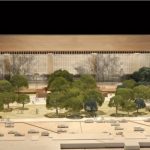
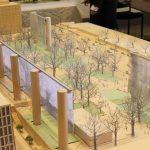
The project, to be built across from the National Air and Space Museum and in front of the Department of Education, now proceeds to hearings at the U.S. Commission of Fine Arts next month, and the before the National Capital Planning Commission this fall. From the meeting’s outset, it was clear that the commission stood united behind Gehry’s design and wanted to move forward after years of years of criticism, including some from members of the Eisenhower family.
Gehry, who said he never writes a speech, composed one for yesterday’s meeting, saying it was important that he “state clearly what I believe
“I come here today more humbled than ever to present the evolution of our design for the Eisenhower Memorial,” he said. “I have spent the last four years immersed in Eisenhower’s words, and the words of those who have shaped how history will define him. These two perspectives are often at odds—one modest, the other monumental.”
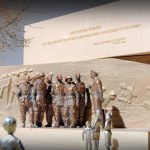
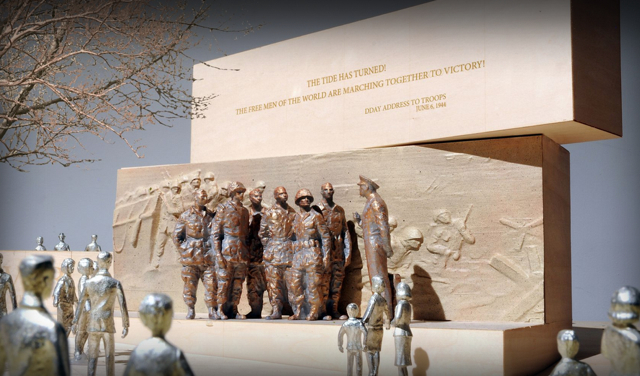
John Bowers, a partner at Gehry’s architecture firm, presented some changes to the frequently nitpicked design. The proposed memorial’s blocks once again feature bas-relief sculptures featuring scenes from Eisenhower’s childhood, military career, and presidency. On the presidential side, the new bas-relief shows Eisenhower signing the Civil Rights Act of 1957, with a bronze sculpture of him standing in front. On the military side, a new sculpture depicts soldiers storming the beach at Normandy. The bronze sculptural group in front features General Eisenhower addressing a standing group of soldiers.
A sculpture of a teenaged Eisenhower sitting on the wall connecting the two memorial blocks has been changed to look toward his future achievements as president.
Asked about the status of the 80-foot tall metal tapestries depicting images of Eisenhower’s hometown of Abilene, Kan., Bowers responded that testing and study continues and the results should be ready to present to the National Capital Planning Commission in July.
Once the changes to the memorial were presented, Rep. Mike Simpson (R-Idaho) read a letter from Susan Eisenhower, the president’s granddaughter and one of the design’s most visible critics, asking the commission to stop work on Gehry’s “controversial” design and vote to hold an open competition for a new memorial. Rocco C. Siciliano, who chairs the the memorial commission, replied that while Susan Eisenhower’s concerns were noted, they are not enough to halt the project. “The family deserves to be heard but they do not deserve to be obeyed,” Siciliano said.
Sen. Pat Roberts (R-Kan.), who said he was charged with carrying the process forward by the late Sen. Daniel K. Inouye, a decorated World War II veteran who was the commission’s vice chairman, said that he was trying to be an honest broker for the project.
“Sometimes you can work things out and sometimes you can’t,” Roberts said. “Starting over is not an option. We have to move forward.”
A House subcommittee approved a bill on June 12 calling for a new design competition for the memorial. The bill also calls for the replacement of the commission’s current members and giving the Eisenhower family considerably sway over the process, though its prospects for consideration in the full House or the Senate are unlikely.
In addition to accepting Gehry’s design, the commission also approved the use of excerpts from Eisenhowers’ Guildhall Address in London in 1945.