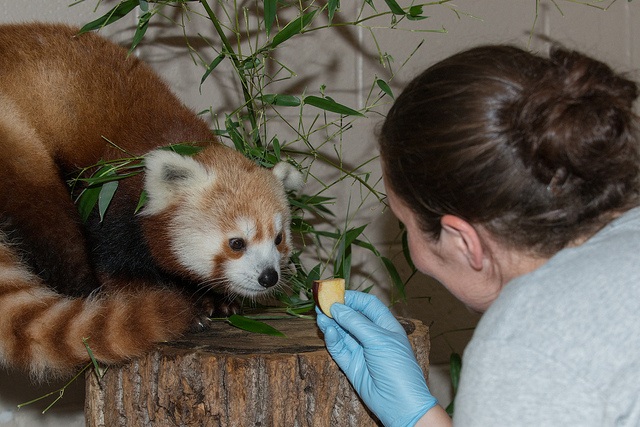
 Photo via Smithsonian’s National Zoo
Just how does a red panda manage to get out of an exhibit that the National Zoo’s staff previously considered practically escape-proof?
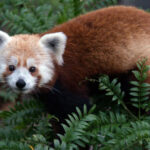
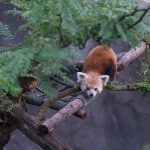
In the case of Rusty, the red panda who went missing late Sunday and turned up Monday afternoon in some bushes in Adams Morgan, all it takes is a bit of rain. The zoo says that Rusty most likely got out by climbing up the water-logged limbs of the trees that fill his exhibit, and proceeded to scramble over the perimeter. According to a news release from the National Zoo, heavy rain last Sunday morning lowered the branches on the trees in the red panda exhibit, making it easier for Rusty—a member of a species with a preternatural habit of tree-climbing—to reach the the tall bamboo plants on the exhibit’s exterior.
“Because of his climbing ability and agility, it is likely that Rusty was able to traverse out of the exhibit due to the bridge created by overlapping tree limbs and bamboo,” the release states.
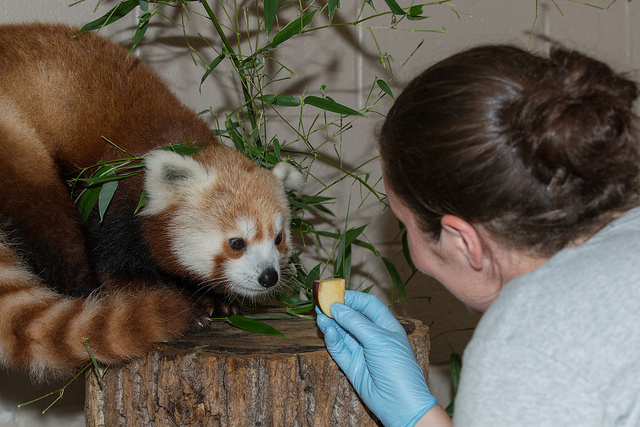
There are three trees inside Rusty’s exhibit, two honey locusts and one amur cork, and there is also a nearby grove of black bamboo, which is a favorite food of red pandas. Zoo staffers surmise that Rusty, upon starting his climb on the swollen trees, made his way for the bamboo in hopes of getting a snack.
But that’s as far as Rusty’s surmised escape route goes. Zoo staff investigating how he got out could not find any tracks.
Rusty is still behing held at the zoo’s animal care facility, and the veterinarians attending to him say he is in good health following a rabies booster vaccination. The zoo says the dexterous red panda is on track to be returned to the exhibit he shares with his companion, Shama, by July 4.
In the mean time, though, the red panda exhibit, located along the zoo’s Asia Trail, is being modified. Not surprisingly, the trees and the bamboo plants are being trimmed so as to limit the red pandas’ climbing area, while an additional visitor barrier is being added to the top of the exhibit so as to create an additional 30 inches of tree-free space.