 Photo by Benjamin R. Freed
In this town, there are some things of which you just need visual proof, no matter how many times government agencies say such things are in progress. Credit card readers in taxicabs almost certainly fit into that group.
But the installation of credit card readers in D.C.’s fleet of 7,300 taxis is underway, and yesterday, the D.C. Taxicab Commission—along with a few of the vendors approved to sell the requisite devices—showed off the progress. By Aug. 31, in order to come into compliance with recently enacted taxi regulations aimed at modernizing the fleet, every cab will be required to carry the equipment needed to, at long last, read a customer’s credit card.
Dustan Lawanson has been driving cabs in D.C. for 22 years. On Tuesday, his car was parked in the garage of USA Motors, a Southwest D.C. business that services taxis, being outfitted with the the new payment system. It was quite the contraption.
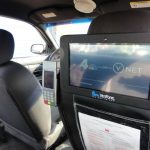
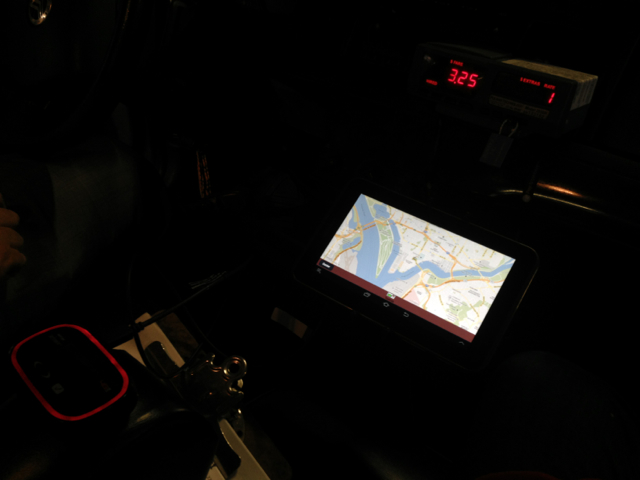
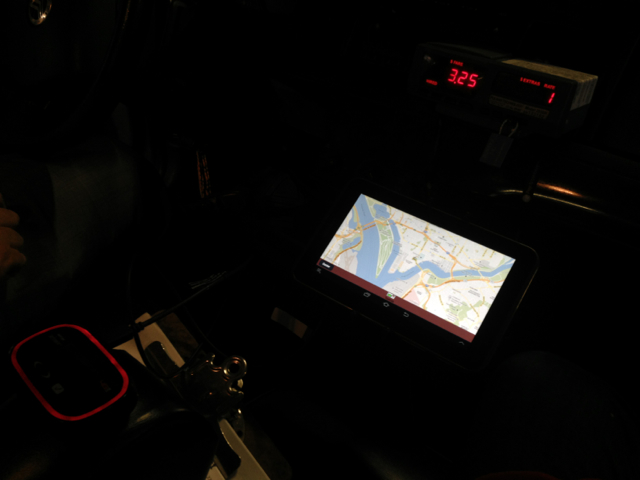
Flipping on the taxi’s meter seems as simple as ever, with the gray, dashboard-mounted box flashing the new base fare of $3.25 (and 25-cent surcharge to fund the DCTC), but the similarities to cab payments of old end there. The meter is linked, via a wireless Bluetooth connection, to a Samsung tablet device with a credit card reader plugged into its headphone jack.
Lawanson ran a simulated trip through the meter—we didn’t go anywhere—then punched up the payment options on his tablet, which was running software provided by TaxiRadar, a one of the first digital dispatch services approved by the D.C. Taxicab Commission under the new regulatory regime. Using this set-up, Lawanson will pass back the device to his passenger at the end of a ride, at which point the passenger will select how they want to pay: cash, credit card, or “external payment,” a technical term for charging the fare to the rider’s card on file with TaxiRadar.
Cash payments are unchanged. To pay by credit card, all one needs to do is select that option on the touchscreen, enter an appropriate tip, and finish the transaction. It’s shockingly novel for D.C. taxis in 2013.
In order to be an approved digital dispatch service under the new system, companies like TaxiRadar must use technology that provides real-time, GPS-guided trip information to both passengers and drivers and stores that data. In addition to TaxiRadar, Hailo, another company that makes a taxi-hailing smartphone app, have been approved. Other companies in that field, notably Uber and myTaxi, are resistant to the new requirements.
So far, about 500 taxis throughout D.C. have been outfitted with smart meters and credit card readers provided by one of the 10 vendors approved by the taxi commission to provide the devices, says Ernest Chrappah, a DCTC employee overseeing the implementation. USA Motors’ president, Balwinder Singh, says he is selling complete set-ups to drivers including credit card readers, tablet computers, and mobile wireless hotspots provided by Verizon. He is aiming to sell 500 by July 24.