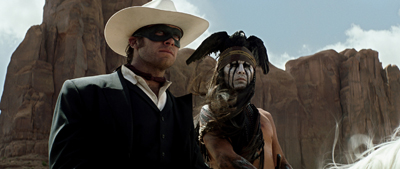
 Armie Hammer and Johnny Depp (Disney)
A fanged rabbit eats a scorpion. It’s a vision of the American West as a feral landscape, where rules are made to be broken and cuddly animals scrape the desert of natural poisons. This stark view of nature would not seem out of place in a Werner Herzog movie. Imagine Herzog’s Lone Ranger, with a hammy Nicolas Cage stumbling drunk out of a saloon, a conflicted anti-hero. This is not that Lone Ranger, but, contrary to reports, it’s not the worst of all possible Lone Rangers. But at two and a half hours, it’s too much, and not enough.
The action begins in 1933, which happens to be the year the Lone Ranger radio serial began. The opening frames of the film show the building of the Golden Gate Bridge, a defining landmark of the new American landscape. It was a time when kids still dreamed of being cowboys. One plucky big-eyed kid, dressed as a miniature Wild West lawman, wanders into a carnival tent with dioramas of taxidermied wildlife. An exhibit called the Noble Savage seems to feature another stuffed costume, but lo, the American Indian speaks! And is Johnny Depp made up to look like a Muppet witch.
The aging Tonto frames the movie, narrating his unreliable version of history. As the sidekick tells it, John Reid (Armie Hammer) was a buffoon whose brother was the real hero. Dan Reid (James Badge Dale) is a lawman brutally ambushed in a canyon that anybody who knew the landscape should have taken for a trap. This easy setup does give the movie some of its rare color. William Fichtner chews up his scenes as Butch Cavendish, an outlaw with a taste for human flesh that marks him as a wendigo, a monster out of Algonquian myth, who in this case is sought after by a Comanche (Tonto).
This isn’t the first time Depp has played an American Indian. Anyone who remembers Jim Jarmusch’s Dead Man (directly quoted in a character’s “stupid white man” lament) will not even want to think about a comparison. Given Depp’s questionable lineage (he has claimed Cherokee or Creek blood, but he isn’t sure), this is one case where the original was more progressive. The Lone Ranger television show, which first broadcast in 1949, starred Clayton Moore as the Lone Ranger and a Canadian Mohawk, Jay Silverheels, as Tonto.
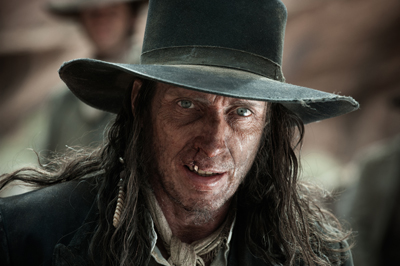 William Fichtner
The characters in this Disney update have the same names and find themselves in similar situations as their forebears, but it otherwise has little in common with the show. This is good and bad. Gone is the low-budget innocence, but the big budget is used for decent stunts, and a modern Western is a great excuse for some big-screen landscapes.
But good landscape is nothing without strong characters, and the hero is blandly written. When Armie Hammer gets to read dialogue like Aaron Sorkin’s in The Social Network, he commands authority, but he isn’t given much to work with here. Neither is the great character actor Barry Pepper, a natural pick for a contemporary western who’s wasted here. Fichtner’s Butch Cavendish is a strong villain, but it’s hard to muster much enthusiasm for such flat heroes.
The director gets one thing right. He waits for a climactic moment to use the iconic television theme music. It’s corny, but it’s probably the most thrilling moment in a movie that has its heart in some of the right places, but just can’t shoot straight.
—
The Lone Ranger
Directed by Gore Verbinski
Written by Justin Haythe, Ted Elliott and Terry Rossio
With Armie Hammer, Johnny Depp, William Fichtner, Tom Wilkinson, Ruth WIlson, Helena Bonham Carter
Running time 149 minutes
Rated PG-13 for sequences of intense action and violence, and some suggestive material
Opens today at a multiplex near you.