 After hearing the recent news that the current Congressional class has passed the least legislation ever so far, one might wonder (again): why is this so hard?
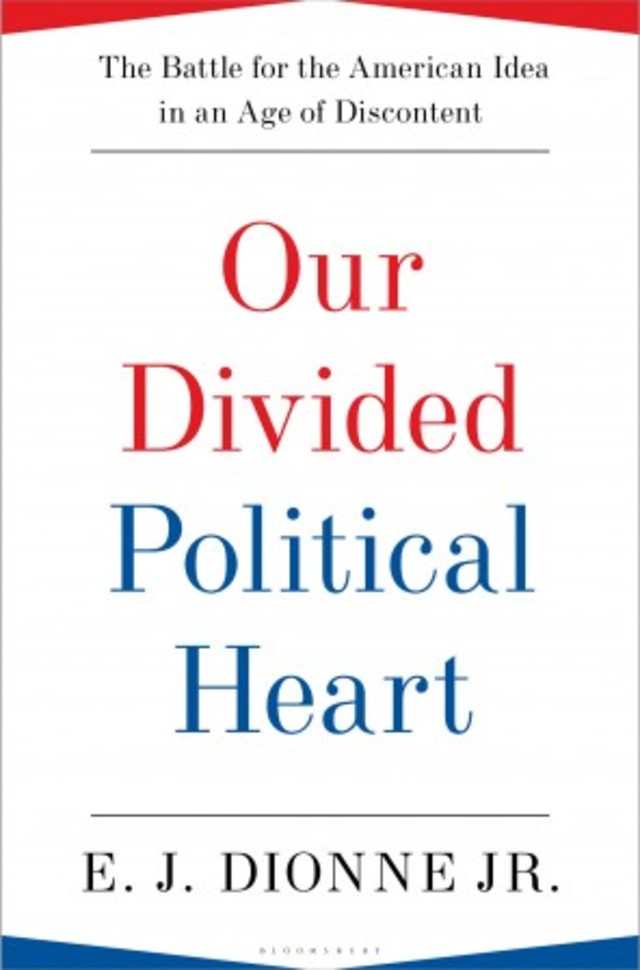
In his latest book, Our Divided Political Heart (Bloomsbury, May 2012), journalist and pundit E. J. Dionne seeks to answer this question by examining the U.S.’s cultural and political roots — which are a bit more twisted than we perhaps like to remember on patriotic holidays. Dionne will be discussing the book at 1 p.m. on Thursday, July 11, at the Women’s National Democratic Club at a speaker luncheon entitled “Our Divided Political Heart and How Washington Can Work Again.”
History has told us that Jefferson, Madison, Hamilton and Adams didn’t exactly write the Constitution while sharing a bowl of popcorn and high-fiving each other. But Dionne posits that the rose-colored hindsight we have on the U.S.’s formative years prevents our understanding that our political system has been up for interpretation since day one. The book provides some background on why “what the Founders intended” is not the best argument in shaping our beliefs and laws. What may be more useful, according to Dionne, is to be inspired by the Founders’ visionary boldness and preparation “to think and act.”
Additionally, he writes, Americans have long been defined by “an irrepressible and ongoing tension between two core values: our love of individualism and our reverence for community.” Both are crucial to most Americans (coexisting within our “political hearts”), and both serve as platforms in the main American political parties. The attempt to balance private ownership and government stems from a commitment to these values. Though Dionne clarifies that “government” too often gets labeled as a detached “them” when actually the Founders, Lincoln, the Roosevelts and others saw the point of democracy is that the government is “us.”
Fast-forward to the book’s section on movements to “take back” the government and drive change, such as the Tea Party and Occupy Wall Street. Dionne writes that both groups “were the product of the anger unleashed by the country’s economic troubles and the anxiety created by fears of American decline … both condemned the bailouts of bankers and financiers.” However, a distinct divide about who to blame kept this debate polarized. Dionne explains the impact of the movements, the role of the media, and the loaded idea of “populism.”
On the bright side, the author notes that these arguments and divisions are what make the U.S. unique, vibrant, and successful in many ways. They come with democracy and are part of the ongoing American “experiment” of self-rule. Our Divided Political Heart does not delve too deeply into what can be done to encourage cooperation and progress in the future, but given the name of the event, hopefully he will offer further insight there on what comes next.
Dionne has an opinion column in The Washington Post, and appears weekly on NPR, MSNBC, and regularly on NBC’s Meet the Press and other news programs. He has received many awards and was named one of the most influential Washington journalists by the National Journal and the Washingtonian. Our Divided Political Heart is his tenth book, receiving praise from both the right and left, and a plug from President Bill Clinton last summer. Dionne lives in Bethesda, Md. with his family.
The lunch starts at 12:15 p.m. and the talk is from 1 p.m. to 2 p.m. The cost for the whole luncheon is $20 for WNDC members and $30 for non-members; the lecture only is $10. The book will be available for purchase, and a Q&A and signing will follow. Registration is online here.