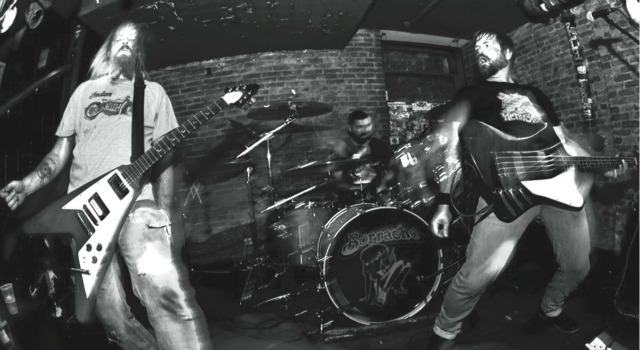
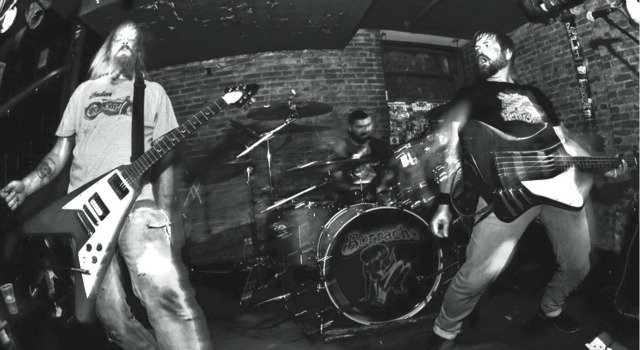
Photo courtesy of Constant Decay Photography
With a name like Borracho, it’s not surprising that Port City did a limited run of “Smokin’ Brown Ale” in the band’s honor. That said, don’t go to a Borracho show expecting a Black Lips-esque free-for-all. There’s nothing sloppy or disheveled about this heavy three-piece outfit. They indulge in drawn out hard rock with gruff riffs and a tinge of psychedelia, which explains the length of some of their tracks. Don’t let the Mob Gathering 7″ fool you, Borracho can easily go on for eight to ten minutes without simply repeating a three minute idea. We talked to singer/guitarist Steve Fisher and drummer Mario Trubiano (bassist Tim Martin was not present) about their following overseas and their take on heavy music coming back to the city.
Find them online: borrachomusic.com
Listen to their music: On Bandcamp.
See them next: Tonight at Rock and Roll Hotel celebrating the release of their new album, Oculus.
What’s the sound that you are you going for?
Steve: We’re going for a thick, heavy sound. I don’t think we go into anything with a preconceived notition of what we want. Most of the songs these days will start in a rehearsal. We’ll just start playing something and it will just evolve over time. It’s a great way to write which is nice. In previous projects writing was such a chore. “We’ve gotta write it out; sit down and write it out.” We have loose ideas of the direction we want to go, but we just let it evolve and kind of let that take us where we are.
Mario: And because our producer has mixed us live, I think that was a big part of it, too. It’s like being how we are in a live setting and being able to translate that to record. It’s not always all that easy and the kind of music that we play — the retro sound is real big, lo-fi, old school production — we’re not necessarily into that. A lot of our music is influenced by classic rock and classic metal. [Lo-fi]’s not an aesthetic that we’re going for and it’s very popular to do so right now but we don’t consciously go for that and maybe it’s not appropriate for the kind of stuff we play. I think the way we come across live is the way we want our records to sound anyway. It’s weird when you hear a band on record and when they play live it’s another animal.
How would you describe your live show?
Mario: Our tunes are kind of long, in general, and stage banter isn’t a huge part if you’re going to stretch into an 11-minute long song. We like to string tunes together, and we only have 30 or 40 minutes to play. For us, it’s like, “Let’s fit as many tunes in there as we can.” So bullshiting around between songs isn’t something we really try to do a lot of. So we try for “Here we are. We’re Borracho,” and start playing. Maybe we take a short break in between a couple of songs, but usually not. Usually we just kind of power through.
Steve: Most people come to see us, I assume, for the music and not for Van Halen with David Lee Roth where you’re trying to go see them for the showmanship. They’re a great band so you’re going for the music as well, but you’re going for the whole show, whereas I like to let the music kind of do the talking.
What is your philosophy behind releasing multiple 7”s and 10”s? It seems to be a popular format right now.
Steve: That’s the collector’s market that started that whole thing. Our last band put out like 35 7”s or something like that. It was all because the singer in the band was a huge record collector, and so we attracted a following of record collectors.
Mario: We’ve kind of carried that on a little bit, which has worked out in a lot of different ways. For one thing, those labels that have put out the stuff for the most part are in Europe where the vinyl thing is even bigger than here. It’s been really cool because we get that exposure to that market. We take some copies here, but we don’t take the majority of them. The majority of them are overseas. We’ve always wanted to tap into that.
We toured in Europe in our last band, too and that’s an ambition of ours: to get back over there. It kind of feeds into that a little bit as well, just having the access to that market and just having the ability to reach them easily. There’s always digital, too, so you have that complement and you kind of get both sides. It’s funny, the expense of putting out a CD isn’t all that appealing to us anymore.
Is it more expensive to put out a CD than it is to put out these 7”s?
Mario: We don’t pay to put out the 7”s. It’s the label putting out the 7”s. The labels we work with are kind of like vinyl labels; collector vinyl labels.
Where are they based out of?
Mario: The two main ones are in Germany and Spain. So, the second 7” that we came out with was sort of spontaneous. When we were recording Splitting Sky, it came up with Frank, our producer, our engineer asked why we named ourselves Borracho. So we told the whole backstory there and then he asked, “Do any of you speak Spanish?” Noah does. He speaks fluent Spanish. Frank kind of had this idea: why don’t you do one of these tunes in Spanish. So, Noah went home and did a crazy translation and came in and cut it the next day. The 7” is “Concentric Circles,” which is kind of the lead single from the album and the B-side is the Spanish version.
Steve: And also the only song that would fit on a 7”.
Mario: So, that was released by Ghost Highway Recordings, which is based in Madrid. It’s a nice way to tie things in and reach that market in an interesting way.
Steve: Metal’s the largest selling music in the world, it’s just here in the states it’s not that popular. In the rest of the world, it’s huge. The largest band in the world is Iron Maiden. They are the largest band in the world. They’re bigger than the Stones at this point.
Mario: Spain was one of the first places I traveled to in Europe and I remember being a 15-year-old metalhead in 1990. Metal was almost dead here at that point and I go over there and it’s dudes in denim jackets with metal patches all over them. Well, Ramones, too. But I remember being like, “Wow. I’m kind of with my people here. This is awesome.”
What is the backstory behind the name Borracho? I know that it means “drunk,” but you mentioned a backstory.
Steve: Well, the specific genre that we’re lumped into is stoner rock, and not everyone in the band is necessarily a stoner. But, we all like to drink. So, I just threw that name out there.
Mario: All the good one word names for bands in English are taken. So, it helps with being memorable, too. You can be Black Fill-in-the-Blank and in our genre, that’s a hundred Black Fill-in-the-Blank names. We weren’t into that.
I know that D.C. is not much of a metal town, but hardcore and metal don’t seem to be dead in the area. There’s Maryland Deathfest in Baltimore and now Damaged City Fest in D.C. Is that anything you’ve ever tapped into?
Steve: We’ve never played Deathfest. We’d like to, but it’s a hard one to get into. Basically, the metal scene isn’t very big in D.C. Rock has not been big in D.C. in a very long time, but the city’s changing. There’s a lot more metal coming into the city. I’m surprised. Girls come out to metal shows now. Things are changing. Suddenly, some of D.C. has decent taste in music.
But Maryland is not that far away, and Maryland is considered the birthplace of doom. We’re also lumped in that genre as well. Bands like The Obsessed and Pentagram were always very influential bands, and the genre came from Maryland. So, Maryland’s the birthplace of the genre, at least on the American side.
Mario: Heavy shows have been coming back into the city again in the past year or two. As fans we’re excited about it because we don’t have to hike up to Baltimore every time.
Steve: I’d go to Philadelphia for shows. A lot of bands won’t come anywhere near D.C. Most rock shows in the ‘90s and 2000 to 2010 — most touring bands would drive right around D.C. They would not even bother. I get excited now looking at shows coming up that there are actually shows that I want to see. Years ago there was nothing I’d want to see unless it was the show my band was putting on. Even now, the Pinch, a block away from my house has metal shows.
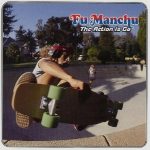
Mario: We’re having better luck, but it’s hard with the Red Palace closing earlier this year. It’s hard with the legitimate venue options getting smaller in the city. And new venues crop up, but I don’t know that U Street Music Hall is a place for us, for instance. But it’s a great big venue and big acts still come there and that’s good for the overall music scene, which I still support. But, we’re not a Black Cat Mainstage sell out band, so our options get more limited. So, we hate to see any venue go away. But we’re having better luck. Playing with Fu Manchu is awesome. They’re one of my favorite bands of all time.
Steve: It means I don’t have to book a show!
Mario: Because we do play out of the area, we know quite a few bands and we do the show swapping deal. We’re doing a lot of work at putting good bills together and have a good mix of heavy local and out of town bands. We’re getting a little more involved in creating the bill and, as long as people show up, absolutely everybody is happy.