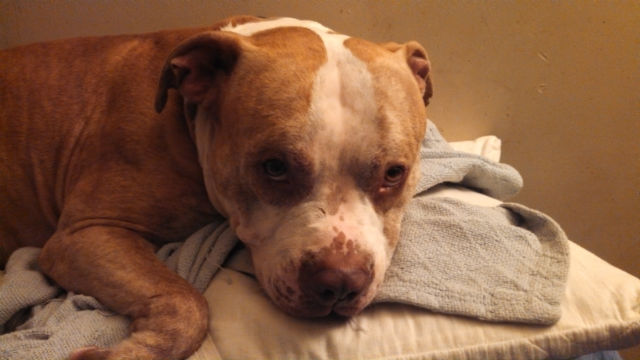
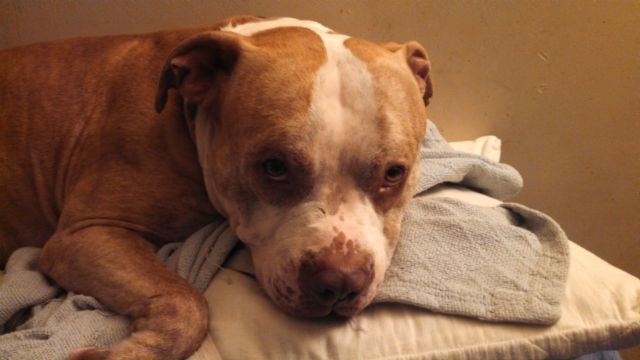
 Prince. Photo courtesy Paula Ward.
Paula Ward’s troubles began with a neighbor.
After Ward’s labrador retriever escaped from her Prince George’s County home, a neighbor who was afraid of the dog called animal control. From the neighbor, Prince George’s County Animal Management Division learned that Ward also had a pit bull named Prince. That was a big problem.
Pit bulls have been banned in Prince George’s County since 1996. The discovery of Prince left Ward with two options: Let animal control take the dog or find him another home.
Ward, a members service representative at City Club of Washington, said during a recent phone interview she called local shelters, but couldn’t find a place where she could guarantee Prince wouldn’t be euthanized. On July 3, Ward called the Washington Humane Society and was put in touch with Alicia Guidi, the head of the organization’s new Pets at Home program. She offered to help.
Pets at Home, launched in April, was created after the American Society for the Prevention of Cruelty to Animals conducted a study that found that the majority of dogs over 35 pounds were being surrendered because of housing issues, Guidi said.
“So often people surrender their animals for a reason we can’t do anything about, like illness, a financial issue,” Guidi says in a phone interview. “But housing, that’s something we can change.”
The humane society was then given a grant by the ASPCA to create the program. Its goals include keeping dogs out of adoption centers by offering people resources and increasing the amount of housing in D.C. that doesn’t have breed restrictions.
“A lot of what we’re doing is education,” Guidi says, adding that one study showed animal owners are more likely to be longterm tenants. “We really just want to educate landlords and property owners about large dogs, especially pit bull-type dogs.”
“It’s why we see so many large breed dogs surrendered to the Washington Humane Society,” she adds.
In Ward’s case, Guidi arranged for Prince to be picked up from Ward’s home and taken to Little Rascals Doggie Day Care and Boarding in D.C. Two hours later, Ward recalls, Prince George’s County police and animal control officers arrived at her home to search for the dog.
Since July 4, Prince has been living at the Georgia Avenue facility while Ward tries to find another home. “It’s been pretty tough,” Ward says. “When Little Rascals came, I started crying.”
“Some people have animals and some people have pets,” Ward says. “He’s my son, that’s my child. I have a relationship with my dog. And I miss him like crazy.”
Pets at Home, currently in its pilot stage, has helped keep nine animals out of shelters so far. On Monday, the Washington Humane Society launched Foster a D.C. Pet, a program that will match animal owners with temporary housing issues with possible fosters.
In Ward’s case, Guidi says the program will pay for Prince to stay at Little Rascals for as long as it takes, because Ward is struggling to find a new home in a community where pit bulls are permitted
Ward, who says she would be unable to pay Prince’s boarding costs on her own, plans to volunteer for the Washington Humane Society as a way to repay the group for its assistance. “Alicia didn’t know me from anywhere,” Ward says. “I didn’t even live in D.C., but she still helped me out.”
“It’s been a difficulty, but I’ll tell you the program is really awesome,” Ward says. “I can’t wait until I get myself situated so I can give back.”