
 Cate Blanchett (Jessica Miglio/Sony Pictures Classics)
You can tell how far Jasmine (Cate Blanchett) has fallen from Park Avenue grace in Woody Allen’s 500th movie, Blue Jasmine. Not just from the Upper East Side to the outskirts of San Francisco’s seedy Tenderloin, but from a world of privilege to a Computer 101 course she takes so she can set up her own online business.
For all Allen’s supposedly strong female characters—and I enjoyed Annie Hall and, if not Hannah, Dianne Weist’s role in Hannah and her Sisters—there are as many strong female performances in thankless roles, like Samantha Morton’s wonderfully expressive mute in Sweet and Lowdown. Allen elevates Jasmine to the title role in his latest film, and brings her cell-phone savvy character down to the level of Computers for dummies. It doesn’t work.
Whether or not the director appears in his own films, there’s always a Woody Allen stand-in, or several, in play. Kenneth Branagh did the honors in Celebrity, Owen Wilson in Midnight in Paris, and no less than five actors, in addition to Allen himself, took on the director’s fragmented personality in the wan To Rome with Love. Cate Blanchett’s titular neurotic does not exactly stand in for Allen, but if we consider for a moment that even his female characters are written through the filter of the director’s own coke-bottle glasses, it’s an intriguing example of self-loathing, a self-aggrandizing look at how the mighty (Allen) have fallen.
Jasmine arrives in San Francisco to live with her sister Ginger (Sally Hawkins), and as soon as she appears at her sister’s modest doorstep, Jasmine launches into what could pass for either neuroses or awkward incompetence (I’m looking at you, Frances Ha). We learn more about how Jasmine got to this level through a fragmented timeline that is fortunately not narrated (I’m talking to you Vicky Cristina Barcelona). Jasmine’s ex-husband Hal (Alec Baldwin) was a supposedly rich businessman who cheated on his wife and with the investment money he was entrusted with.
The most Allenish figure here is the most unlikely. Ginger’s schlubby ex-husband Augie is played by Andrew Dice Clay in a nervous impersonation of Allen as a graying nebbish recovering from steroid abuse.
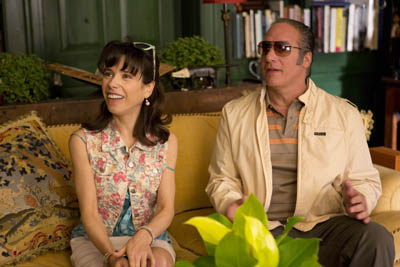 Sally Hawkins and Andrew Dice Clay (Jessica Miglio/Sony Pictures Classics)
The fragmented timeline isn’t the only thing that keeps characters and plot lines from coming together. Take one simple scene between Hawkins and Dice Clay. The camera cuts back and forth between the actors as they exchange lines, which both reflects and exacerbates the emotional distance between the characters. But it also keeps the actors from finding a rhythm together.
One of the few actors who works is Michael Stuhlberg as Dr. Flicker, the dentist who takes Jasmine on as his receptionist, and who comes on to his new employee. He’s another variety of the Allen persona, but he doesn’t come off as stage bound and hogtied by the script.
I thought To Rome with Love didn’t work, and for the most part it didn’t. But when it did, in Alec Baldwin’s scenes with Jesse Eisenberg, it worked well, and might have fit in with his earlier, funny movies. Baldwin phones it in for his undeveloped character here. Blue Jasmine works even less well than Allen’s last film. As a hybrid of his artsy dramas and comedies, it has been compared to Tennessee Williams and John Cassavettes, but is neither as heated as the former or as real as the latter.
—
Blue Jasmine
Written and directed by Woody Allen
With Cate Blanchett, Alec Baldwin, Sally Hawkins, Andrew Dice Clay, Louis C.K.
Rated PG-13 for awkward sexual chemistry and all of the other usual neuroses.
Running time 98 minutes