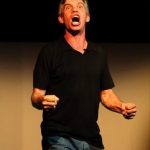
 Mike Boggs of We Were Pirates. Photo by Lisa Boggs.
By Tony Porreco
We Were Pirates is the moniker of D.C. area multi-instrumentalist Mike Boggs, who has been recording and releasing albums of moody jangle-pop since 2007. In 2009, Boggs’ brother sent him to a link to a Kickstarter campaign seeking funding to make Dear Mr. Watterson, a feature length documentary exploring the impact of Bill Watterson’s beloved comic strip, Calvin & Hobbes.
A longtime fan of the strip, Boggs reached out to the film’s director Joel Schroeder in hopes of contributing some of his music to the project. Schroeder ended up asking Boggs if he was interested in composing an original score for the film. Boggs said “yes.” The resulting effort consists of a delightfully buoyant collection of pop-rock instrumentals that complement the film, which arrives in theaters November 15.
DCist sat down with Boggs to discuss his experience of writing the score for Dear Mr. Watterson, the beloved comic strip and his approach to writing a score versus writing an album.
How did you become involved in scoring of Dear Mr. Watterson?
It was just one of those things where this was before Kickstarter really blew up and kind of became a big deal, and it seemed like such a cool novelty. It was the first time I had seen a Kickstarter campaign and I was like, “This is perfect!”. It was such a DIY thing to do, and that appealed to me. And I’m a huge Calvin & Hobbes fan. So without even thinking about it I just sent [Director Joel Schroeder] a quick email, not thinking much about it and heard back almost immediately and the director was like, “I dig this stuff”, so we talked back and forth some, and that was years ago. I want to say it was 2009, 2010, definitely. I just don’t remember when. So that’s how it started out.
So there was a substantial period of time between Schroeder saying, “I’d definitely like to use some of your music” and his commissioning you for an original score. What was your reaction upon receiving this request?
It was like, “Oh yeaaah.”, I had completely forgotten about it. It was exciting, because I hadn’t heard anything about it. There was kind of a flurry of media activity when they first came up with the Kickstarter and then things died down for years while they were actually getting into the project, so I don’t think they had a Facebook or a Twitter, or even like a mailing list, so it just wasn’t on my radar for a long time. And then I was actually in the middle of demoing some new songs at that point, so I was getting ready to record another EP. And so it was immediately a shift in perspective, but it was one that I was happy to make.
You hadn’t done anything like this before. What was going through your mind when you were commissioned: Self doubt? ‘Can I do this?’
For sure. I remember very vividly when I got the email that said ‘We want to use your music.’ It was definitely a second of “Oh shit. I really have to do this now,” just because I knew the timing and that it was going to be a lot of work.
What did you do get into the mindset for composing a soundtrack?
That’s a good question. I definitely went back and read some Calvin & Hobbes. And then I did go back and listen to my favorite film scores and soundtracks and that sort of thing. Just to kind of get a feel for how other people approach it, because it was always this sort of thing where it wasn’t going to be your typical Hollywood score in the sense that it wasn’t going to be a lot of string swells and stuff like that. It was going to be more instrumental pop rock, that kind of thing.
What are some films you think have great soundtracks?
Definitely Where the Wild Things Are, the Karen O soundtrack. I’m a big Wes Anderson fan; I love Mark Mothersbaugh’s soundtracks. Eternal Sunshine of the Spotless Mind. David Wingo, he scores a lot of David Gordon Green films and Jeff Nichols films.
How much did you know about the film before you began work on the music?
They had a trailer up online. It was pretty basic, but it did a good job of capturing what they were trying to do. So I did have some idea of the tone of everything. It was just like a series of interviews. It’s actually not that different than the trailer that’s up now.
How long did the score take from start to finish?
It started in late June, early July [2012]. And then everything was released in April [2013]. I think we were probably done in March.
Describe your work flow: Did you write everything first and then record, or was it more piecemeal?
It’s a lot of songs. That was the more daunting thing about it. The way it worked was first I was just demoing songs. So I was working on ideas as soon as I got the email…And then I would work on a couple at a time because I was sending them in batches of like two or three. My recollection is that I was cranking them out pretty quickly, towards the beginning, just in the demo phase.
But then later on as the film evolved some, there were some specific scenes that needed to be filled. So for most of it, I was just writing in a general way after having seen the trailer. And then I watched the rough cut of the film in July, which is not that far removed from the final product. The narrative had kind of been established by that point for the most part.
Did seeing the film’s rough cut help you fill in the gaps and see what still needed to be done?
Definitely. That was always the thing: I knew the director Joel wanted a lot of music in it. So a big thing for me was to make sure nothing was overly repetitive. That’s why there are the sheer volume of tracks; I wanted to make sure it never plateaued or stalled out with one song for too long…And that was the other thing: I wanted to approach it from as many different angles as possible, to try to represent a range of emotions so it didn’t sound too homogenous.
The score features some darker pieces (e.g. “A Shot Across the Bow” and “A Strange Experience”). Are there moments in the film that merit these moody compositions?
Yeah, totally, there are conflicts. For instance, the licensing debate, something in terms of a plot that would explain some of the tension would be just financially, Watterson wasn’t independent. He had a publisher and he had the syndicate. The syndication deals with the newspapers – Anybody who gets to the level that he got is going to have some creative conflict sooner or later, so that definitely gets addressed in the film.
But what’s cool is the way people have responded to the score; a lot of people have said it’s the kind of thing they listen to and it makes them feel good. It’s an upbeat kind of thing, which is true. That’s something I wanted to come through.
Compare your experience of writing the score with your usual approach for We Were Pirates songs.
The nice thing about it, the difference, and something that was kind of cool was that it was collaborative to a certain extent…Joel and I got along so well that it was like we were almost always on the same page. I think because we’d been in touch so much and because we had so such similar outlooks on our respective fields, it was never an issue of addressing the direction of everything. The collaboration was great.
As far as the approach to the songs, it wasn’t too much different than what I normally do because the demoing phase is always how I write the songs and I’m always writing them with multiple instruments in mind. So that was pretty similar, but the nice thing was not having to write lyrics. I think if I had to write an album with lyrics and vocals, I don’t think I could have made it happen in that short of a turn around.
You’ve written music for a documentary about a cherished comic strip, and comics are frequently associated as the stuff of kids. Is there a connection between your work and childhood?
Yeah, I think so. It’s a tough thing to explain the creative process. I think the way I would describe it is that as an adult, it’s not always a logical decision to be doing a creative project. The older you get, it’s more like, ‘Oh you’re still doing that thing, huh? Oh, that’s cool.’ So for me, I’m a pretty nostalgic person about that age.
The name of the project is We Were Pirates, which is a shout out to a nostalgic look back at playing pretend and exploring in the woods, that sort of thing. I feel like I’m always trying to connect to that time in my life where creativity was standard day-to-day practice…I remember fondly that you could get away with being an artist or having a different look on the world, that maybe, as you age, society is not so kind to that.
You’re a big Calvin & Hobbes fan: Could you speak a little bit about your relationship with the comic and what it means to you?
I’m 30, so I grew up when the syndication started in the ‘80s. It was always in the paper. My story with Calvin & Hobbes is not unique. But for me, what I liked so much about it is the fact that it works on multiple levels. I was a 7 or 8 year old kid who was laughing hysterically and then as I was aging, I was reading the same things and realizing that it’s dealing with philosophy and art and ethics and dealing with things on multiple levels…It felt like that Watterson was actually addressing some real life issues. I think that’s why I connected with it.
As the songwriter of We Were Pirates, you’re writing and recordings albums all by yourself. But how do you conduct rehearsals when you’re doing things on your own and then bringing them to a band? How much direction do you give your bandmates?
I always wanted to be involved in creating music to the point where it was kind of like, if no one else is on board, fine, I’ll just end up doing it myself. So because my process is pretty strict in the studio when it comes to actually writing and recording the songs, when it comes to playing them live, I try to mellow out and not be super strict about this stuff.
In a live setting, ideally, the songs would kind of stay true to the general feeling and aesthetic that is on the records, but it’s not strict in the sense that if someone comes up with a better way of doing something that I think is cool and unique, we’ll do it. So yeah, it’s certainly more collaborative on the live side of things.
What’s next for We Were Pirates?
Writing and creating is a helpful thing in my life. It serves a purpose. So I can’t imagine ever not making music or writing, just in general. So that’s something I plan on doing, whether or not anybody picks up on it or anybody cares. So I’ll be making records, you know what I mean? I really enjoyed the process of scoring Dear Mr. Watterson, so that’s something that if it was the right project, I would definitely be interested in doing something like that again. It would be great for another project to come along that was as exciting creatively as Dear Mr. Watterson was. That would be the ideal thing.