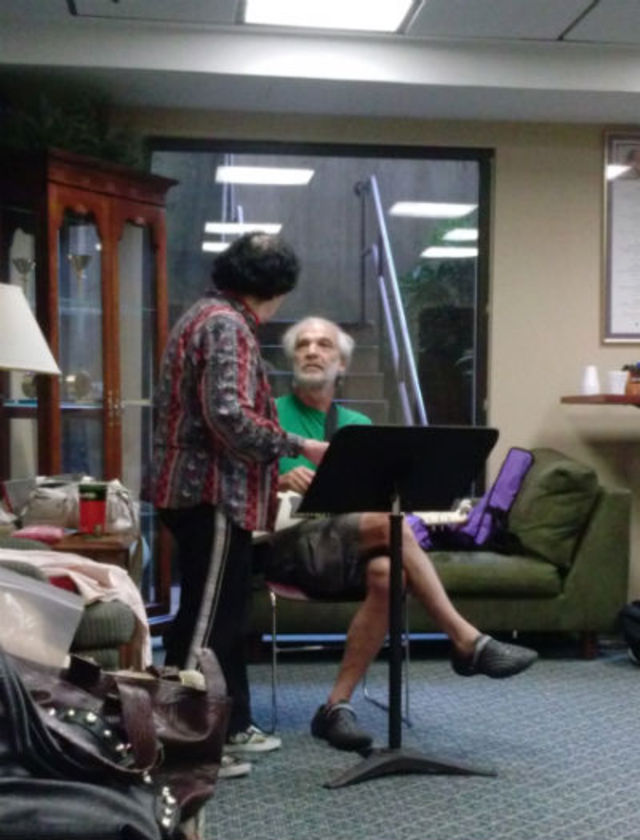
 Betty May speaks to Dennis Sobin. Photo by Sarah Anne Hughes.
On a recent weekday evening, shortly after offices began to clear out, a handful of people met in the basement of St. Mary’s Court in Foggy Bottom to rehearse the words of prisoners. On Saturday night, they will be performing these words at the Kennedy Center.
Led by director Betty May and producer Dennis Sobin, the cast of seven — Raoul Anderson, Melanie Boyer, Brandy Facey, Ed Higgins, Lisa Kays, Tommy Malek and Maxton Young-Jones — will perform a play completely written by incarcerated people during the Page to Stage Festival.
May, who previously developed the play Faces using the words of women from the Maryland Correctional Institution for Women, said inmates from across the country submitted plays. From a field of about 20, May selected nine, plus Faces, to edit into a two-hour show.
The director, who has been leading shows since she was three, said she selected the plays that showed promise. “One was 80 pages long: It had bombs and ships and airplanes and combat and people crawling through trenches,” May said. “That took a lot of editing.”
Of the subject matter, May said “It’s pretty graphic,” and includes rape, murder and abuse. “It’s written by prison inmates. Many of whom have had really horrible experiences. And it’s written by people who have no voice really.
“So it’s an opportunity for them to have their voices heard.”
“You want to do them justice,” actor Brandy Facey said. “Betty did a wonderful thing by sitting us down and pretty much explaining to us the people … and some of the background. So trying to channel that has been very effective. Being able to try to present it without losing the true original emotion that’s there.”
George Washington University student Maxton Young-Jones added, “It’s a huge responsibility.”
“As an actor you want to make choices,” he said. “But you also really, really, really want to preserve the voice of the original people because they worked so hard on this and they came from a place of immense darkness in their lives.”
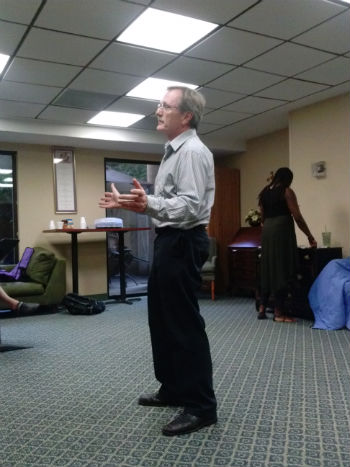 Ed Higgins. Photo by Sarah Anne Hughes
Ed Higgins — who, when asked if there was apprehension about auditioning for the play, said with a laugh, “Oh, God yes!’ — said, “I’m trying to convey who they are.”
“Everyone has opinions of what prisoners are like,” Higgins continued. Our play “is showing that the stereotypes aren’t exactly what they’re thinking. Not justification, just explanation.”
The show is a mixture of monologues and scenes, with staging that’s “very involved in some places,” Young-Jones said. “Some of them are realism, some are them are magical realism, some of them are experimental things.”
When asked about how it feels to be performing at the Kennedy Center, May exclaimed, “It’s the Super Bowl, honey!”
“It’s a one shot deal,” May said. “But it’s the Kennedy Center.”
The group hopes to find time to make a video of the performance, but May said they’re all adults who have to do “stupid things like earning a living, eating.” With a video, they hope to find more performance spaces and allow the prisoners to see their work performed.
“I think we’re all pretty strongly committed to the project and to the people who wrote it,” May said. “I could paper my bathroom with rejection slips. These people are no different from me. They’ve poured their heart and souls into the plays. I felt terrible turning down [some plays.] I know that their plays meant as much to them as my books mean to me.”
May said one woman at MCIW, who has three PhDs and was convicted of murder, told her “We want to be heard, we want to be heard. We want our voices to be heard. And we want to make a difference in the world. We’re not dead.”
“And now their voices are going to be heard at the Kennedy Center.”
The voices of prisoner playwrights have been heard at that D.C. institution for eight years now, thanks in part to Dennis Sobin, who founded the Safe Streets Arts Foundation after leaving prison ten years ago.
“We work in the arts, basically, as a therapeutic and rehabilitative tool for men and women is prison,” Sobin said. “By therapeutic, I mean giving some dignity, self-worth to prisoners.”
Of rehabilitation, Sobin said he doesn’t believe a lot of prisoners need it: “They just have different views of society. And I believe Martin Luther King did, too.”
As chronicled in a 2010 Washington City Paper profile, Sobin once owned a brothel, produced pornographic films, and was a mayoral candidate. He was convicted of racketeering and child pornography, a charge he disputes, in 1992.
“In my case, in the 80s, we felt very strongly that there should be no censorship by the government,” he said. “I lost my own battle, which resulted in me as a casualty, but I think the war was ultimately won.”
“So I’ve been around and I’ve always been interested in the arts,” Sobin said, adding that when he got to prison he decided to become well-read, as well as proficient at the guitar and touch-typing. He then thought, “Why can’t this be done for other people?” Thus Safe Streets Arts was born.
“We found that through the arts, when people work in some form of art in prison, they take that with them, that skill, that knowledge,” Sobin said. “When I left, I left with my guitar and that was my companion.”
This latest work, Sobin said, will be introduced to the outside world “from the outerspace known as prison” Saturday at 7:30 p.m. at the Kennedy Center’s Family Theater.
“The main thing all of us want is to do justice to the people who wrote the material,” May said. “We started Faces five years ago because [the women of MCIW] wanted to be heard, they wanted to make a difference in the world. They wanted to have their voices to be heard beyond the prison walls.”
“To go from that to the Kennedy Center,” May said, knowing that she didn’t need to finish her thought.