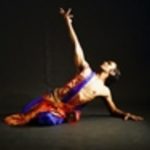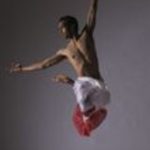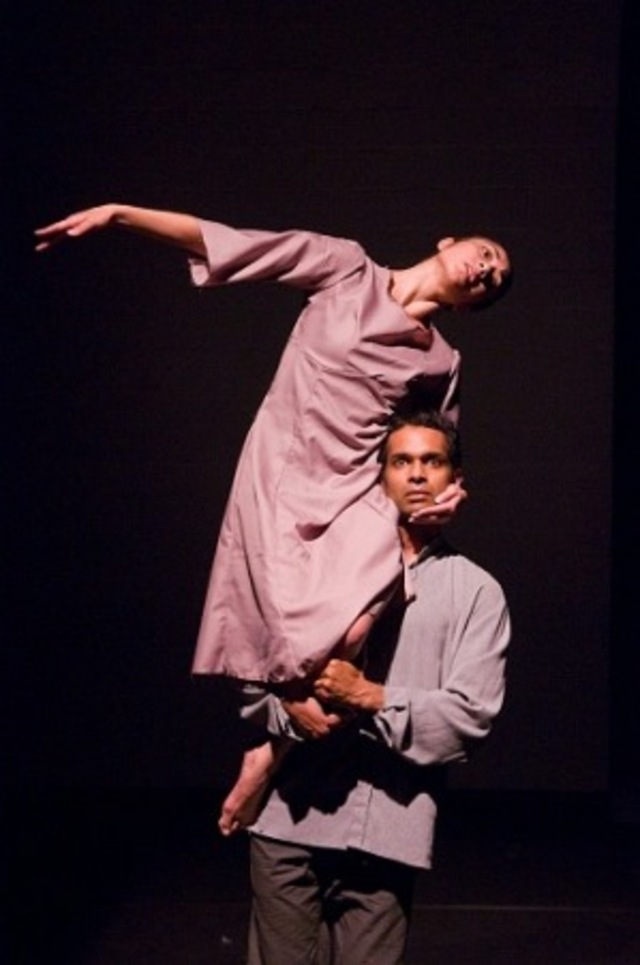
 Daniel Phoenix Singh (right) in performance with Melissa Greco Liu.
 Forming any sort of organization takes a certain amount of gumption. Running an organization for ten years takes dedication of the highest order, especially in the case of an arts endeavor where the return on investment involves rewards that the bottom line cannot measure in and of itself. But that is exactly what D.C.-based dancer and choreographer Daniel Phoenix Singh has accomplished. His ensemble, the Dakshina/Daniel Phoenix Singh Dance Company, is celebrating its tenth anniversary this season.
Singh was initially trained in Bharata Natyam, a classical style with roots in South India. He also received an MFA in choreography and performance from the University of Maryland. One trait that sets his company apart from other South Asian dance troupes is his commitment to forging connections with the broader arts community. His outreach has resulted in innovative programming that has earned Singh respect and awards from regional arts institutions. In the past, he won the Founders’ Award for Innovation in Dance from Dance/MetroDC. This year, Singh won the Pola Nirenska Memorial Award for Outstanding Contribution to Dance for his commitment and service to promoting dance in the District.
Dakshina’s celebration will reach its climax with its Fall Festival, taking place over the next two weekends at The Shakespeare Theatre Company‘s Sidney Harman Hall. The 2013 iteration of this annual event brings together some of the finest classical dancers from the Indian subcontinent. Among the performers are Madhavi Mudgal, who will be presenting an all-female company specializing in the sensuous and soft Odissi dance style from Eastern India. As a bookend to this performance, Sheejith Krishna has assembled an all-male company to perform a specially commissioned work that connects to “confluence, the festival’s theme. Headlining the closing performance will be the Dhananjayans who have been partners on and off stage for over 40 years and will be focusing on the emotional aspect of dance. Artists based in the United States, including Dakshina itself, will open each show and those performances will expand the program to include spoken word, theater and music.
Singh took some time away from planning the festival to answer some questions about the upcoming event and his experiences with running Dakshina for ten years.
DCist: So Dakshina is celebrating its 10th anniversary. I’d like you to reflect back on the vision you had back then and whether the Dakshina of today reflects that same vision.
Daniel Phoenix Singh: Dakshina means “offering,” and I began the company with this idea of offering and giving back to the community. Particularly, I wanted to find a way to present dance as an extension of my identity and bridge my interests in Bharata Natyam and modern dance through our signature fusion style. Along with our own work, I also wanted to present the leading choreographers of both the styles we work in, and we do this through our signature Fall Festival of Indian Dance and Arts and our multi-year partnership with the Sokolow Foundation. I feel that has been our greatest offering, giving people the ability to experience dance in multiple ways.
DCist: What have been the biggest challenges you’ve faced and what lessons have come from them?
Singh: Our challenge has been the flip side of our greatest strength because we use a three pronged approach with our different dance styles. So often theaters, funders, the press, and various others don’t know how categorize us. Here also, I think Dakshina is doing important work in allowing people to think outside the check boxes that people usually associate with dance. But over time, I think people have come to see Dakshina as the company that is able to successfully bridge multiple forms, and that means a lot to me. One of the lessons I’ve had to learn was to take the articulation and fluency we have in our bodies and find a way to express this in words so that people unfamiliar with our work can find an entry point into our work.
DCist: Given your 10 years of experience running an arts organization, what are some pieces of advice you would give to someone looking to start her own?
Singh: The first thing would be to clarify her/his own vision to figure out what it is they want to do. Even if the vision is not perfectly clear, they should at least narrow the areas of their interest. Then, I would suggest that you work with an established company in your area for a while so that you can get on the street experience, and be mentored through this connection. There is no point in reinventing the wheel of the structural and logistics of starting a company. There is also the option of working with a collaborating artist or umbrella organization rather than starting your own—this would allow you to at least share the needs and growth. And finally, this is common knowledge, but I would suggest that they commit to a set number of years and try their darndest for whatever number of years they’ve set as their goal.
DCist: Let’s turn to this years fall festival. How did you go about curating the events? It seems like most of the people on the program are repeat performers. Was this intentional?
Singh: Yes, I intentionally wanted to program this years festival by bringing back some of the leading dancers we’ve presented before. In South Asian dance forms, the mature dancer is revered and continues performing well into their sixties and seventies. So I wanted to bring back these dancers we’ve had before and let the audience experience them in the golden years of their careers. South Asian dance forms are among a handful of styles that continue to support and nurture artists across generations. Each artist brings a unique dance style and has a unique feature to add to the festival. Each performance will also have a family friendly component two hours before each main stage performance. So it should be a feast for the senses.
DCist: Explain the unifying theme to this year’s festival.
Singh: This year’s unifying theme is Sangamam [The Confluence]. I wanted to present our art forms in a composite way in which dance, music, poetry and theater all come together. This guiding theme also allowed us to bring together some of the U.S. based artists who are doing important and pioneering work in their respective fields. I’m so excited to be able to present both my mentors and peers this year.
DCist: Let’s say someone isn’t really into dance but is somewhat curious. What would you say about your festival that might be attractive to that person?
Singh: I would say come with an open mind, pick something that is interesting to you — whether it is the music, the rhythms, or the narrative aspect — and let yourself just soak it in. Just let it wash over you and try not to start figuring out the dance. Go for the big picture, and by doing that, you will be able to find different entry points at different times. Let yourself feel whatever the dance evokes in you, and let yourself steep in that feeling. The reflection on what it means can come later, if at all. Come and just let yourself have an open mind.
DCist: What do you hope that same person walks away with after seeing one or more of the performances?
Singh: This year we celebrate Dakshina’s 10th anniversary festival. I chose the theme to represent the composite structure of South Asian dance and art forms. The festival is a coming together of many dance companies and dance styles, old friends and new ones, and most importantly it is a coming together of generations and traditions across the oceans. Each one of the artists we are showcasing has been a pioneer in many different ways and four of the featured artists have been recognized with presidential honors in India. The essence of rasa [emotional transformation] is the guiding principle in South Asian dance. I welcome all of you to join us for a transformative journey through dance and the arts.