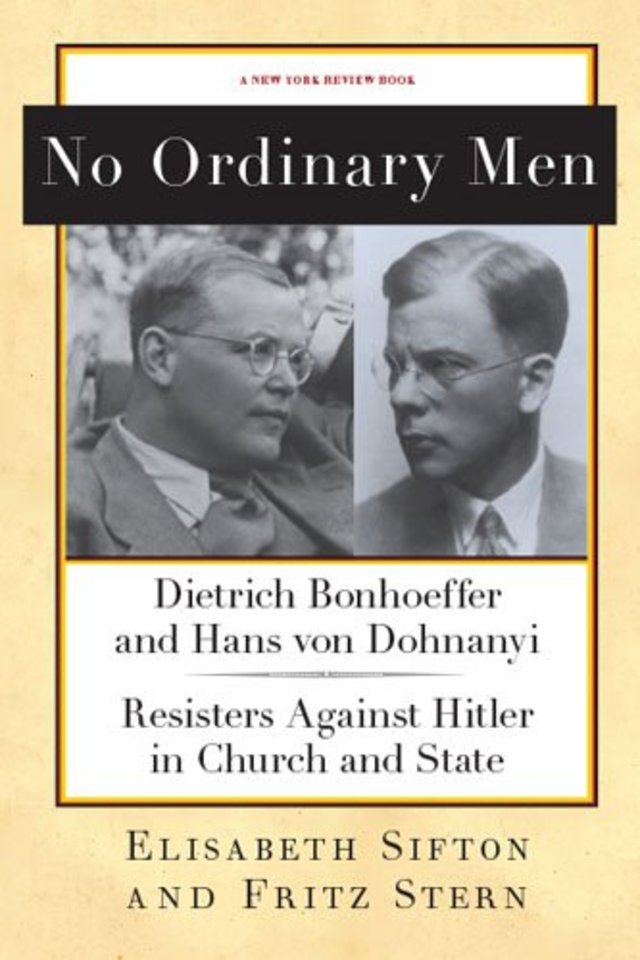

It’s important to remember the names of people who risked their lives to challenge extraordinary evil. That list should include Dietrich Bonhoeffer and Hans von Dohnanyi, two men who ultimately lost their lives while trying to stop Hitler. Their stories are told in No Ordinary Men: Dietrich Bonhoeffer and Hans von Dohnanyi, Resisters Against Hitler in Church and State (New York Review Books, September 2013) and will be discussed by authors Fritz Stern and Elizabeth Sifton in D.C. tonight at Politics & Prose at 7 p.m., and tomorrow, September 24 at the Goethe-Institut at 6:30 p.m.
Though it was quite unpopular to do so at the time, Bonhoeffer and Dohnanyi distrusted Hitler early in his rise to power. The economy and employment were finally improving after the devastation of World War I, but a few skeptical (and perceptive) Germans were already wary of the new leader’s “demagogic propagandistic speeches” and seemingly “psychopathic symptoms.” The authors instructively note the increasing red flags of the new regime and what, if anything, was the public reaction.
As a pastor, Nazi socialism especially concerned Bonhoeffer when Hitler seized control of German churches. Learning about pacifist leaders like Gandhi inspired Bonhoeffer to resist, along with his more radical brother-in-law Dohnanyi. A lawyer, Dohnanyi disagreed with new racist public policies and that crimes like murder were being committed with no trials or sentencing. He kept his own records of Nazi crimes, personally helped Jews escape Germany, and was one of the conspirators in multiple failed-but-ridiculously close attempts to assassinate Hitler (think very temperature-sensitive explosives and last-minute Führer schedule changes).
No Ordinary Men explains how Bonhoeffer and Dohnanyi’s lives intersected in their pursuit to save Germany from Hitler, from the beginning to the unfortunate end. The book’s thorough detail won’t be lost on history and World War II buffs; those with less background would still appreciate the insight from original sources and the overall heroism of the situation.
Stern, born in Germany and forced to leave in 1938, is University Professor Emeritus and former provost at Columbia University. He is an expert on German-Jewish relations and this is his fifth book on German history. Sifton is the daughter of famous theologian and ethicist Reinhold Niebuhr (who knew Bonhoeffer) and has written and published on faith and civic action.
Both talks are free to the public, and Goethe goers may register online in advance.