 Sun Studio, which has stood at 706 Union Ave. in Memphis, Tenn., since 1950, is now a National Historic Site (since 2003) and tourist attraction, sure. But it’s still the same small and unassuming brick building that housed some of blues and R&B’s most influential performers, like Howlin’ Wolf and B.B. King.
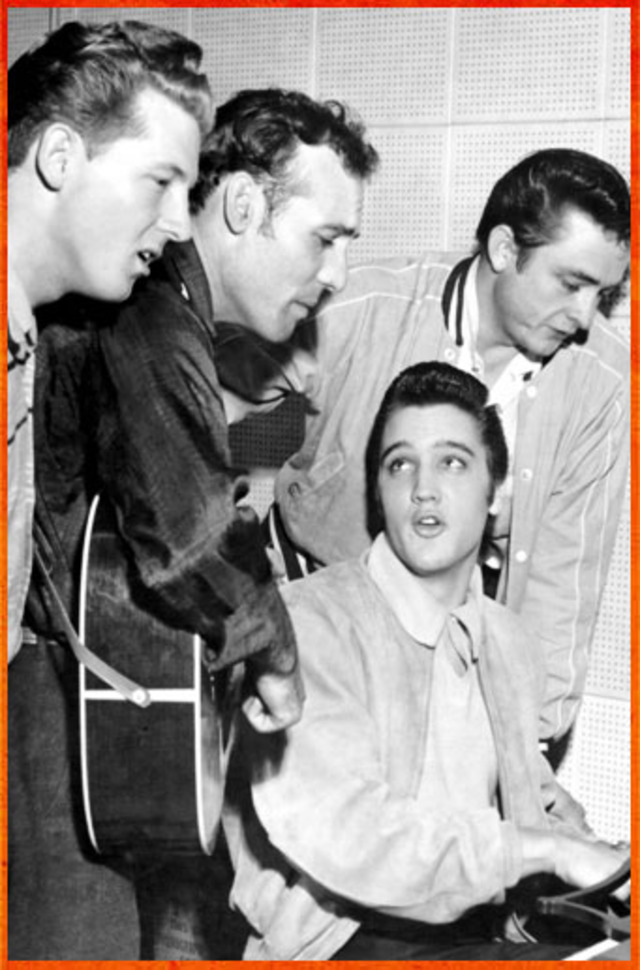
Beyond that, Sun is arguably most famous for a single recording session—noted with a spot on the floor of the building now—for tourists to take pictures of (and where Bono wore an amazing hat in the 1987 U2 documentary Rattle and Hum).The “Million Dollar Quartet,” also the subject and title of a musical that opened last night at the Kennedy Center and runs through Oct. 6, took place on Dec. 4, 1956, bringing together Elvis Presley, Jerry Lee Lewis, Carl Perkins, and Johnny Cash.
I’ll just let you drink that in for a minute.
All four were at various stages of their careers. Elvis was hot, Cash was doing OK but hadn’t risen to Cash-by-Johnny-Cash level of fame yet, and Lewis was just a glint in the Rock God milkman’s eye (a metaphor I apologize for, given Lewis’s biography).
What is now considered to be the most giddily epic jam session of all time is especially impressive because, unlike a lot of collaborations these days, it pretty much happened spontaneously. Each guy just dropped in and they decided to play a few casual tunes together.
As a musical, Million Dollar Quartet is structured a bit like Jersey Boys. It’s mostly a vehicle for audiences to hear some of the iconic songs recreated live, but with bits of rock history and biographical details of the performers sprinkled in. It premiered in Florida in 2006, and made its way to Broadway in 2010, where it showed in the Nederlander Theatre, famed for having premiered Rent back in ’96.
Charles Isherwood, in his review of the Broadway show, mused in the New York Times on “the magic that must have taken place, as four great musicians with troubled lives and complicated careers came together to forget everything but what they loved to do most: express the riotous joy, beauty and sadness of life in songs that shoot straight for the soul.”
The piece is narrated by Sun owner Sam Phillips, who not many will recognize or know anything about right off the bat. The actor who plays him on this touring show, Vince Nappo, says he enjoys that aspect of his role. “[Phillips] was not flawless, that’s for sure. He hurt some people. I mean, Carl [Perkins, who wrote ‘Blue Suede Shoes’] kind of got pushed to the back-burner. Carl’s a guy people don’t know as much about like they do Johnny and Elvis, but Carl, that guy, he may have had the most talent musically out of all of them.”
Nappo, who recently had a brief televised spotlight playing a British sociopath coincidentally named Vincent on ABC’s Red Widow, says that Phillips was a bit like the man behind the curtain—the musical equivalent of Max Perkins’s editor to Ernest Hemingway’s writer. “There’s some real focus on how kind of raw Elvis and Johnny were. They weren’t the guys who walked into the studio and wowed you out of your wits immediately. They needed someone to kind of pry open the doors, and that’s what Sam had a real knack for.”
But even as in-the-rough as Elvis and Cash may have been, it’s no easy task to avoid turning the whole thing into something along the lines of a Bruce in the USA concert (though, to be fair, Bruce in the USA is awesome.)
Actor Scott Moreau, who plays Cash, says he simply focuses in on the Cash of that specific day, who would have been in his early 20s, married to his first wife Vivian, with only a few songs on the radio at that point. “The challenge is that because he’s such an icon and because people see ‘Walk the Line’ … to get people to maybe put aside those preconceived notions about his icon a little bit,” Moreau says. “We have hindsight now … [But] he wasn’t technically the Man in Black yet.”
Like Bono, Moreau got to live out his fandom by recording some of Cash’s tunes at Sun Records, with the cast. Having toured for two years with the show, the Litchfield, Maine, native has been to a lot of cities, and has noticed that different populations react to the show in markedly diverse ways.
“When we play in the south, there are a lot of things in the show, just turns of phrase, that some northeastern audiences just don’t get. They think it’s funny but they don’t quite get it. We were in Arkansas, and there’s a line that Sam says to Elvis about ‘I can tell without even asking you’re from Mississippi.’ To most people, it’s not really funny. To that audience, we got this huge reaction.”
With about an hour and a half onstage nonstop, the cast has to roll with the punches. All of the musicians play their instruments live in the show. Strings break, actors fall flat on their faces, but the show must go on. And while Moreau comes from a Rodgers and Hammerstein/Lerner and Loewe musical background, having taught himself to play guitar about 10 years ago, the production’s new Jerry Lee Lewis, North Carolina native John Countryman, says he was never much into theater before this. “I just wanted to rock,” he says.
Countryman spent five years playing keyboard with a band called The Dirty Names, before he quit to “get a respectable job” at a bank, after he decided to propose to his now-wife Jennice (whom he married in June, and who travels with the show selling merchandise, “an extended honeymoon”).
“For me, Jerry Lee has been The Guy since I was a little kid. I started playing piano about that time,” he said. “My mom showed me some licks on the piano. ‘You should play like Jerry Lee’… That kind of rocking rhythm in the left hand, that’s how I play.” His mom, an even bigger Elvis fan, will get to see him at the Kennedy Center, playing “a goofball and a bit of an asshole.”
“I mean, the writers took liberties and probably made it more interesting than that night was. But those guys were actually in the studio on that night. You talk about rock and roll gods … They thought let’s explore that night, let’s just riff on it,” Napp says.
“The audience is the key ingredient,” says Countryman. “It’s electricity.”