 Image via Sundance Selects
In the sobering opening credits of Blue Caprice—Alexandre Moors’ haunting film about the Beltway snipers—chilling 911 calls play over archival news footage that shows the panic that John Allen Muhammad and Lee Boyd Malvo cast over the region.
It’s been 11 years since Muhammad and Malvo went on their murderous crime spree across the D.C. region, striking fear across the area over the span of three weeks for their seemingly random killings.
In Blue Caprice, the feature film debut from French director Alexandre Moors, the story of Muhammad’s and Malvo’s heinous crimes is explored. But the film is not a typical police procedural that depicts the events of their three-week shooting spree. Unlike the made-for-TV movies D.C. Sniper: 23 Days of Fear and D.C. Sniper, Blue Caprice instead focuses on the months leading up to Muhammad’s and Malvo’s pilgrimage to the Washington area, showing how they first met, and how Muhammad’s psychological manipulation of Malvo transformed a shy, vulnerable teen into a hateful killing machine. Gorgeously shot in the Pacific Northwest, the film is as poetic and inquisitive as it is haunting and absolutely jarring.
Recently, DCist talked to director Alexandre Moors about the making of the film, working with actors Isaiah Washington and Tequan Richmond, and the culture of violence.
DCist: This is your feature film debut. What made you want to make a film about the Beltway snipers?
Alexandre Moors: Well, for me what I found in the story was a very minimal setting that allowed me to tackle the issue of violence and the culture of violence that exists in America through an original and unusual angle, which is this story of a father and son who decided to wage this insane war against the State. So, for that story I wanted to talk about the education that this young teenager received. How he was groomed and transformed into a killer. The film, for me, was really an allegory.
DCist: Most of the film focuses on the months leading up to Lee Boyd Malvo’s and John Allen Muhammad’s murderous crime spree. How much research did you do to piece together the details of that part of the narrative?
AM: We did extensive research for months before we sat down to write the script. We had access to all the court documents, police records, and medical records. We also went on the road and visited all of the places they were in Washington, as well as all of the crime scenes in the D.C. area.
That kind of gave us a road map for what the story was. But the interesting thing for me was that there were so many holes in that story. There will always be missing pieces in that puzzle. The film was really constructed around that notion that we’ll never know the entire truth. It’s impossible to really get a single answer or comprehend this crime fully, so you have to use what you can get and interpret those holes in order to get the bigger picture.
DCist: Did you talk with Lee Boyd Malvo at all during the process of making this movie?
AM: No. It wasn’t important to me that the film was a biopic, or documentary, or any kind of reenactment. Thus, it became very important for me to keep a certain distance from the real actors of the drama, whether that was Lee or the families of the victims. From the beginning it was clear that I was taking the core of these tragic events and making an interpretation of this tragedy that is hopefully universal.
DCist: I think the most interesting aspect of your film is how Lee Boyd Malvo is almost portrayed as a victim – the victim of John Allen Muhammad’s psychological and emotional manipulation. At what point in the writing process did you realize that the focal point of the film would be Malvo?
AM: I think from the beginning, what interested me was the process during which Lee would turn into a criminal, a child soldier. And really, the film shows that initially when he grew up he was, in a sense, just a normal teenager, but he was a very vulnerable boy. So, it was clear early on that the film would be about him, his trajectory from the state of innocence to becoming this impersonation of evil.
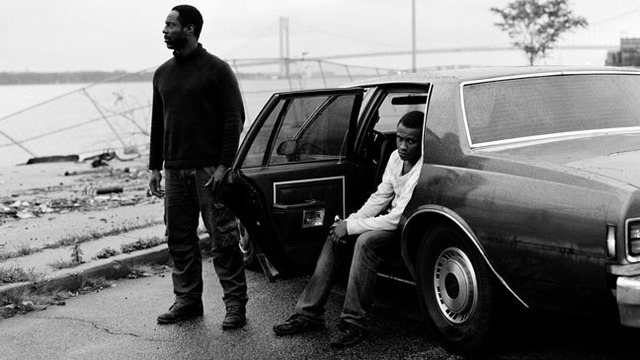
DCist: Did the actors portraying Malvo and Muhammad, Isaiah Washington and Tequan Richmond, ever feel uncomfortable playing these men?
AM: Yeah, it was difficult for them for various reasons. Those are not easy characters for them to slip into. You don’t want to feel too close to these characters. I think it was especially difficult for Tequan, because he’s such a lively, wonderful human being. A really great teenager to be around. To transform into this torn child was very difficult and we had to do a lot of improvisation for him to really dive into this character and live with it for the duration of the shoot.
It’s not something you can really just snap in and out of between takes, you have to really inhabit the character. And I think the two of them—Tequan and Isaiah—really had the same dynamic. Isaiah being this wonderful, seasoned actor, he took the young Tequan under his wing. During the shoot they had a little bit of the same dynamic that the characters had. I think that helped. They definitely bonded and that helped with their wonderful performances, I believe.
DCist: As a first-time filmmaker, it’s usually pretty difficult to get your feature off the ground. What was the hardest part of getting this film made?
AM: What do you mean?
DCist: Well, I’ve read stories of first-time filmmakers working on film for years and years before it actually gets released, did you find much difficulty in getting this film off the ground when you first set out to make it?
AM: No, weirdly it was actually it was quite, quite easy. I sometimes joke that I’m afraid it was too easy, that it will never be that easy again. From the moment I decided to make the film, it took us seven months to roll on the first day of shooting. It went pretty quickly and painlessly.
I think the people involved immediately recognized that it was a subject that was important, a subject that had notoriety, and could make a lot of noise, as they say. And at the same time, they immediately saw in our project that we weren’t going to make the film that everyone expected, that we had quite a unique angle. So, people jumped in—producers, investors, and especially Isaiah—and really from the first contacts about this it was really painless.