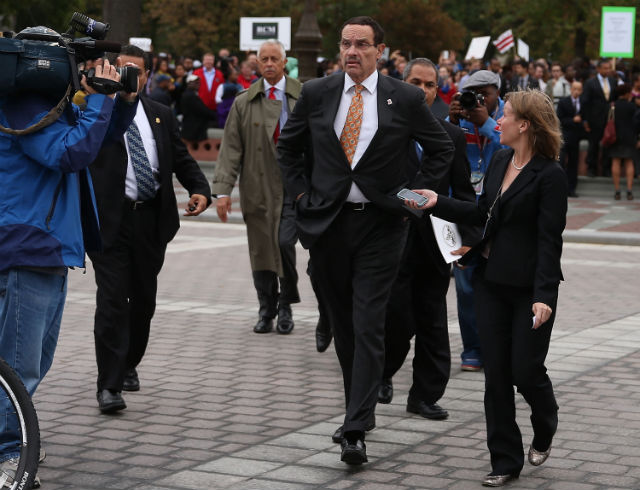
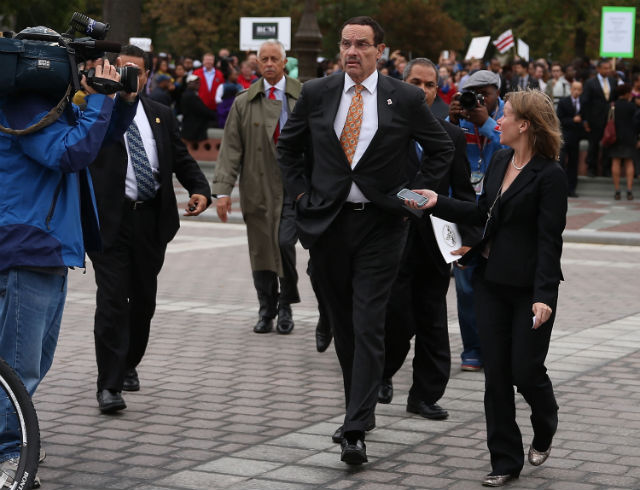
 Washington D.C. Mayor Vincent Gray participates in a rally on the government shutdown at the U.S. Capitol. (Photo by Mark Wilson/Getty Images)
By DCist contributor Jonathan Neeley
At a press conference held yesterday by Mayor Vincent Gray and Del. Eleanor Holmes Norton, which was perhaps overshadowed by the former’s exchange with a certain Senate leader, Mary’s Center for Maternal and Child Care president and CEO Maria Gomez emphasized the financial crisis that mental health providers like hers will face if the D.C. Department of Health Care Finance remains unauthorized to make Medicaid payments.
“Medicaid payments represent the majority of our services,” said Gomez on behalf of the District’s mental health providers. “Some [providers] will be unable to make payments to employees in the next week. Please understand the harm to [D.C.’s] 28,000 mental health patients.”
Now in its 10th day, the federal government shutdown bars the D.C. government from spending money its 2014 fiscal year money because Congress appropriates the city’s budget at the same time as the federal one. Though a bill to fund the D.C. government through mid-December passed in the House last week, both Senate Democrats and President Obama have rejected it because they will not accept a compromise that stops short of ending the shutdown completely.
Representatives and consumers from mental and physical health providers, along with administrators, teachers, and students from public charter schools, turned out to urge Congress and the President to free D.C.’s budget; their organizations face dire consequences if a solution is not found soon.
“We’ve got about four more weeks, but we’re doing better than most,” said Amy Brooks, CEO at RCM of Washington, which provides employment services for the disabled. “I’m hoping the president will let D.C. release some of their funds. There are folks that are being affected.”
On Wednesday, the Latin American Youth Center, which provides mental health services for youth, furloughed much of its staff, including all senior leaders, asking them to serve as volunteers. “The reckless battle going on in Congress is impacting our services,” said a press release issued by LAYC CEO and president Lori Kaplan.
“Many of us cannot accept new clients,” Gomez said. “[We cannot see] people who are pregnant; children; elderly. People are walking the street with mental health issues.”
“We budget around an expectation of how we’re going to get paid, and a big chunk is through federal government programs,” Yavar Moghimi, a psychiatrist at Whitman-Walker Health, said. Whitman-Walker served 13,618 D.C., Maryland, and Virginia residents in 2012, and this year 64 percent of Moghimi’s patients have had Medicaid as their primary insurance. “Patients are supposed to taper off medications,” Moghimi said. “For example, if someone with schizophrenia was well controlled and all the sudden stopped, they could have a recurrence of symptoms. It can be pretty catastrophic if we can’t provide the services we thought we could.”
The shutdown’s negative impact is made worse for health care providers by the fact that Medicaid dollars owed to providers for services rendered in the 2013 fiscal year are also frozen; the DHCF had budgeted 2014 money for the initial payment that states and territories must make before being reimbursed by the fed.
“The reimbursement for services that we’re providing during the shutdown will be a problem as those bills start to come due,” Julie Martinez-Ortega, chair of the Mary’s Center board, said. “But we’re not able to get the money for services we provided in June, July, August, September.”
“The 2013 money would keep us afloat through all of November and possibly December,” Gomez said.
Many of the District’s students also face the impending disruption of an essential service. As it stands, the city will not be able to make its quarterly per-pupil payment to its charter schools. Gray noted the social and emotional support that schools provide for low-income students, saying that many eat their only meal of the day at school.
Ramona Edelin, executive director of the D.C. Association of Chartered Public Schools, said the payment, totaling $101 million, is supposed to go toward preparation for SAT and other entrance tests as well as food services and teacher pay. “Some schools have something in reserve, and some will apply for bridge loans, which they’ll have to repay with interest, which is not in their budgets,” Edelin said. “Some schools could have to close their doors.”
Elsie Whitlow Stokes Freedom Public Charter School executive director Erika Bryant said that 68 percent of her students are low-income, which is defined as qualifying for free or reduced-price lunch. She emphasized the impact that the budget freeze is already having on her community. “Several of our families are receiving TANF (Temporary Assistance for Needy Families) and WIC (Women, Infants Children), and they’re faced with the possibility of not receiving those subsidies,” Bryant said. “We have families where two parents work for the fed, and they’re not getting any income. They’re all furloughed; they’re stressed out about that, that has a ripple effect on children.”
“This is not about missing a check that will be paid later,” Tom Wilds, president and CEO of St. John’s Community Services, said. “It’s about losing homes, jobs, and support staff. I am ashamed of my Congress.”
On Tuesday, Gray sent a letter to President Obama, House Speaker John Boehner, and Senate Majority Leader Harry Reid urging them to pass emergency legislation exempting D.C. from the federal shutdown. After the press conference was finished, Gray walked toward an adjacent gathering of Congressional Democrats, the letter in-hand.
“This has to end,” he said.