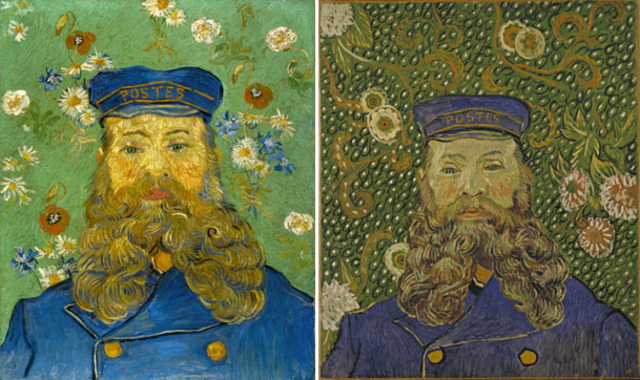
 Left: Vincent van Gogh – The Postman Joseph Roulin, February -March 1889. Oil on canvas,25 5/8 x 21 1/4 in. Collection Kröller-Müller Museum, Otterlo. Right: Vincent van Gogh, Portrait of Joseph Roulin, 1889. Oil on canvas, 25 3/8 x 213/4 in.The Museum of Modern Art, NewYork. Gift of Mr. and Mrs. William A.M. Burden, Mr. and Mrs. PaulRosenberg, Nelson A. Rockefeller, Mr.and Mrs. Armand P. Bartos, The Sidney and Harriet Janis Collection, Mr. and Mrs. Werner E. Josten, and Loula D.Lasker Bequest (all by exchange).Digital Image © The Museum of Modern Art/Licensed by SCALA / Art Resource, NY
Update: The exhibit has been extended through February 2.
The baby portrait is one of the most reviled of art forms, thanks to Anne Geddes and whoever it was that first stuffed infant-sized angels’ wings into a mall photographer’s prop bag. So imagine tormented ginger Vincent Van Gogh painting your baby. Now imagine three of them.
Van Gogh is the subject of a new exhibit at The Phillips Collection. Art lovers associate Van Gogh with a spontaneous intensity, an impressionistic example of the concept of “first thought, best thought.” But there were subjects Van Gogh felt he didn’t get right the first time, or the second time, or the third time. Repetitions is the first Washington-area showcase of Van Gogh’s work in fifteen years, and features a rare chance to see how the master would refine his work and obsess over a subject.
Take The Postman Joseph Roulin. In the space of eight months (during which time Van Gogh sliced off part of his own ear), the artist made six paintings and three drawings of his friend, a postal clerk in Arles. The Phillips gathers three of the six paintings: the first copy is a blunt, almost abstracted version inspired by Van Gogh’s time with Gauguin. This was the third version of this portrait he made. The Phillips hangs this beside two other versions, one from the Museum of Modern Art and another from the Kunstmuseum.
There are similarities among the versions: the distance between the postman’s eyes is consistent throughout the six paintings. But the similarities are subtle. The differences are bold, and fascinating. A pair of video screens helpfully spell out the different details in variations on the Postman, and La Berceuse, Van Gogh’s variations on the postman’s wife. But you’ll want to examine the canvasses on display as closely as you can, though not closer than the two feet distance that the gallery requires. At that distance you can still soak in the details of Van Gogh’s almost sculpturally thick impasto.
Back to that incredible baby. It’s Roulin’s infant child Marcelle. Van Gogh painted each member of the Roulin family multiple times, his repetition not only of a single image but of a single variation of Roulin DNA. Van Gogh wrote to his brother Theo that “A newborn baby … has the infinite in his eyes.” The child is father to the man and the iterations of Mr. and Mrs. Roulin. The most remarkable of the baby portrait, 1888’s Madame Roulin and her Baby Marcelle, is the crudest. Madame Roulin is barely there, her face a rough outline, bowing as if to hide in the background, her maternal fingers like forbidding branches clutching her infant, who appears to be standing unnaturally erect for its age. The baby’s face seems to stare down the artist, infant fists struggling with the inability to clench and strike out at the clingier aesthete. The little creature is wild and haunting.
 Vincent van Gogh,Portrait of MarcelleRoulin, 1888. Oil on canvas, 13 3/4x 93/4 in. Van Gogh Museum, Amsterda
Van Gogh’s images have been appropriated for the most benign of uses, his burst stroke reduced to mere decoration, but his genius is such that, as universally recognized as it is, his work still looks entirely distinctive and familiar yet it has lost none of its strange power. Look at a Van Gogh sunflower, ugly and beautiful at the same time. If a Van Gogh still has the power to shake even a modern viewer, imagine what his contemporaries saw. Pretend you are Mr. and Mrs. Roulin and your friend Vincent offers you a rendition of your precious baby as a grotesque. Would you let him paint your little dumpling again?
Repetitions features two more versions of Marcelle right beside the startling mother and child canvas. These are head shots that more closely resemble the cute baby portraits of modern times, the pictures we take over and over again with our smart phones. The smaller portraits of Marcelle are relatively more conventional, but an ingenious anxiety still comes through, in the stylized Marcelle worried expression, in the slightly rougher Marcelle’s brushstrokes. Come to Repetitions for Mr. Roulin’s beard, which the Phillips cleverly uses as a promotional mask. Stay for a gallery dedicated to Van Gogh’s inspirations, works on paper by Millet and Daumier and Rembrandt that Van Gogh studied and copies and revisited. Come back and come back again for that remarkable baby.
Van Gogh Repetitions opens at The Philips Collection on October 12, and will be on view through February 2, 2014.