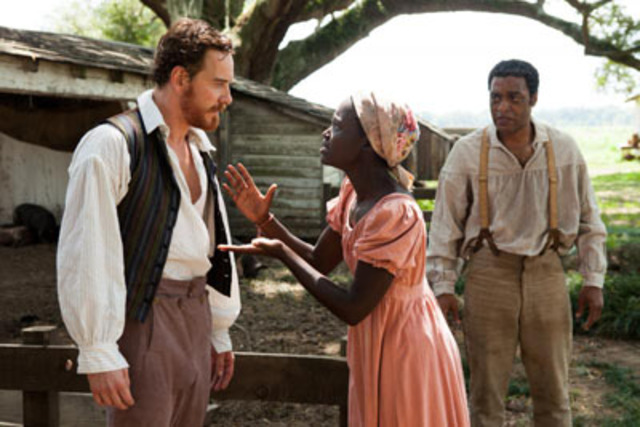
 Michael Fassbender, Lupita Nyong’o and Chiwetel Ejiofor (Fox Searchlight)
Director Steve McQueen makes films that are as stylized as they are unpleasant. His 2008 feature film debut Hunger featured gorgeously photographed shots of falling snow and bathed Bobby Sands in light and composition inspired by Dreyer’s Joan of Arc. But its hero was a terrorist; Hunger boasts prison walls smeared with excrement. In 2011’s Shame, mild-mannered Brandon lived in a sleek Manhattan apartment and had dalliances at the upscale Standard Hotel overlooking the High Line, but his insatiable sex drive led him to increasingly desperate places. The leads in both of McQueen’s previous feature films has been Michael Fassbender, but the black British director of Grenadian descent has given his alter ego a different role in his new film.
12 Years a Slave is adapted from the memoir of Solomon Northup, a free man living in upstate New York who was kidnapped in 1841. Chiwetel Ejiofor plays Northup, who becomes not only a slave but an outsider, and this is where McQueen’s signature theme comes in: the body and human desires. McQueen’s characters have been slave to the needs of the flesh and the emotional havoc to which desire can lead. It is in the very title of McQueen’s films, which could have been followed by, perhaps, Sloth? Greed (a remake?) But the director took another direction, one that’s perhaps more conventional.
12 Years a Slave carries McQueen’s interest in the demands of the body to a logical level: what of the demands on man unfairly imprisoned? Northup is an educated and artistic man who finds it difficult to connect with the slaves he meets, who are as often as not complacent and despairing of their lot. We meet him mid-plot, trying and failing to construct usable ink out of the juice of berries — hunger leads to art. Northup’s refusal to play the game can be seen as inspirational, but it also makes him an outsider among his peers, an aesthete among philistines. The ability to read and write — to communicate— is as essential to man as food and sex, but do these desires set him apart from the plight of others?
This dynamic makes 12 Years a Slave more than just a slave narrative. Northup went on to assist slaves on the Underground Railroad, but for much of the film, his background leaves him at odds with other slaves’ attitudes. As harrowing as his experiences are, there is a curious aesthetic remove here, as if the film is more Kafka than Roots. The movie isn’t as stylized as McQueen’s previous efforts, shot in what looks like natural light, but there’s still an art house feel and an art house distance to this prestige picture. In a series of shots in which Northup is dangling from a tree, standing on tip-toe to keep from strangling, the camera looks at him from a kind of journalistic remove, enough to document the brutality but not enough to get involved, as it were.
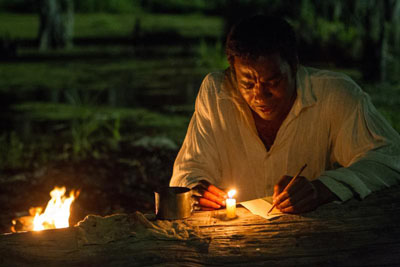 Chiwetel Ejiofor (Fox Searchlight)
Not that McQueen remains at that distance. The director told the New York Times, “I wanted to see the lash on someone’s back,” and he shows the lash in detail, perhaps more painfully graphic than in any other film about slavery. McQueen’s approach does not have the sleek stylishness of his previous films, but it is stylish nonetheless. More Barry Lyndon than Django Unchained. But as Northup is forced to hide the fact that he can read and write from his masters, McQueen restrains his genius, muting his for style in order to serve a prestige picture. He avoids the sensationalism of Tarantino (or of Mandingo and other films that inspired Tarantino’s po-mo slave narrative) (and a pair of scenes between Fassbender and Pitt recall their pairing in another Tarantino revisionism, Inglorious Basterds), but ends up with something that is emotionally cool despite the gut-wrenching action.
Which makes Fassbender’s casting as a sadistic slave-owner Edwin Epps an interesting choice. Fassbender has been McQueen’s everyman, a hero who suffers but is also suspect: look at the saint like glow McQueen gives to terrorist Bobby Sands in Hunger, the life of privilege he gives sex-addicted Brandon in Shame. These are men who suffer under conditions they helped create, but Fassbender creates three-dimensional characters out of them. But the brutal Epps is an unforgivable 2D villain. That he is played by the director’s stand-in makes you wonder: how does this figure relate to the director?
The movie feels hemmed in by convention in a way that McQueen’s previous films did not. In Hunger and Shame, McQueen forced the viewer to face things they did not want to face. 12 Years a Slave continues McQueen’s habit of forcing the viewer to see something uncomfortable. I wish I’d seen more of McQueen in this movie, but maybe that wouldn’t have worked. This plight of a slave is also the plight of an artist. Which makes the film both too personal and not personal enough.
Directed by Steve McQueen
Written by John Ridley, based on the book by Solomon Northup
With Chiwetel Ejiofor, Michael Fassbinder, Lupita Nyong’o
Rated R for violence/cruelty, some nudity and brief sexuality
Opens today at Regal Gallery Place, Regal Majestic, Landmark Bethesda Row, and Angelika Mosaic